About This Image
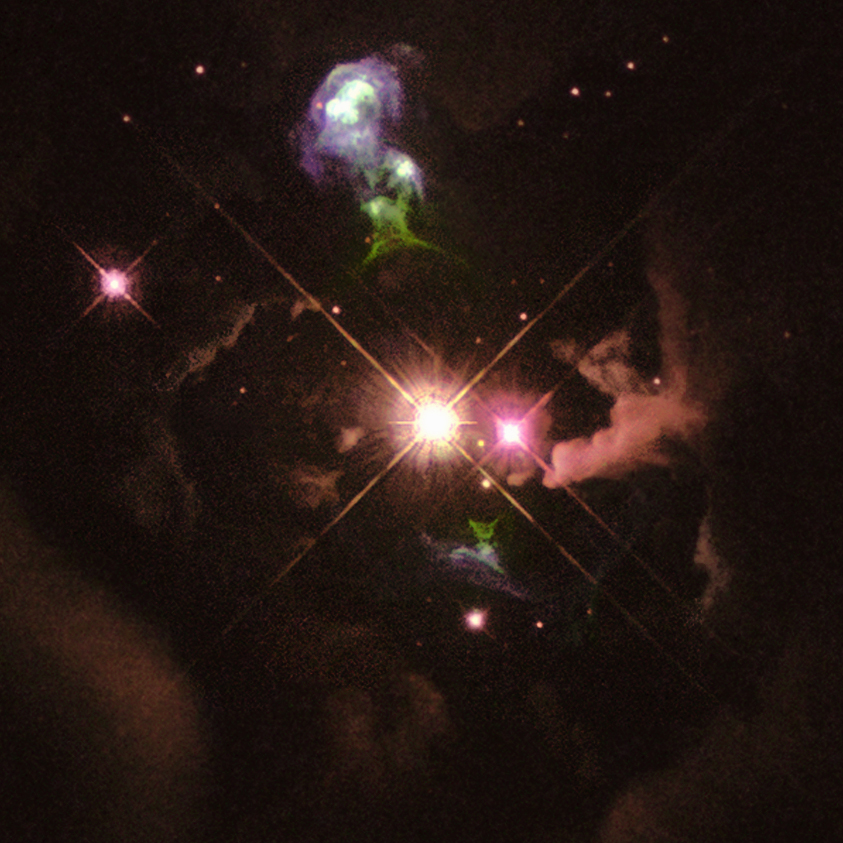
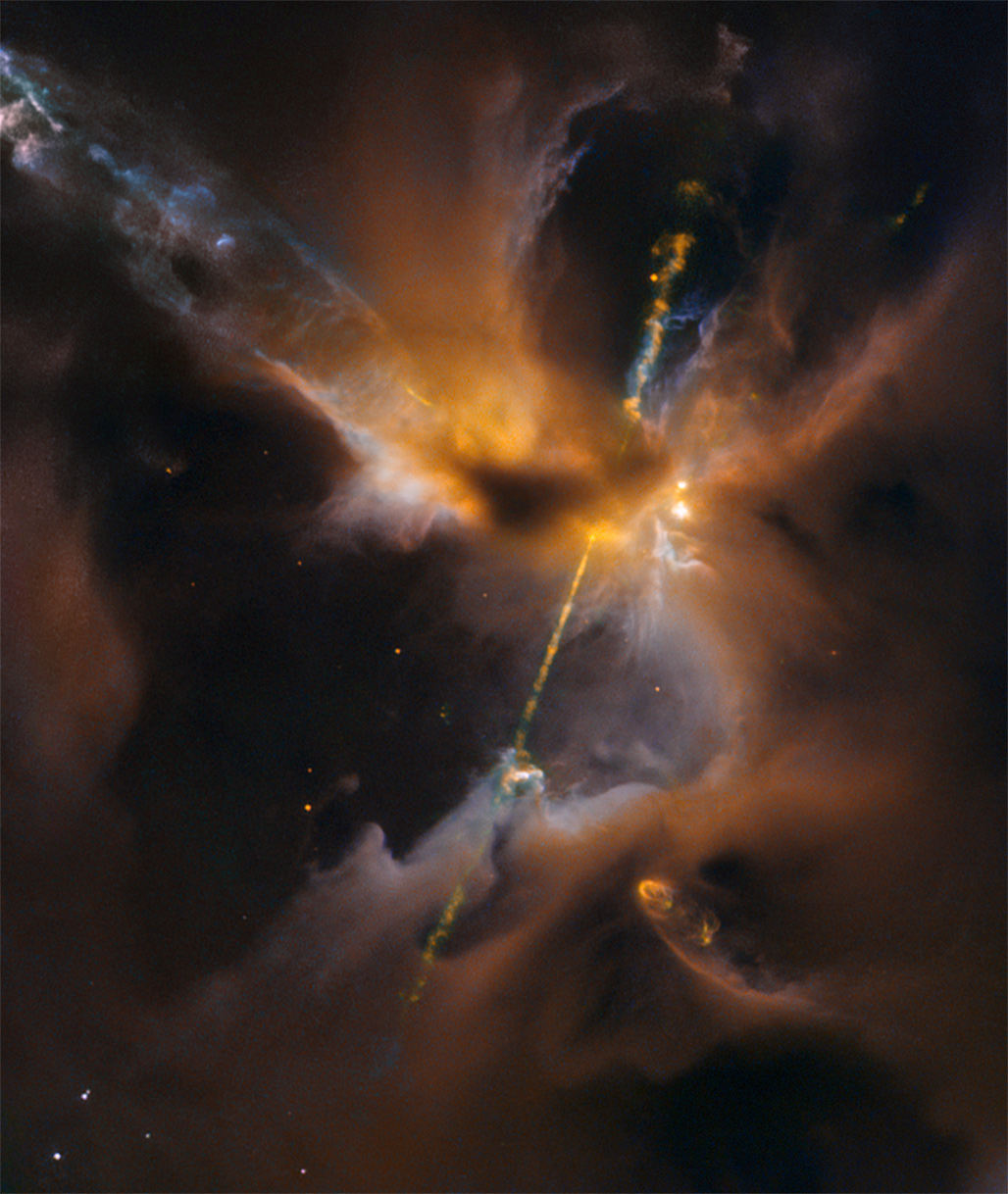
A partially obscured, newborn star near the center of this image is shooting twin jets of superheated gas into the surrounding molecular cloud. These supersonic jets, traveling at hundreds of kilometers per second, plow into the ambient gas and dust, creating the glowing shock fronts collectively called Herbig-Haro 24. The shocks compress and heat the gas to temperatures of tens of thousands of degrees, causing it to glow brightly in characteristic emission lines. This dramatic scene captures a critical phase in stellar birth, when young stars expel excess angular momentum and energy through powerful bipolar outflows. The jets will eventually clear a cavity in the surrounding cloud, allowing the infant star to emerge into view.
Scientific Significance
Herbig-Haro 24 provides crucial insights into the angular momentum problem of star formation. As a cloud of gas collapses to form a star, conservation of angular momentum would spin it up to such high velocities that it would fly apart — unless some mechanism removes angular momentum. The bipolar jets seen in HH 24 represent one of the primary mechanisms for this angular momentum removal, carrying away both mass and rotational energy from the central protostar-disk system. The morphology of the jets reveals the geometry of the accretion disk and magnetic field configuration near the star. By studying multiple Herbig-Haro objects like HH 24, astronomers have built a comprehensive picture of how low-mass stars like our Sun assembled from collapsing cloud cores, shedding their birth material through powerful outflows over hundreds of thousands of years.
Observation Details
Hubble imaged HH 24 using the Wide Field Planetary Camera 2 (WFPC2) in narrowband filters targeting hydrogen-alpha and sulfur emission lines. These filters isolate light from shocked gas while suppressing the continuum emission from stars and scattered light from dust. The resulting image reveals the detailed structure of the shock fronts, including bow shocks where the jet impacts ambient material and internal working surfaces where faster jet material overtakes slower ejecta. Near-infrared observations with ground-based telescopes penetrated the dust to reveal the embedded protostar and its circumstellar disk driving the outflow. The jet's proper motion has been measured over multi-year baselines, confirming its high velocity and the location of its source.
Location in the Universe
Constellation
Orion
Distance from Earth
1,350 light-years
Fun Facts
- 1
The twin jets of HH 24 extend over half a light-year in each direction, yet they originate from a protostar smaller than our Sun that is hidden behind dense dust.
- 2
Herbig-Haro objects are cosmically short-lived phenomena — the bright shocks visible today will fade and dissipate within just a few thousand years.
- 3
The central protostar is so deeply embedded in dust that it is invisible at optical wavelengths, detectable only in infrared and radio observations that can penetrate the obscuring material.
Image credit: NASA, ESA, Hubble Space Telescope