About This Image
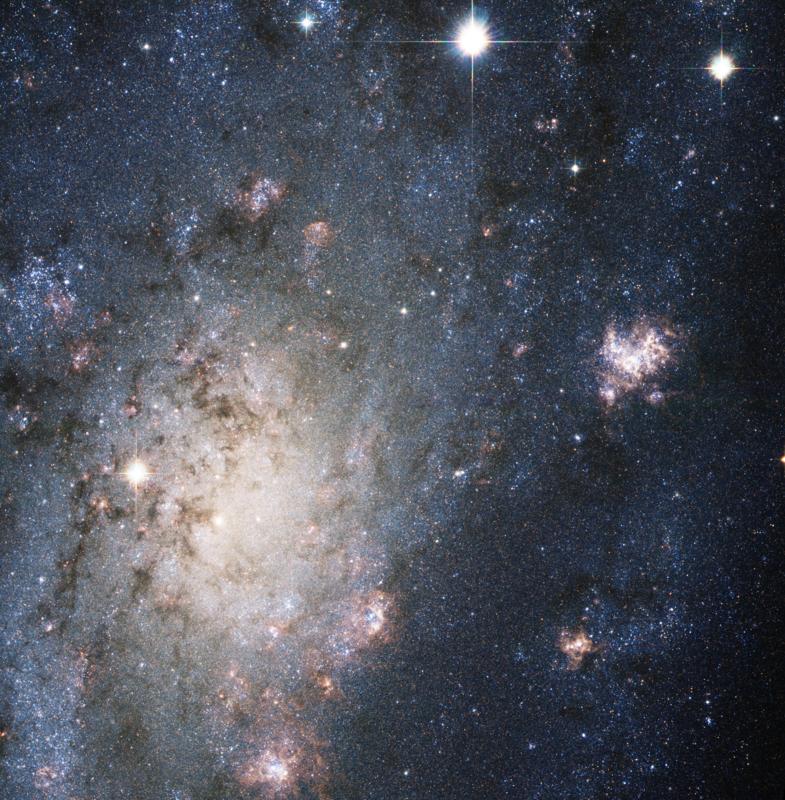
This image captures a stellar explosion — a supernova — in the galaxy NGC 2403, marking the catastrophic death of a massive star. The supernova appears as a bright point of light in the upper-right portion of the field. The brighter star near the top of the image, and other bright stars scattered across the field, actually reside within our own Milky Way galaxy, lying between Earth and the distant NGC 2403. This supernova, designated SN 2004dj, was one of the closest supernovae observed in modern times, providing astronomers with an exceptional opportunity to study the physics of stellar explosions in detail. The host galaxy NGC 2403 is a spiral galaxy similar to the Milky Way, located in the constellation Camelopardalis.
Scientific Significance
SN 2004dj provided one of the most detailed studies of a core-collapse supernova ever conducted. Because pre-explosion Hubble images of the site existed, astronomers could directly identify the progenitor star — a rare achievement that tests theories of which stars explode as supernovae. The supernova was classified as Type IIP, characterized by a plateau in its light curve lasting about 100 days, during which the hydrogen envelope released energy at a nearly constant rate. Follow-up observations tracked the supernova's evolution over years, revealing the transition from photospheric emission to the nebular phase where the expanding debris becomes transparent. The explosion enriched the surrounding interstellar medium with heavy elements, demonstrating how supernovae seed galaxies with the raw materials for future generations of stars and planets.
Observation Details
Hubble observed SN 2004dj at multiple epochs using the Advanced Camera for Surveys (ACS) in optical filters and the Near Infrared Camera and Multi-Object Spectrometer (NICMOS) in the infrared. The observations tracked the supernova's brightness evolution and color changes as the exploding material expanded and cooled. Comparison with pre-explosion archival images enabled identification of the progenitor star as a red supergiant with initial mass around 12-15 solar masses. Later observations detected the supernova's interaction with circumstellar material shed by the star in the millennia before explosion. Ground-based spectroscopy complemented the imaging observations, measuring the velocity of the expanding debris and identifying the chemical composition of the ejected material.
Location in the Universe
Constellation
Camelopardalis
Distance from Earth
11 million light-years
Fun Facts
- 1
SN 2004dj reached peak brightness of about magnitude 11.2, making it visible with amateur telescopes for several months after its discovery.
- 2
The progenitor star that exploded was identified in archival Hubble images taken before the supernova — it was a red supergiant about 15 times more massive than the Sun.
- 3
This was the brightest supernova visible from Earth since SN 1987A in the Large Magellanic Cloud, allowing unprecedented spectroscopic monitoring.
Image credit: NASA, ESA, Hubble Space Telescope