About This Image
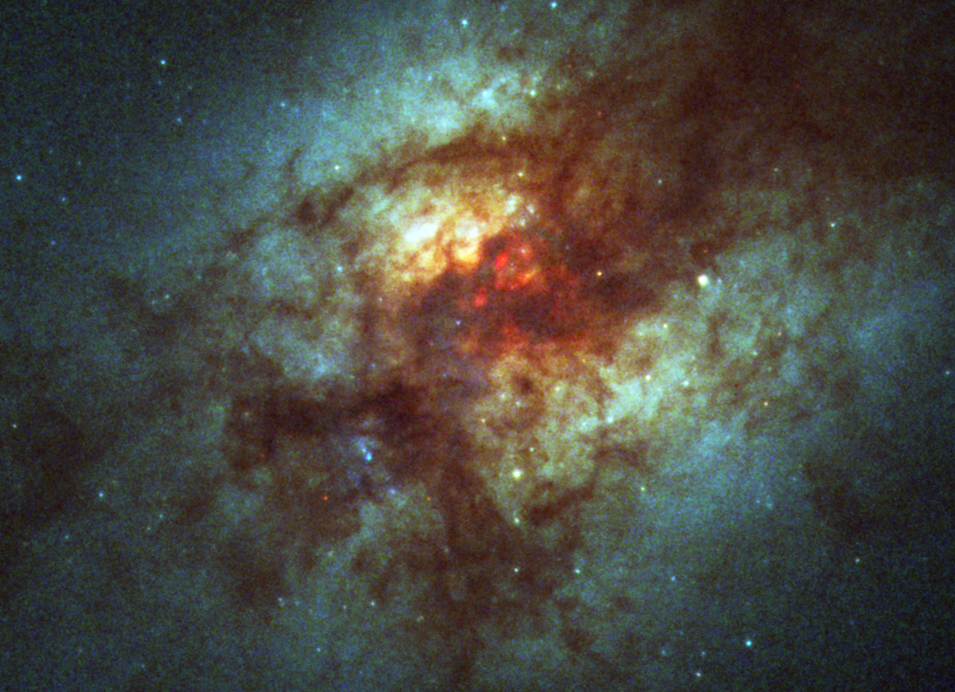
Arp 220 captures the chaotic aftermath of a cosmic collision between two spiral galaxies that began approximately 700 million years ago. Located about 250 million light-years from Earth in the constellation Serpens, this ongoing merger is one of the nearest examples of interacting galaxies to our planet. The gravitational turmoil has triggered an immense starburst, with new stars forming at a rate hundreds of times greater than in normal galaxies. Most of this furious activity is hidden behind thick curtains of dust, making Arp 220 one of the most luminous objects in the infrared sky — an ultraluminous infrared galaxy (ULIRG). The tangled structure visible in optical light represents the outer regions of the merger, where tidal tails and loops of ejected stars trace the violence of the ongoing collision.
Scientific Significance
As the nearest ultraluminous infrared galaxy (ULIRG), Arp 220 serves as the primary template for understanding the most extreme phase of galaxy mergers. Its prodigious infrared luminosity — exceeding one trillion solar luminosities — arises from massive starbursts deeply embedded in dust that absorbs optical and ultraviolet light and re-radiates it at infrared wavelengths. Radio observations have detected enormous quantities of molecular gas fueling the starburst, along with the highest supernova rate of any known galaxy. The system also provides a local analog to the dust-obscured starburst galaxies that dominated cosmic star formation at earlier epochs. By studying Arp 220 in detail, astronomers can calibrate their understanding of similar systems seen at high redshift, where individual features cannot be resolved.
Observation Details
Hubble observed Arp 220 using the Advanced Camera for Surveys (ACS) in optical filters that capture the outer structure of the merger while the dust-obscured core remains hidden. The image reveals tidal debris, loops, and shell structures characteristic of advanced mergers, tracing the gravitational disruption of the original galaxy disks. Near-infrared observations partially penetrate the dust to reveal the two nuclei, while radio and submillimeter telescopes provide views of the molecular gas and obscured star formation. X-ray observations detect both the hot gas heated by supernovae and possible emission from actively accreting supermassive black holes in both nuclei.
Location in the Universe
Constellation
Serpens
Distance from Earth
250 million light-years
Fun Facts
- 1
The two original galaxy nuclei are still visible as separate cores only about 1,200 light-years apart — in cosmic terms, they are moments away from their final merger into a single nucleus.
- 2
Arp 220 produces new stars at such a prodigious rate that it hosts supernovae explosions roughly once every few months — compared to about one per century in the Milky Way.
- 3
The merger has created over 200 massive young star clusters, some containing millions of stars packed into regions only a few light-years across.
Image credit: NASA, ESA, Hubble Space Telescope