About This Image
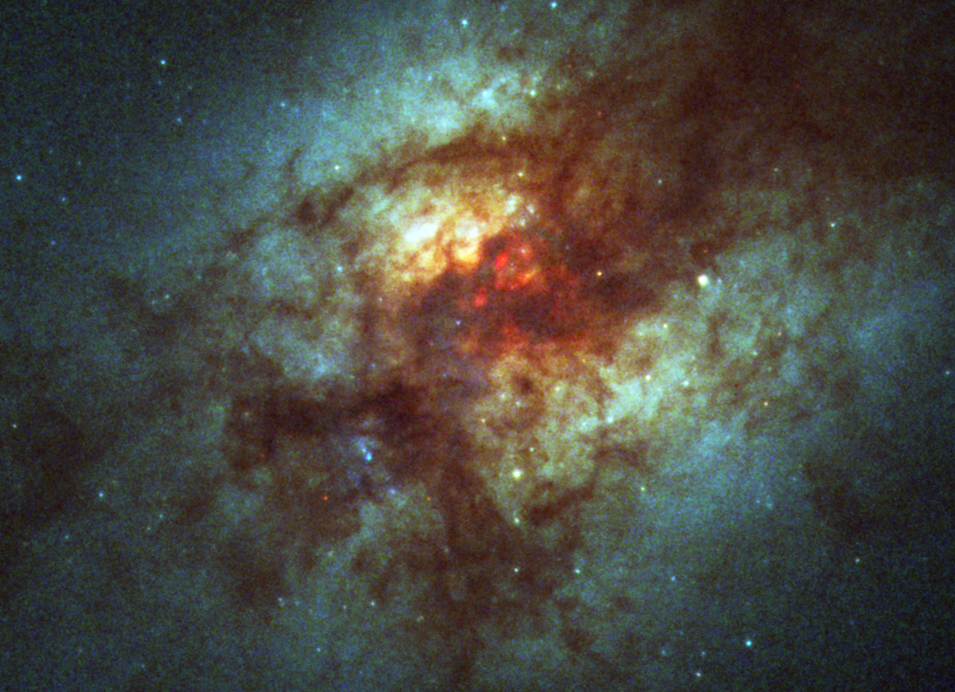
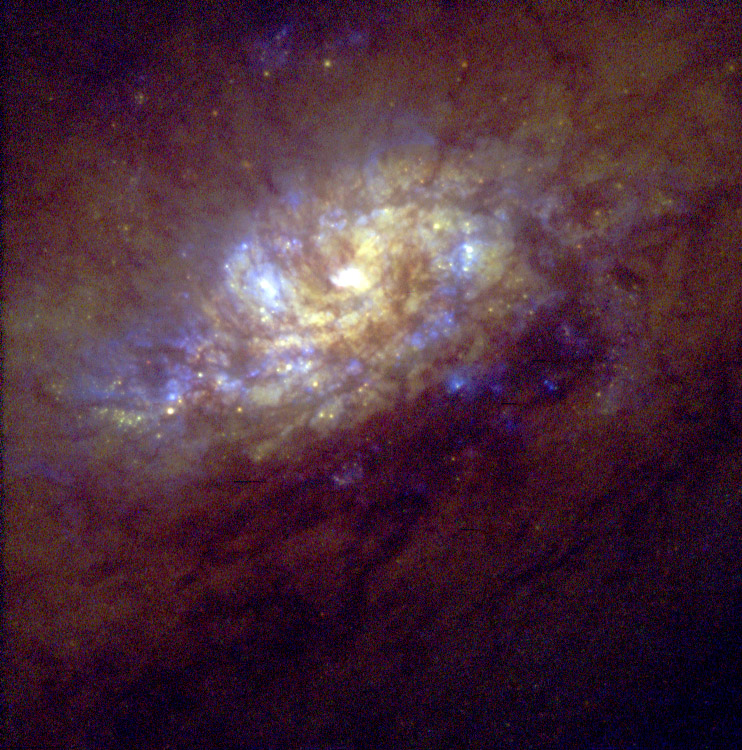
This close-up view reveals a hotbed of star formation at the center of spiral galaxy NGC 1808, where a nuclear starburst is producing new stars at a furious rate. In the image, older stellar populations appear yellow, representing stars that formed billions of years ago and have evolved to cooler temperatures. Young, hot stars blaze blue, marking the sites of recent star formation triggered by gas flowing into the galaxy's central regions. NGC 1808 is classified as a Seyfert galaxy, indicating that its central supermassive black hole is actively consuming material and contributing to the energetic activity in the nucleus. The chaotic appearance of the central region reflects the violent processes driving the starburst, including supernova explosions and powerful galactic winds.
Scientific Significance
NGC 1808 is a key object for understanding the connection between nuclear starbursts and active galactic nuclei. The coexistence of intense star formation and black hole accretion in the same compact region raises questions about how these processes influence each other. Observations suggest that the same gas inflow that fuels the starburst also feeds the central black hole, while supernova-driven winds and AGN feedback may eventually quench both activities. The detailed structure of NGC 1808's nuclear region, resolved by Hubble, reveals individual star clusters and dust lanes that trace the gas flow patterns feeding the starburst. This galaxy represents a crucial link between normal spiral galaxies and the more extreme ultraluminous infrared galaxies like Arp 220.
Observation Details
Hubble observed NGC 1808 using the Wide Field Planetary Camera 2 (WFPC2) in multiple broadband filters to separate stellar populations of different ages. The blue filter captures light from young, hot O and B stars, while red and infrared filters reveal the older stellar populations and penetrate dust obscuration. The observations resolved individual star clusters in the nuclear starburst region, measuring their sizes, colors, and luminosities. Comparison with stellar population models enabled estimation of the clusters' ages and masses, revealing that the starburst has proceeded in multiple episodes over the past 100 million years. Ground-based spectroscopy confirmed the Seyfert classification and measured gas velocities throughout the nuclear region.
Location in the Universe
Constellation
Columba
Distance from Earth
40 million light-years
Fun Facts
- 1
NGC 1808's nuclear starburst produces new stars at a rate roughly 10 times higher than the entire Milky Way, all concentrated within the central few thousand light-years.
- 2
The galaxy shows evidence of a past interaction or merger that may have driven gas toward the center and triggered the current starburst episode.
- 3
NGC 1808's galactic wind, powered by thousands of supernovae, expels hot gas from the disk at speeds exceeding 500 kilometers per second.
Image credit: NASA, ESA, Hubble Space Telescope