About This Image
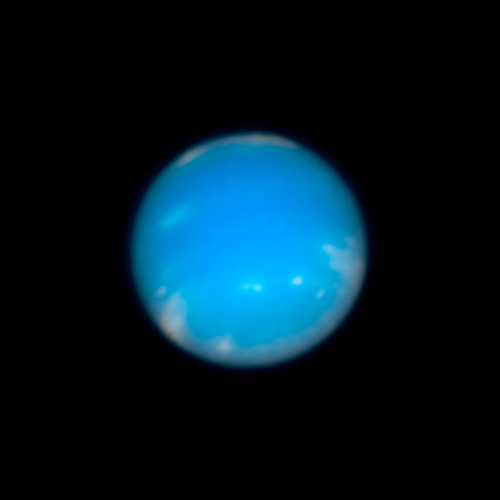
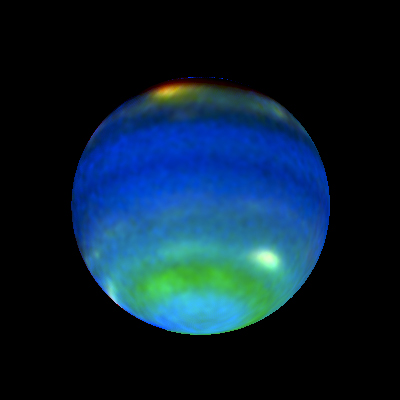
This image reveals Neptune's dynamic atmosphere, showing bright clouds and cloud bands wrapping around the most distant major planet in our solar system. On this giant world, winds blow at up to 1,200 miles per hour — the fastest sustained winds of any planet — while huge storms, some the size of Earth itself, come and go with surprising regularity. The bright features in the image are high-altitude clouds of methane ice crystals that rise above the main cloud deck, catching sunlight against the deep blue backdrop of Neptune's atmosphere. This blue color results from methane in the atmosphere absorbing red light, allowing only blue wavelengths to reflect back to space. Neptune's weather patterns remain poorly understood, making continued observations essential for planetary science.
Scientific Significance
Hubble observations of Neptune have revolutionized our understanding of ice giant atmospheric dynamics. The Voyager 2 flyby in 1989 provided only a snapshot, but Hubble's repeated observations over decades have revealed the planet's weather patterns to be far more variable than those of Jupiter and Saturn. The Great Dark Spot observed by Voyager disappeared by the time Hubble looked in 1994, replaced by new storm systems. These observations indicate that Neptune's atmosphere undergoes dramatic changes on timescales of years, despite receiving only 1/900th the solar energy that Earth does. Understanding what drives Neptune's energetic weather has implications for the growing population of Neptune-sized exoplanets being discovered around other stars, which represent the most common type of planet in the galaxy.
Observation Details
Hubble captured this image of Neptune using the Wide Field Planetary Camera 2 (WFPC2) in multiple filters spanning visible and near-infrared wavelengths. The blue appearance results from the combination of methane absorption in the red and infrared portions of the spectrum. Near-infrared filters reveal the high-altitude methane clouds as bright features standing out against the darker background. The angular diameter of Neptune as seen from Earth is less than 2.5 arcseconds, requiring Hubble's excellent resolution to discern cloud features. Multiple exposures taken over the planet's 16-hour rotation period allow construction of maps showing cloud patterns across the entire disk.
Location in the Universe
Constellation
N/A (Solar System)
Distance from Earth
2.7 billion to 2.9 billion miles (varies)
Fun Facts
- 1
Neptune was the first planet discovered through mathematical prediction rather than direct observation — its existence was calculated from perturbations in Uranus's orbit before anyone saw it through a telescope.
- 2
Despite being 30 times farther from the Sun than Earth, Neptune radiates more than twice as much energy as it receives from the Sun, indicating a powerful internal heat source.
- 3
Neptune's largest moon, Triton, orbits backwards (retrograde) compared to the planet's rotation, suggesting it was captured from the Kuiper Belt rather than forming alongside Neptune.
Image credit: NASA, ESA, Hubble Space Telescope