About This Image
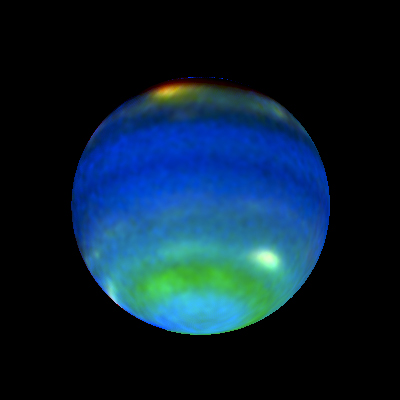
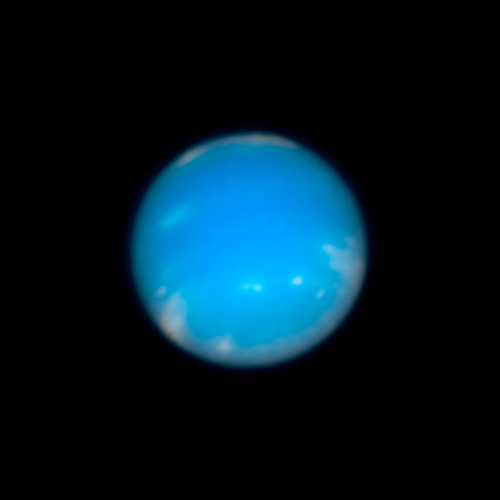
Neptune, the most distant major planet in our solar system, displays its characteristic blue coloration in this Hubble portrait. The bright patches on the planet are high-altitude clouds composed of methane ice crystals that tower above the main cloud deck, catching sunlight and standing out against the darker blue background. Neptune's atmosphere is dominated by hydrogen and helium, with trace amounts of methane that give the planet its distinctive azure hue by absorbing red light. Despite receiving only 1/900th the solar energy that Earth does, Neptune maintains a dynamic atmosphere with the fastest sustained winds in the solar system, reaching speeds of 1,200 miles per hour. These extreme weather patterns hint at powerful internal heat sources driving the atmospheric circulation.
Scientific Significance
Hubble's long-term monitoring of Neptune has revealed that the planet's atmosphere undergoes dramatic changes that no single spacecraft flyby could capture. The storms observed by Voyager 2 in 1989 had disappeared by the time Hubble began systematic observations in the 1990s, replaced by entirely new cloud features. Recent Hubble observations have tracked the evolution of new dark spots — giant anticyclonic storms similar to Jupiter's Great Red Spot — that appear, persist for years, then dissipate. These observations constrain models of how energy flows through ice giant atmospheres and drive weather patterns. Understanding Neptune's atmospheric dynamics has become increasingly important as exoplanet surveys reveal that Neptune-sized worlds are among the most common planet types in the galaxy.
Observation Details
Hubble captured this image using the Wide Field Camera 3 (WFC3) in multiple filters spanning visible and near-infrared wavelengths. The blue coloration is enhanced by methane absorption features in the red and near-infrared, where the atmosphere is more opaque. Bright features are composed of methane ice crystals at altitudes of 30-50 kilometers above the main cloud deck, where they catch direct sunlight. Time-series observations over Neptune's 16-hour rotation period allow construction of global maps showing cloud patterns across the entire planet. Spectroscopic observations measure the chemical composition and vertical structure of the atmosphere, providing context for the imaging data.
Location in the Universe
Constellation
N/A (Solar System)
Distance from Earth
2.7 billion to 2.9 billion miles (varies)
Fun Facts
- 1
Neptune completes one orbit around the Sun every 165 Earth years — it has not yet completed a single orbit since its discovery in 1846.
- 2
Neptune's moon Triton has geysers of nitrogen gas that erupt up to 5 miles high, despite surface temperatures of -391°F (-235°C).
- 3
Neptune is about 17 times more massive than Earth, yet you would experience only slightly more surface gravity due to the planet's low density.
Image credit: NASA, ESA, Hubble Space Telescope