About This Image
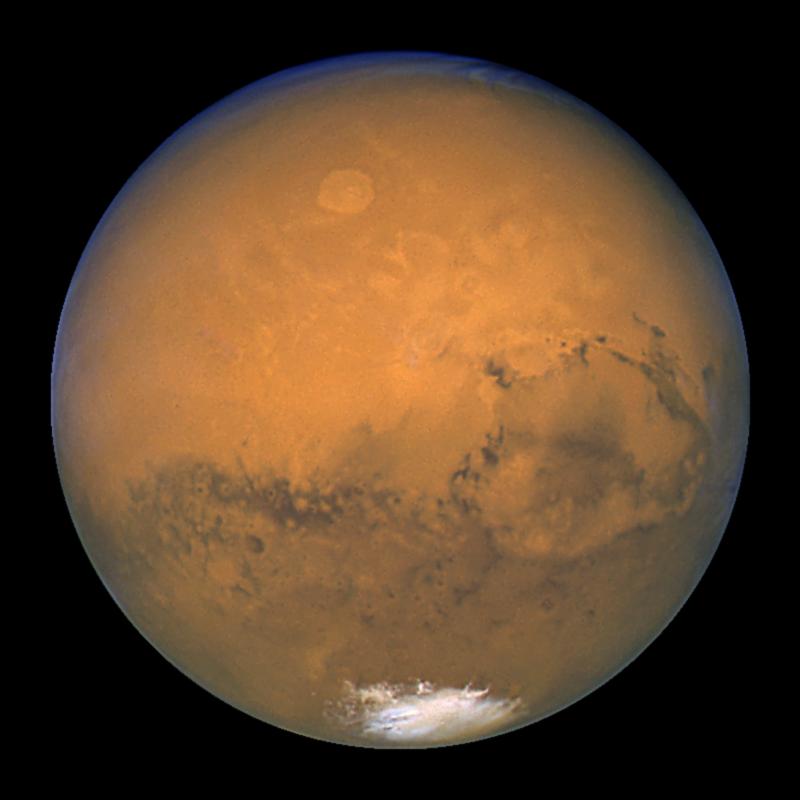
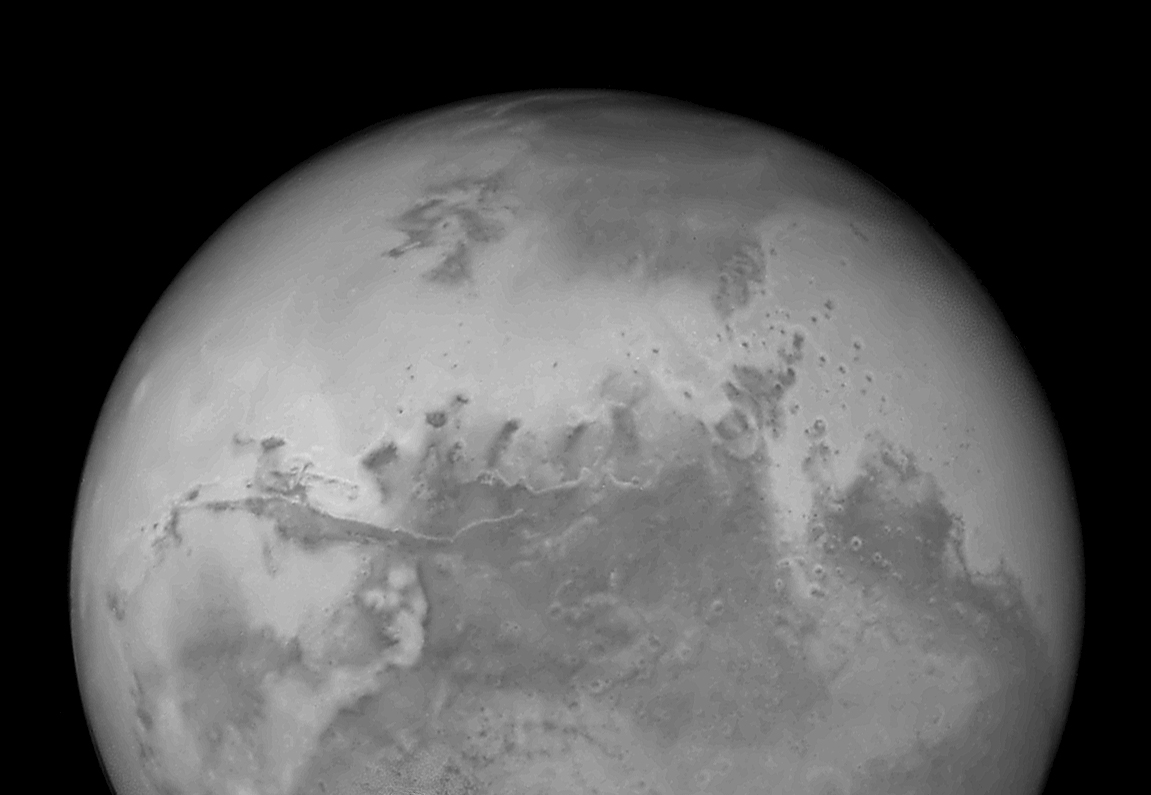
Hubble captured this stunning image of Mars when the planet was approximately 34.7 million miles from Earth, nearing its closest approach in over 60,000 years. The dark linear feature prominent on the left side of the disk is Valles Marineris, a canyon system stretching over 2,500 miles across the Martian surface — long enough to span the entire continental United States. This colossal rift dwarfs Earth's Grand Canyon, reaching depths of up to 5 miles and widths of 120 miles in some sections. The image also reveals the planet's polar ice caps, dark volcanic regions, and the reddish dust that gives Mars its distinctive appearance. This opposition period provided astronomers with the best views of Mars in a human lifetime.
Scientific Significance
The 2003 opposition provided astronomers with exceptional opportunities to study Mars with both Hubble and ground-based telescopes. The close approach allowed Hubble to achieve its highest-ever resolution of the Martian surface from Earth orbit, resolving features as small as 16 miles across. The observations supported planning for NASA's Mars Exploration Rovers (Spirit and Opportunity), which were en route to Mars during this period. Hubble monitored Martian atmospheric conditions, tracking dust storms and clouds that could affect rover landing and operations. The atmospheric observations also measured seasonal variations in water vapor and studied the polar ice caps, which contain both water ice and carbon dioxide ice that sublimates and refreezes with the Martian seasons.
Observation Details
Hubble observed Mars using the Advanced Camera for Surveys (ACS) in multiple filters spanning ultraviolet through near-infrared wavelengths. The observations were timed to capture different rotational phases of the planet as Mars turned on its 24.6-hour day. Ultraviolet filters revealed ozone distribution in the atmosphere, while near-infrared observations penetrated atmospheric haze to reveal surface features with maximum contrast. The color composite combines data from blue, green, and red filters to approximate Mars's appearance to the human eye. Complementary spectroscopic observations measured the composition of surface minerals and atmospheric gases.
Location in the Universe
Constellation
N/A (Solar System)
Distance from Earth
34.7 million miles (closest approach 2003)
Fun Facts
- 1
Valles Marineris is so large that if placed on Earth, it would stretch from New York to Los Angeles — it formed through a combination of volcanic activity and tectonic rifting.
- 2
The 2003 Mars opposition brought the planet closer to Earth than at any time since the Neanderthals walked the Earth approximately 60,000 years ago.
- 3
Mars's red color results from iron oxide (rust) in its soil — the planet essentially has a rusty surface created by ancient chemical reactions with water and oxygen.
Image credit: NASA, ESA, Hubble Space Telescope