About This Image
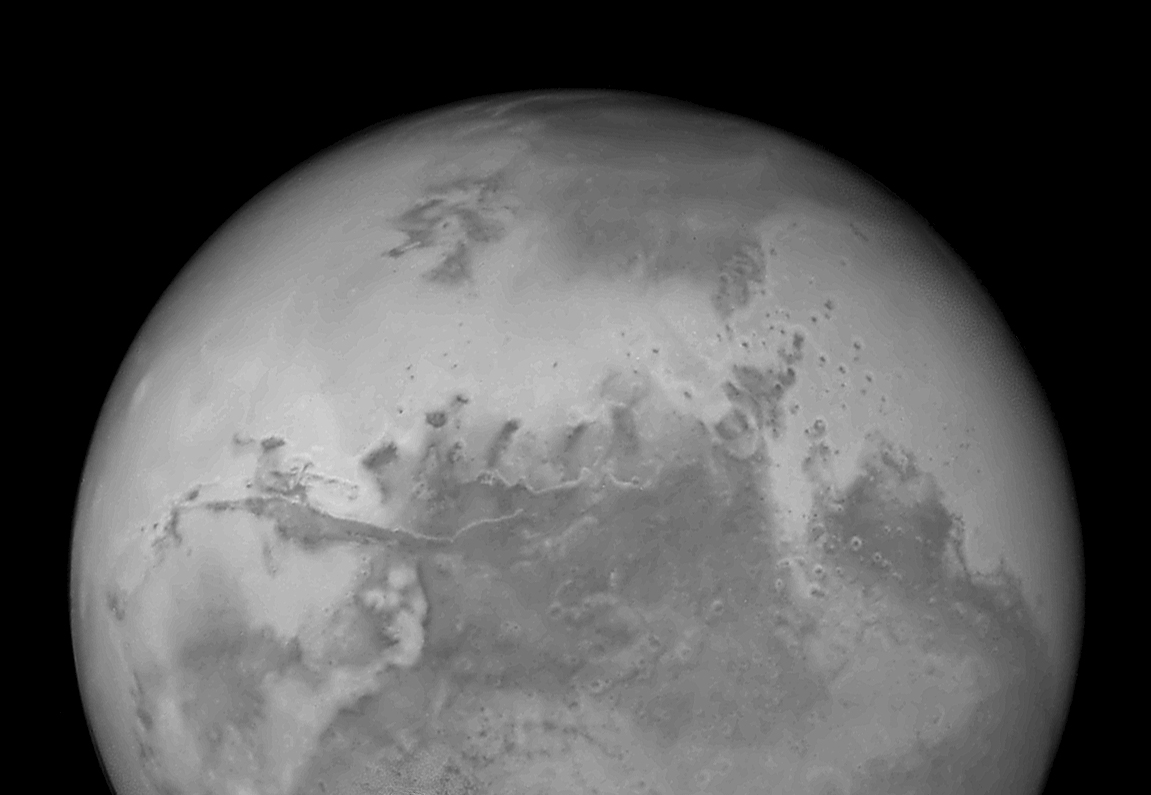
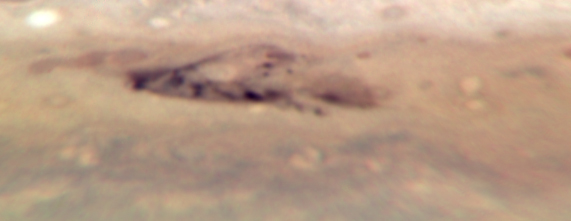
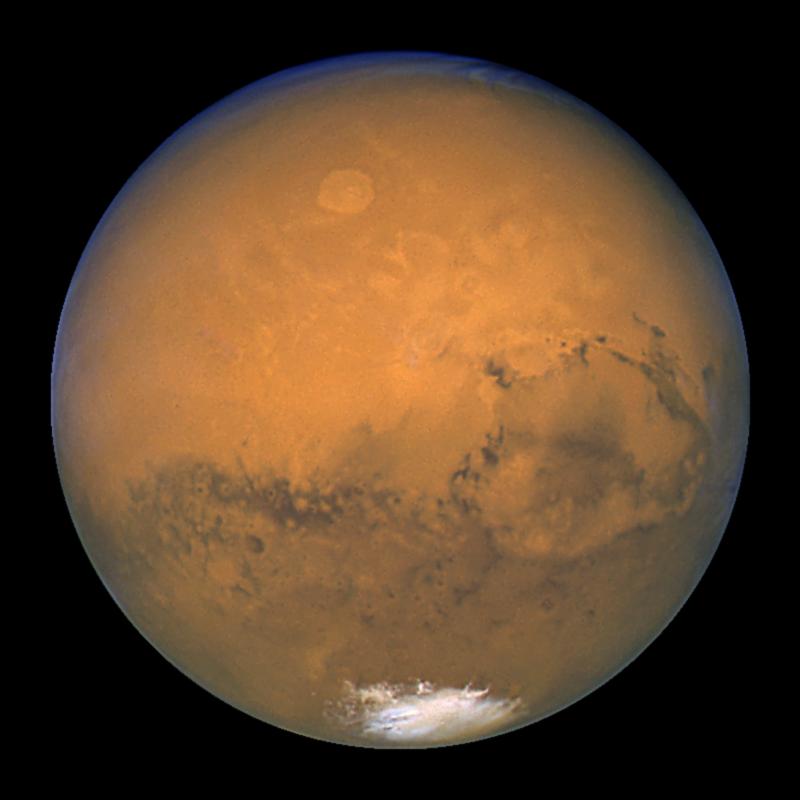
Hubble captured this remarkable image of Mars during the historic 2003 opposition, when the planet made its closest approach to Earth in nearly 60,000 years. The solar system's largest volcano, Olympus Mons, appears prominently near the top of the visible disk. This shield volcano towers 13.6 miles above the surrounding terrain — nearly three times the height of Mount Everest — and its base spans an area roughly the size of Arizona. The caldera at its summit, formed by successive collapses as magma chambers emptied during eruptions, is large enough to swallow several Earth cities. This extreme close approach allowed Hubble to achieve its highest resolution ever of the Martian surface, revealing details as small as 16 miles across.
Scientific Significance
The 2003 Mars opposition observations provided crucial data for understanding Martian geology and atmospheric dynamics. Hubble's high-resolution imaging revealed the current state of major geological features that can be compared with maps from orbiting spacecraft to track changes over decades. The observations captured the seasonal sublimation of the south polar ice cap, releasing carbon dioxide into the atmosphere and causing planet-wide pressure variations. Water vapor measurements tracked the global distribution of atmospheric moisture, an important input for understanding Mars's water cycle. These Earth-based observations complement data from Mars orbiters and rovers by providing global-scale context and enabling observations during periods when spacecraft may not be positioned for optimal viewing.
Observation Details
Hubble observed Mars using the Advanced Camera for Surveys (ACS) High Resolution Channel, which provides the telescope's highest angular resolution. The observations employed multiple filters covering wavelengths from ultraviolet through near-infrared, enabling studies of surface mineralogy and atmospheric composition. The UV observations were particularly valuable for mapping the distribution of ozone, which is destroyed by photochemical reactions involving water vapor. Near-infrared filters revealed surface features with enhanced contrast by penetrating atmospheric dust. Multiple observations spanning Mars's 24.6-hour rotation period enabled construction of full-disk maps. The data complemented simultaneous observations from Mars orbiters, providing a comprehensive view of the planet during this exceptional close approach.
Location in the Universe
Constellation
N/A (Solar System)
Distance from Earth
34.6 million miles (closest approach)
Fun Facts
- 1
Olympus Mons is so enormous that an observer standing on its summit would be unable to see the edges of the volcano — they would extend beyond the horizon in all directions.
- 2
The 2003 close approach brought Mars within 34.6 million miles of Earth — closer than it had been since the Stone Age and closer than it will be again until 2287.
- 3
Mars's thin atmosphere — only about 1% as dense as Earth's — allows Hubble to see surface features clearly without the atmospheric blurring that limits ground-based telescopes.
Image credit: NASA, ESA, Hubble Space Telescope