About This Image
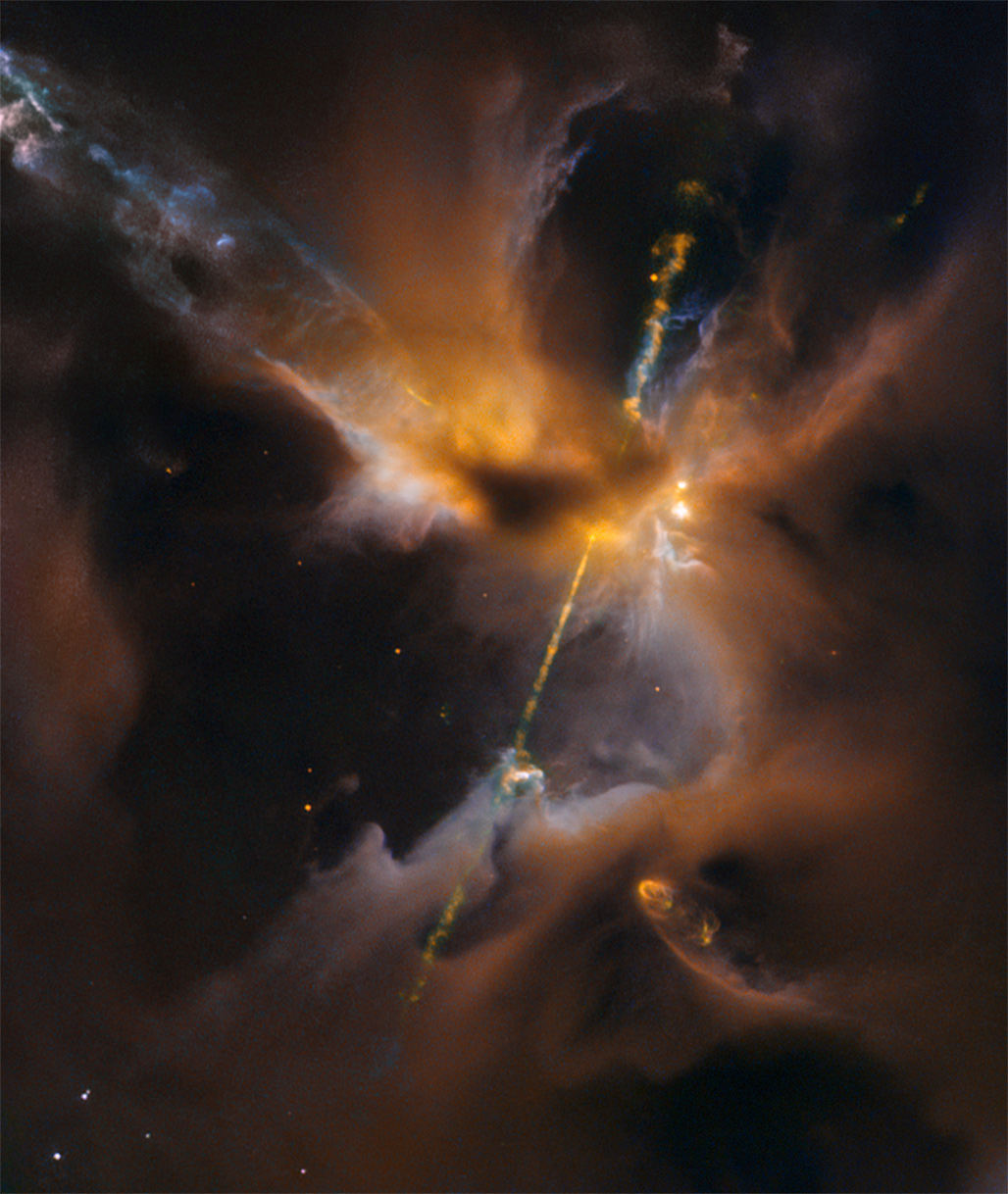
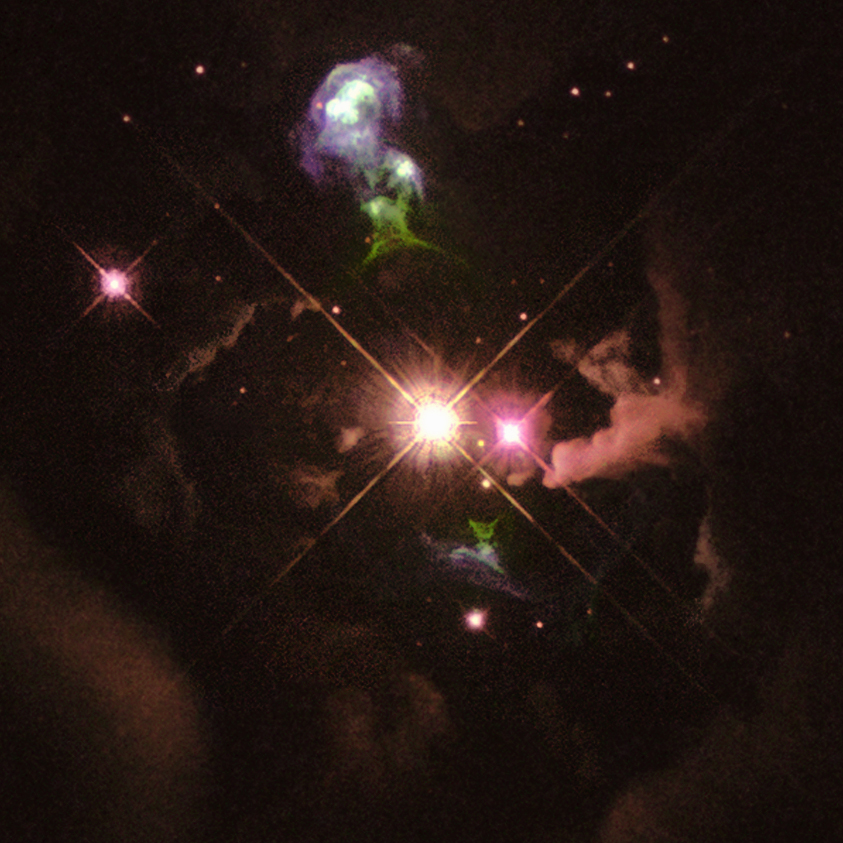
HH 32 is a spectacular example of a Herbig-Haro object, formed when young stars eject powerful jets of material back into interstellar space at supersonic velocities. These jets, traveling at hundreds of kilometers per second, plow into the surrounding nebula and produce strong shock waves that compress and heat the gas, causing it to glow brilliantly in characteristic emission lines. The complex structure visible in this image reveals multiple bow shocks where the jet material collides with stationary ambient gas, creating luminous arcs that illuminate the otherwise dark cloud. HH 32 demonstrates the violent processes that accompany star birth, as young stars shed angular momentum and mass through these dramatic outflows while they are still accumulating material from their surrounding disks.
Scientific Significance
Herbig-Haro 32 has been studied extensively as a prototype for understanding the jet-driving mechanisms in young stellar objects. The detailed structure revealed by Hubble observations shows evidence for variability in the jet velocity and mass-loss rate over time, with dense knots marking episodes of enhanced ejection that propagate outward at measurable speeds. Time-baseline observations spanning years have directly tracked the proper motion of shock features, confirming the connection to the central star and measuring the jet velocity. The complex shock morphology informs models of how jets interact with inhomogeneous ambient media. HH 32 also demonstrates the importance of outflows in regulating star formation by injecting energy and momentum into molecular clouds, potentially triggering or suppressing star formation in neighboring regions.
Observation Details
Hubble observed HH 32 using the Wide Field Planetary Camera 2 (WFPC2) in narrowband filters targeting emission lines from ionized gas. The H-alpha filter captured emission from hydrogen, while filters centered on [S II] and [O III] lines traced gas at different temperatures and ionization states within the shock structures. The combination reveals the stratified structure of the bow shocks, with highly ionized gas near the shock front and cooler, partially ionized gas in the wake. The observations represented one of the first demonstrations of WFPC2's capability for detailed nebular imaging after the COSTAR corrective optics were installed.
Location in the Universe
Constellation
Aquila
Distance from Earth
960 light-years
Fun Facts
- 1
HH 32 was one of the first Herbig-Haro objects imaged by Hubble after the 1993 servicing mission restored the telescope's vision, revealing unprecedented detail in these stellar nurseries.
- 2
The jets that create HH 32 are 'bipolar' — they emerge from both poles of the young star's disk, often at angles tilted to our line of sight.
- 3
Herbig-Haro objects are named after George Herbig and Guillermo Haro, who independently discovered and characterized these emission nebulae in the 1950s.
Image credit: NASA, ESA, Hubble Space Telescope