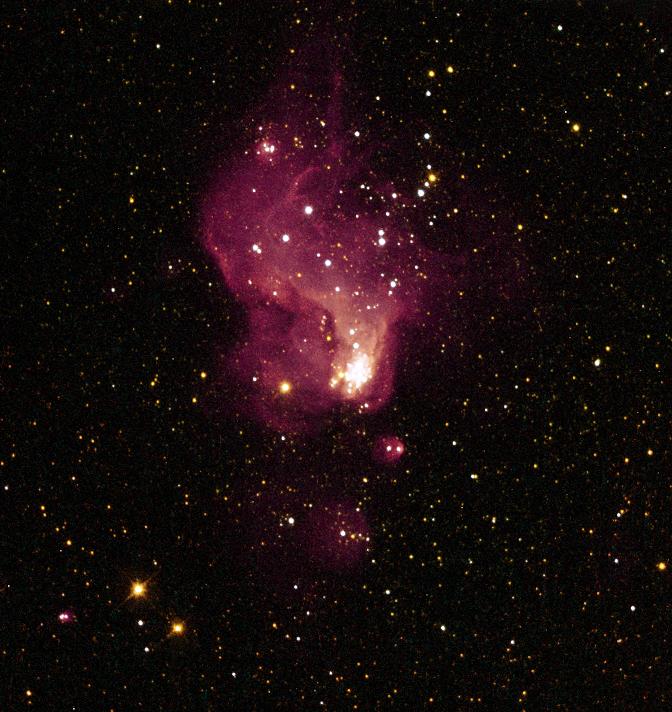
About This Image
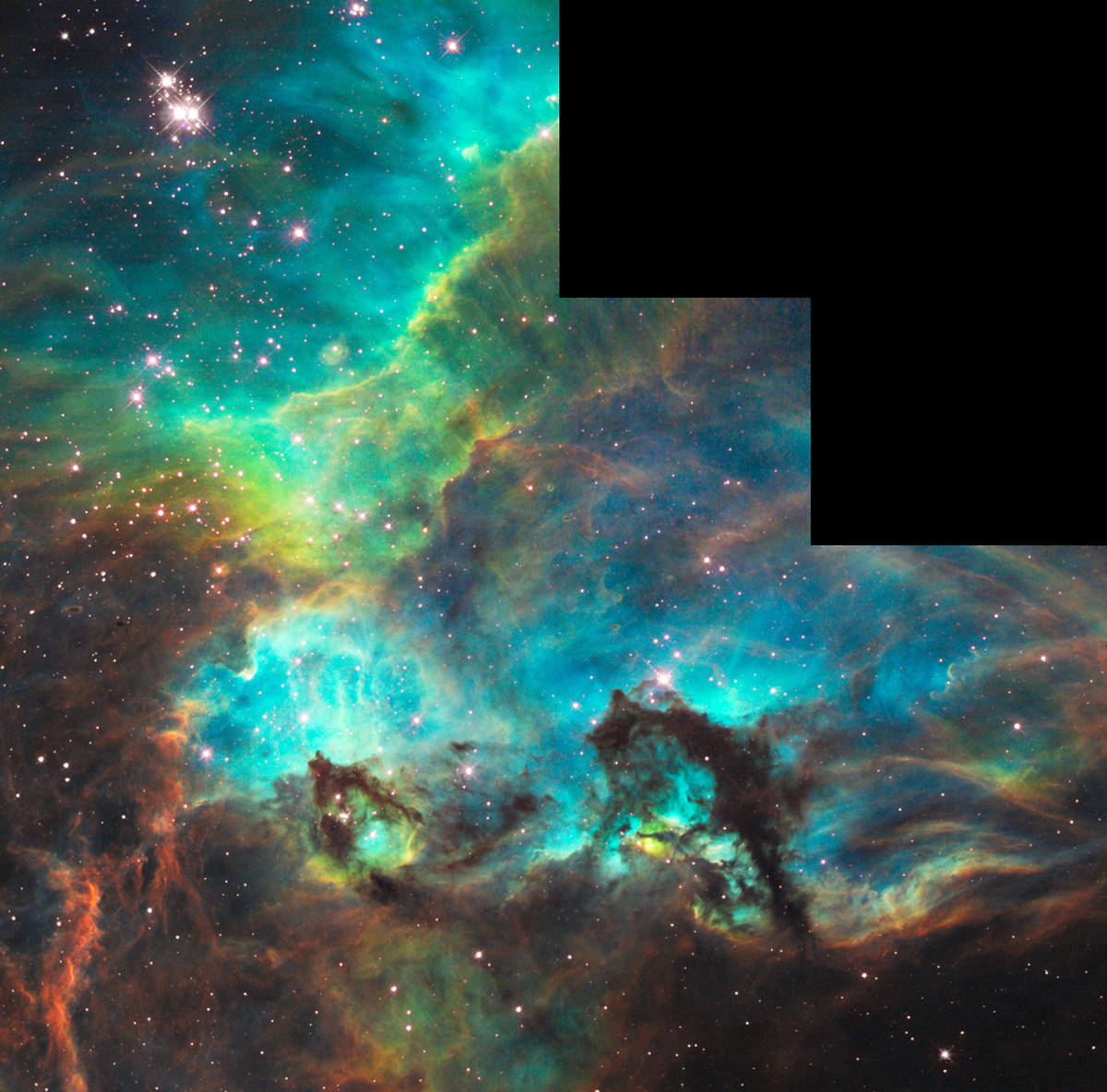
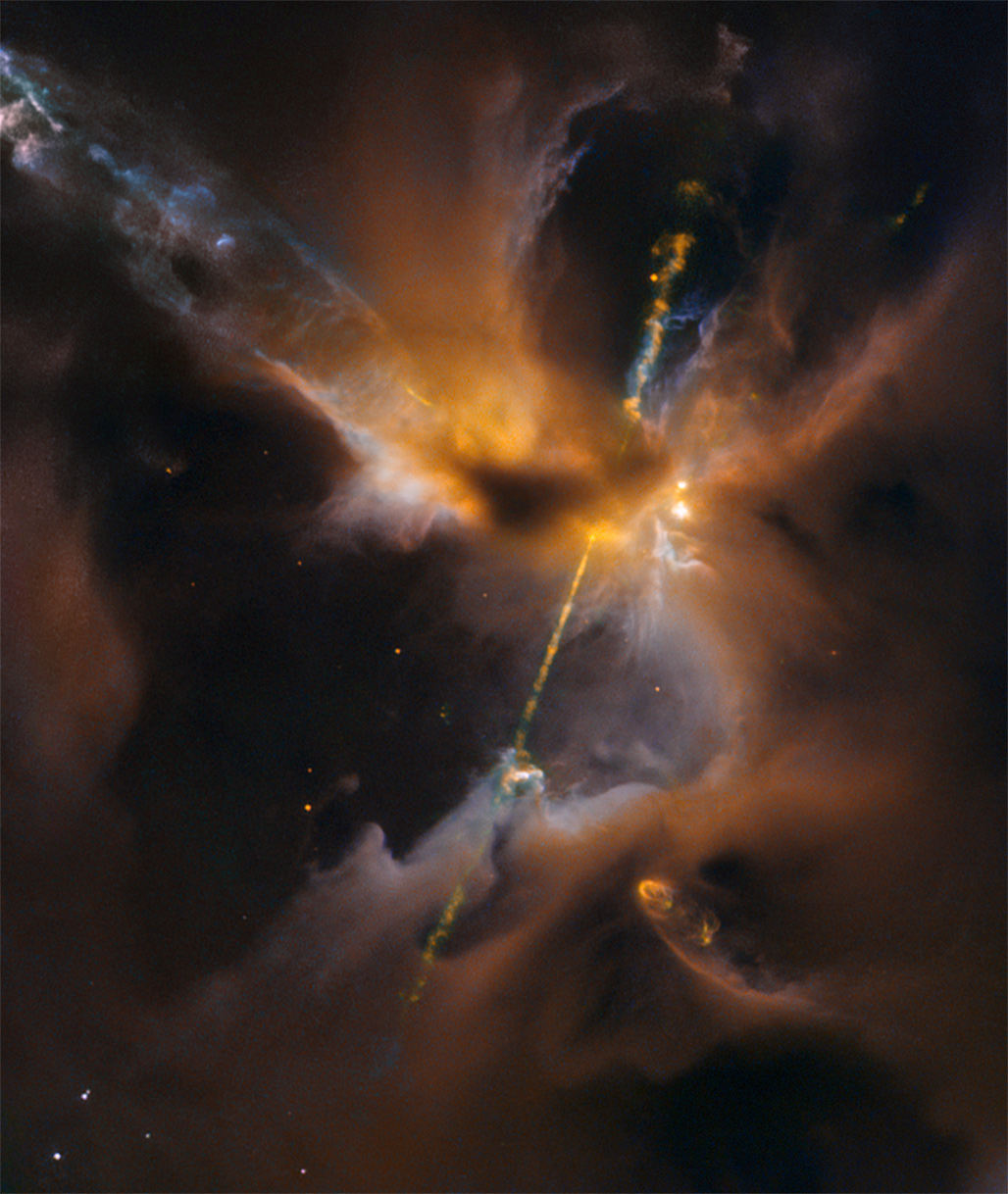
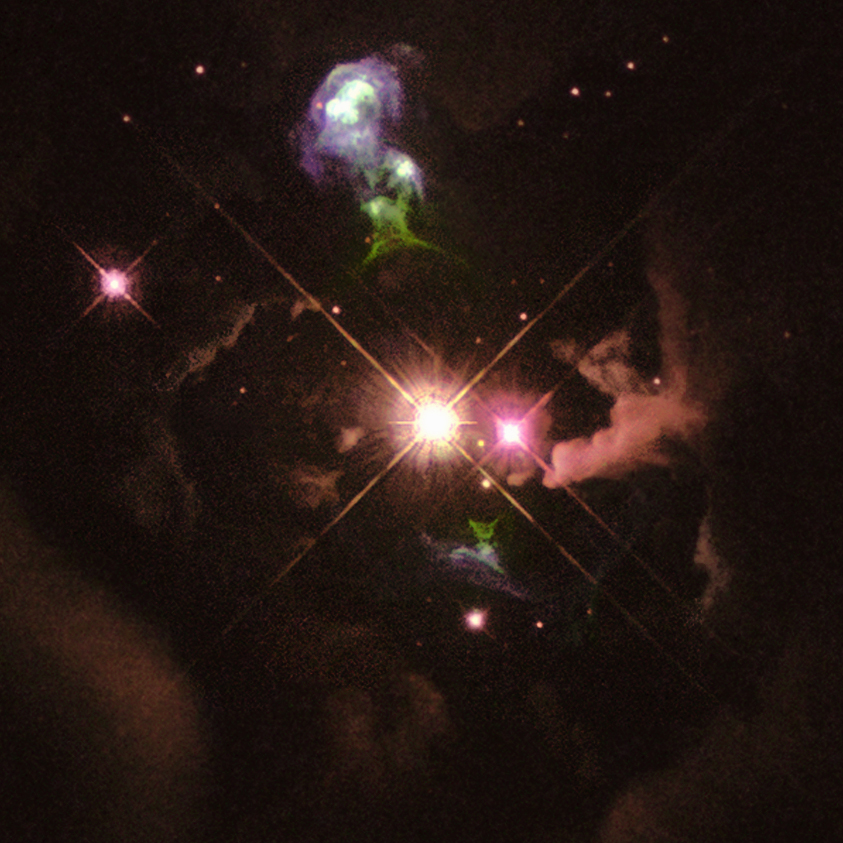
Hubble-V is an active star-forming region within galaxy NGC 6822, one of the Milky Way's nearest galactic neighbors. The cloud is about 200 light-years across and contains a dense knot of dozens of ultra-hot stars, each burning up to 100,000 times brighter than our Sun. This compact stellar nursery represents one of the most intense concentrations of young, massive stars known in any nearby galaxy. The fierce ultraviolet radiation and powerful stellar winds from these newborn giants sculpt the surrounding gas into dramatic pillars and arcs, while simultaneously triggering new waves of star formation in compressed gas at the nebula's edges. Hubble-V provides astronomers with a nearby window into the extreme physics of massive star birth.
Scientific Significance
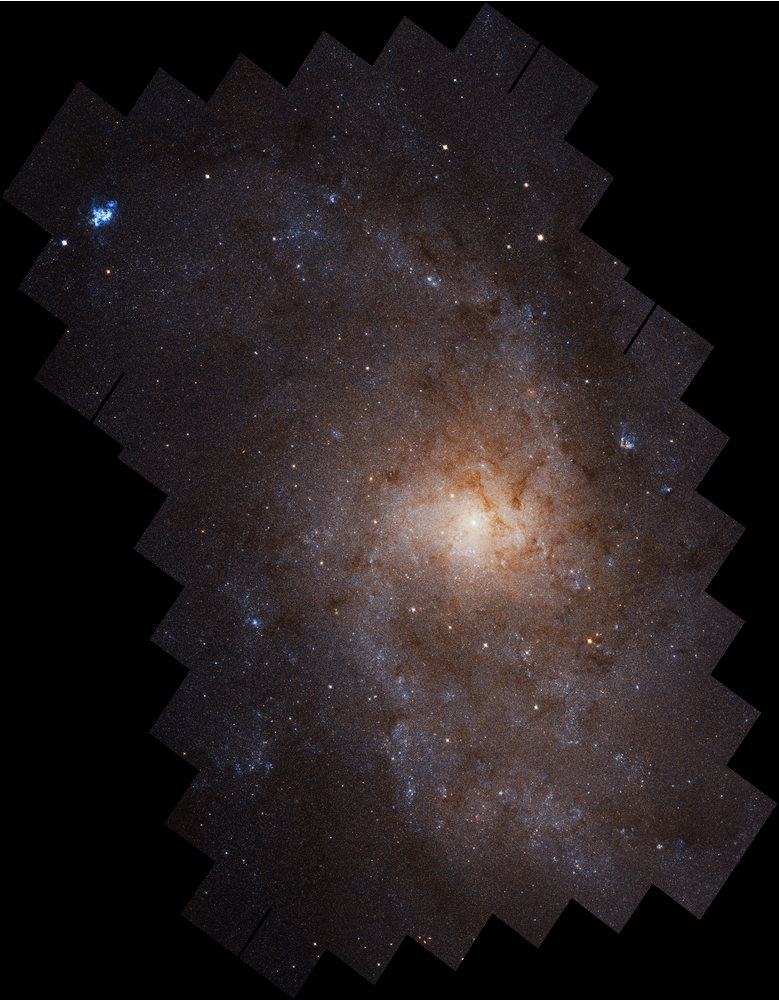
Hubble-V offers a unique opportunity to study massive star formation in an environment quite different from the Milky Way. NGC 6822 is a dwarf irregular galaxy with lower metallicity than our galaxy — meaning it contains fewer heavy elements. This metal-poor environment more closely resembles conditions in the early universe, when the first generations of stars were forming. By studying Hubble-V, astronomers can test whether massive star formation proceeds differently under these primordial-like conditions. The compact nature of the stellar cluster within Hubble-V, with dozens of O-type stars packed into a small volume, provides insights into how massive stars interact with each other during their formation and early evolution. Observations have revealed complex shock structures where stellar winds collide, creating X-ray-emitting hot gas.
Observation Details
This image was captured using Hubble's Wide Field Planetary Camera 2 (WFPC2) in multiple narrowband filters that isolate specific emission lines from ionized gas. The filters captured light from hydrogen (H-alpha), oxygen ([O III]), and sulfur ([S II]), allowing astronomers to map the temperature and ionization structure of the nebula. The combination reveals how the central star cluster's radiation creates distinct zones of ionization extending outward from the hot stellar core. Follow-up spectroscopic observations measured the velocities of gas flows within the nebula, tracing the expansion of wind-blown bubbles around the most massive stars.
Location in the Universe
Constellation
Sagittarius
Distance from Earth
1.6 million light-years
Fun Facts
- 1
Hubble-V was named in honor of the Hubble Space Telescope, which first revealed its complex structure in unprecedented detail.
- 2
The most massive stars in Hubble-V will burn through their nuclear fuel in just a few million years and explode as supernovae, seeding the galaxy with heavy elements.
- 3
NGC 6822, the host galaxy of Hubble-V, was one of the first galaxies recognized as lying beyond the Milky Way, helping establish the true scale of the universe in the 1920s.
Image credit: NASA, ESA, Hubble Space Telescope