About This Image
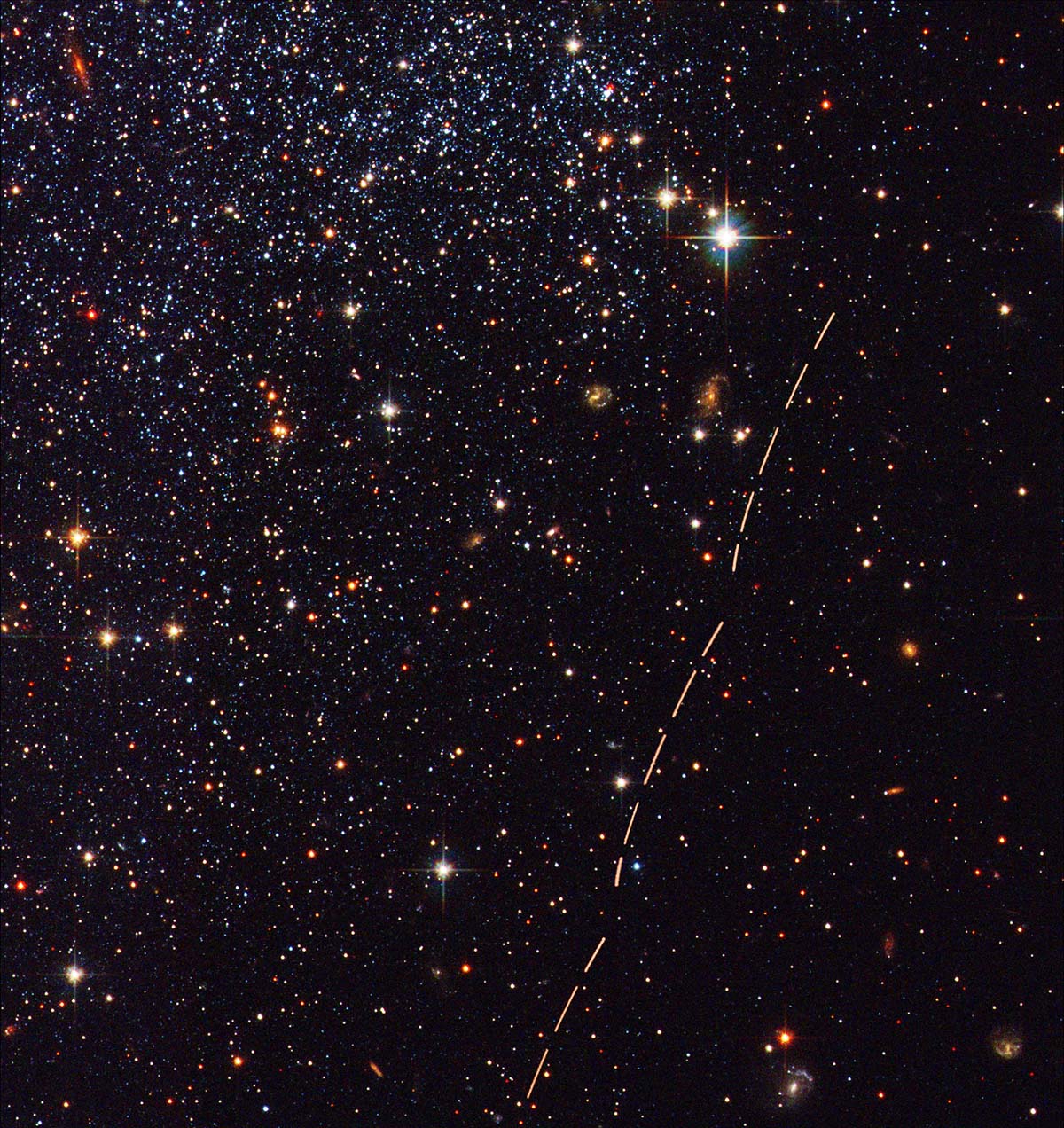
While observing the Sagittarius dwarf irregular galaxy (SagDIG), Hubble unexpectedly captured the trail of a faint asteroid drifting across the field of view. The trail appears as a series of 13 reddish arcs on the right side of the image, created as the asteroid moved during the multiple exposures that were combined to create this deep image. This cosmic photobomb demonstrates how objects within our own solar system can intrude upon observations of distant galaxies billions of times farther away. Meanwhile, the target of the observation — SagDIG — appears as a sparse collection of blue and red stars in the image. This dwarf galaxy lies near the edge of the Local Group and provides valuable insights into how isolated, low-mass galaxies evolve.
Scientific Significance
Beyond the serendipitous asteroid detection, this observation of SagDIG provides important constraints on how dwarf galaxies form stars in isolated environments. Unlike most dwarf galaxies in the Local Group, which orbit close to large spirals like the Milky Way and Andromeda, SagDIG has evolved in relative isolation and thus has not experienced the gas stripping and tidal disruption that affect satellite dwarfs. The galaxy shows evidence of recent star formation despite its low mass, indicating that even tiny galaxies can sustain star formation over cosmic time if left undisturbed. The resolved stellar population reveals an extended star formation history, with both old red giants and young blue stars present in the galaxy.
Observation Details
Hubble observed SagDIG using the Advanced Camera for Surveys (ACS) in multiple broadband filters to characterize the stellar population. The observations employed a standard dithering strategy that shifts the telescope pointing slightly between exposures, which explains why the asteroid trail appears as separate segments rather than a continuous streak. Each exposure captured the asteroid at a different position as it moved against the distant background. The deep exposures required to detect faint dwarf galaxy stars also made the trailing asteroid clearly visible. Photometric analysis of the resolved stars in SagDIG enabled construction of a color-magnitude diagram that constrains the galaxy's star formation history and distance.
Location in the Universe
Constellation
Sagittarius
Distance from Earth
3.4 million light-years
Fun Facts
- 1
The asteroid captured in this image is likely only a few kilometers across, yet it appears comparable in brightness to stars millions of light-years away due to its extreme proximity.
- 2
SagDIG is one of the most isolated galaxies in the Local Group, lying over 4 million light-years from the nearest large galaxy — this isolation makes it a unique laboratory for studying galaxy evolution.
- 3
Asteroid trails like this one appear frequently in deep Hubble observations, sometimes obscuring the scientific targets and requiring additional observations.
Image credit: NASA, ESA, Hubble Space Telescope