About This Image
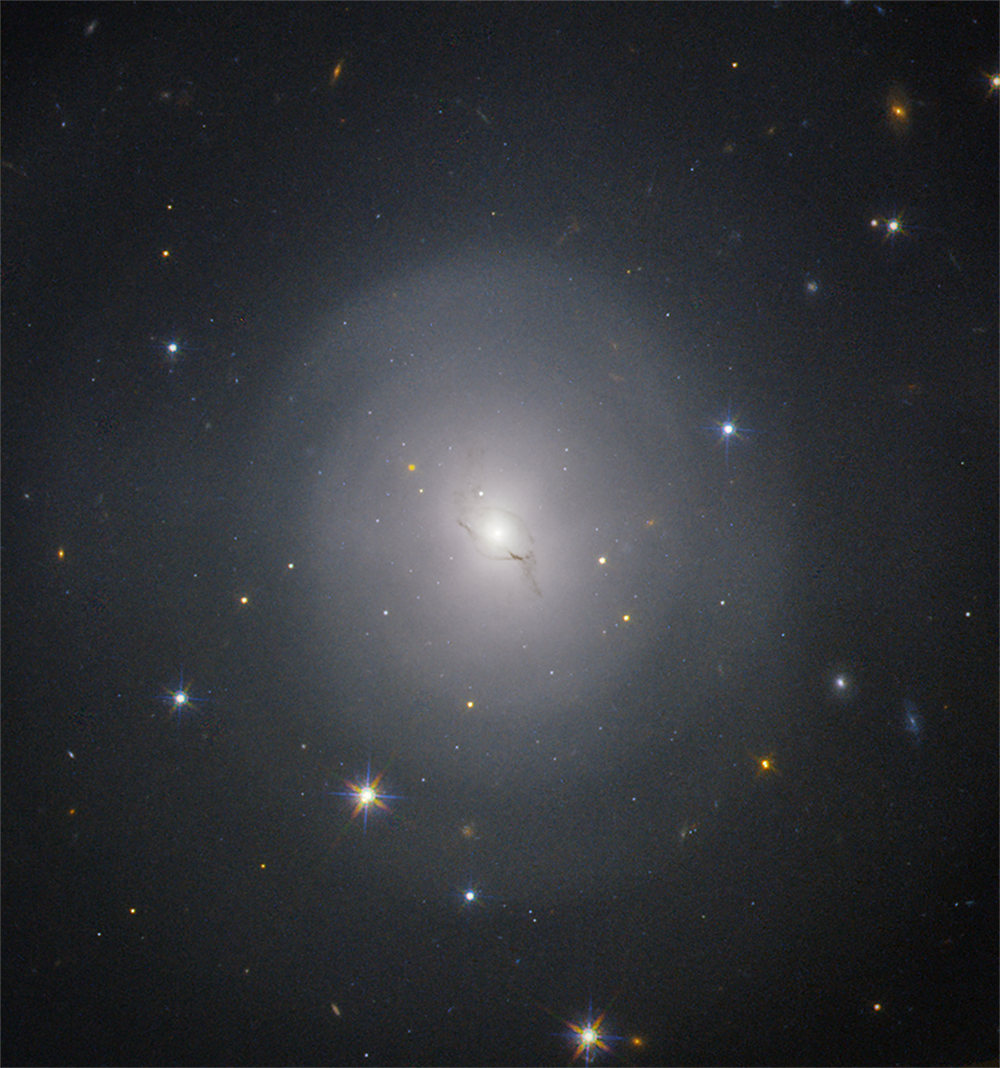
In this elliptical galaxy called NGC 4993, one of the most significant astronomical events of the century occurred: two neutron stars spiraled together and collided, creating gravitational waves discovered on August 17, 2017. The event produced a flash of light called a kilonova, which appears as a point source to the upper left of the galaxy's center in this image. This cosmic collision marked the first time that gravitational waves and electromagnetic radiation were detected from the same astronomical event, opening a new era of multi-messenger astronomy. The merger not only confirmed key predictions of Einstein's general relativity but also proved that neutron star collisions are cosmic factories for heavy elements like gold, platinum, and uranium that cannot form in ordinary stars.
Scientific Significance
The neutron star merger in NGC 4993 stands as one of the most important astronomical discoveries of the 21st century. The simultaneous detection of gravitational waves by LIGO/Virgo and electromagnetic radiation across the spectrum confirmed the multi-messenger approach to astronomy that scientists had theorized for decades. The kilonova light curve and spectrum provided direct evidence that neutron star mergers are the primary sites of rapid neutron capture nucleosynthesis (r-process), which produces heavy elements beyond iron. Hubble observations tracked the kilonova's evolution over weeks, watching it fade and shift in color as the expanding debris cooled. The precise localization to NGC 4993 enabled an independent measurement of the Hubble constant using the gravitational wave signal as a 'standard siren,' though the result is still debated.
Observation Details
Hubble observed NGC 4993 multiple times following the gravitational wave detection, using the Wide Field Camera 3 (WFC3) and Advanced Camera for Surveys (ACS) in visible and infrared filters. The initial observations, taken within days of the merger, clearly detected the kilonova counterpart as a bright point source distinct from the smooth stellar light of the elliptical galaxy. Follow-up observations over subsequent weeks tracked the kilonova's rapid fading and dramatic color evolution from blue to red as the ejected material expanded and cooled. The observations constrained the mass and velocity of the merger ejecta, providing crucial input for nucleosynthesis models. Later observations searched for evidence of a jet breakout or late-time emission from the remnant.
Location in the Universe
Constellation
Hydra
Distance from Earth
130 million light-years
Fun Facts
- 1
The kilonova from this neutron star merger produced an estimated 10 Earth masses worth of gold and platinum — the origin of much of the heavy elements in the universe.
- 2
The gravitational wave signal, called GW170817, was detected just 1.7 seconds before the first gamma-ray burst, confirming that gravitational waves travel at the speed of light.
- 3
Over 70 observatories worldwide observed this single event, making it the most intensively studied transient astronomical phenomenon in history.
Image credit: NASA, ESA, Hubble Space Telescope