About This Image
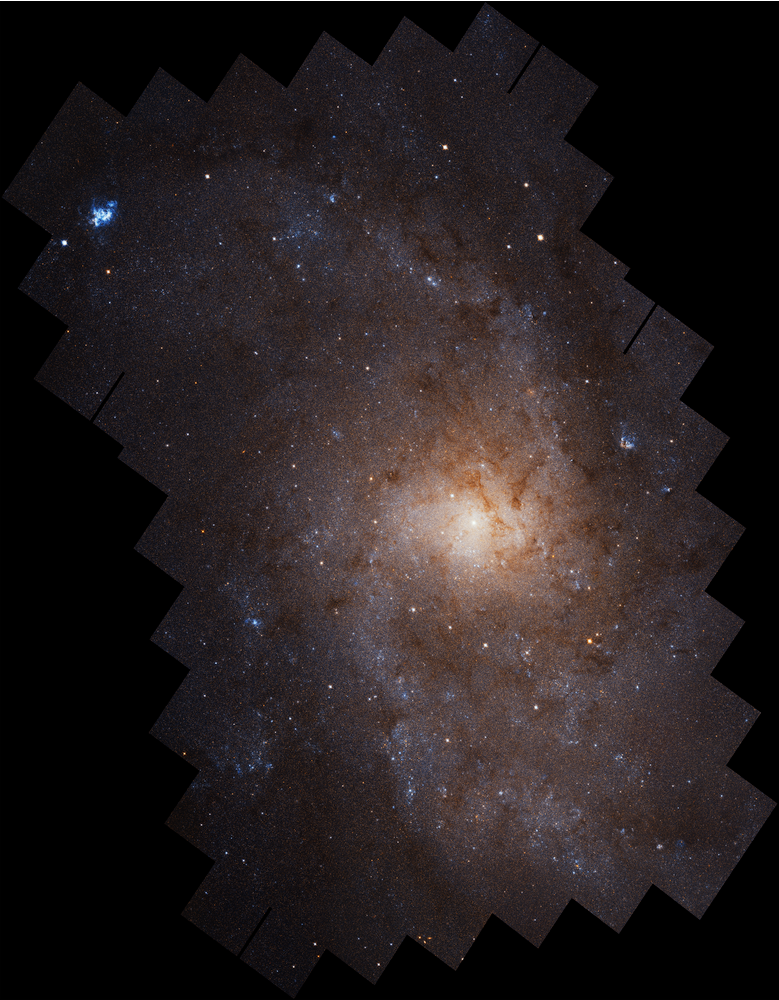
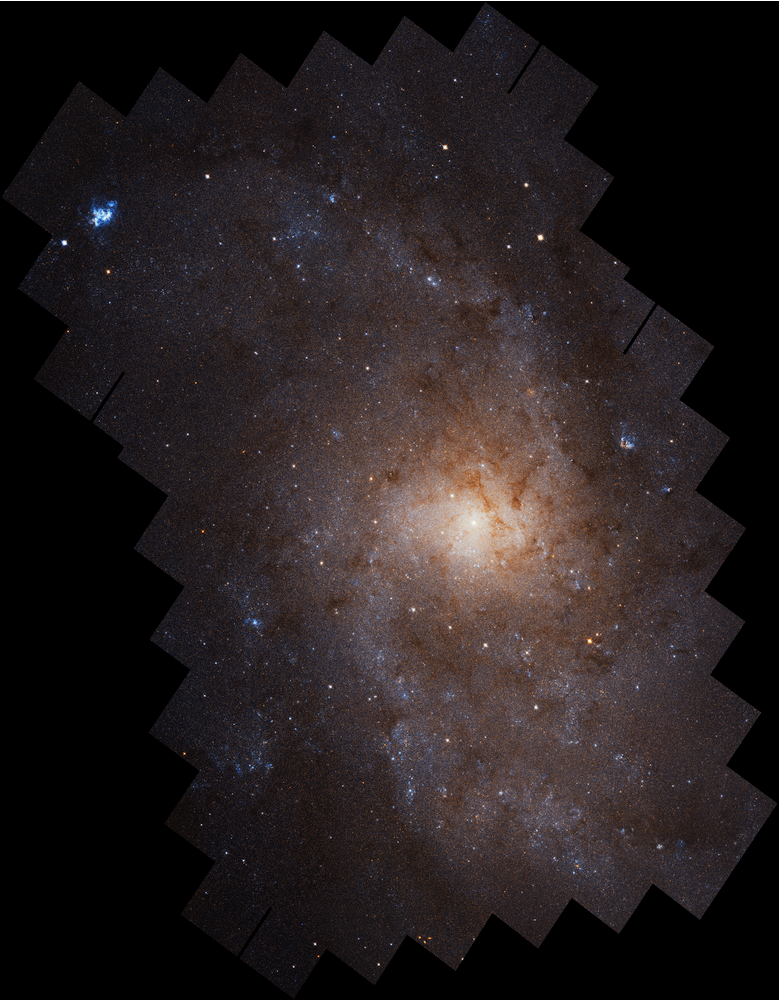
This mosaic captures the nearby Triangulum galaxy. Striking areas of star birth glow bright blue throughout the galaxy, particularly in beautiful nebulas of hot gas like star-forming region NGC 604 in the upper left.
Scientific Significance
Triangulum is a key nearby late-type spiral for studying disk star formation and chemical evolution. Its proximity allows resolved-star and nebular studies over wide areas, linking local star-forming complexes to global galaxy properties. As a Local Group system, it also helps test interaction histories with Andromeda and their effect on disk structure.
Observation Details
Hubble assembled mosaic imaging that resolves young blue star-forming complexes and older stellar background populations across M33. Multi-filter coverage emphasizes H II regions such as NGC 604 and surrounding dust structure. The data support both stellar-population analysis and calibrations of star-formation tracers.
Location in the Universe
Constellation
Triangulum
Distance from Earth
2.73 million light-years
Fun Facts
- 1
Triangulum (M33) is the third-largest member of the Local Group after Andromeda and the Milky Way.
- 2
NGC 604, visible in the mosaic, is one of the largest known star-forming regions in the local universe.
- 3
M33 has a relatively small central bulge and an open, gas-rich disk.
Image credit: NASA, ESA, Hubble Space Telescope