About This Image
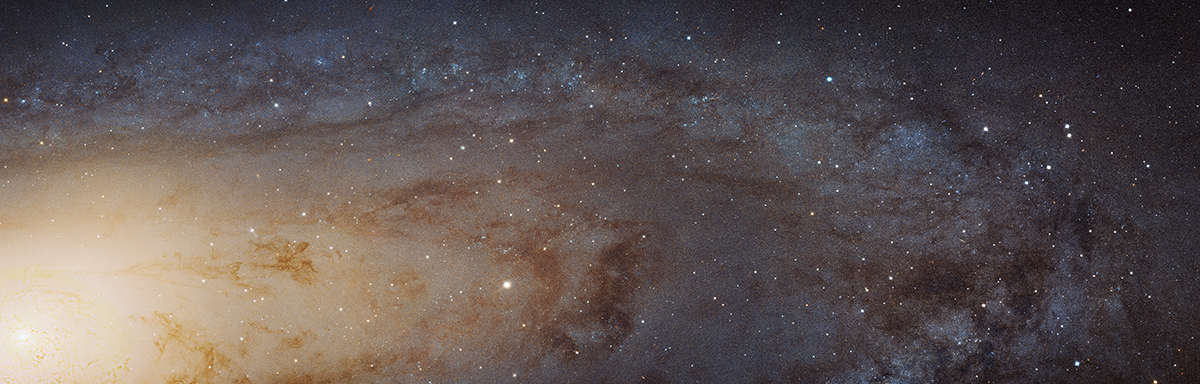
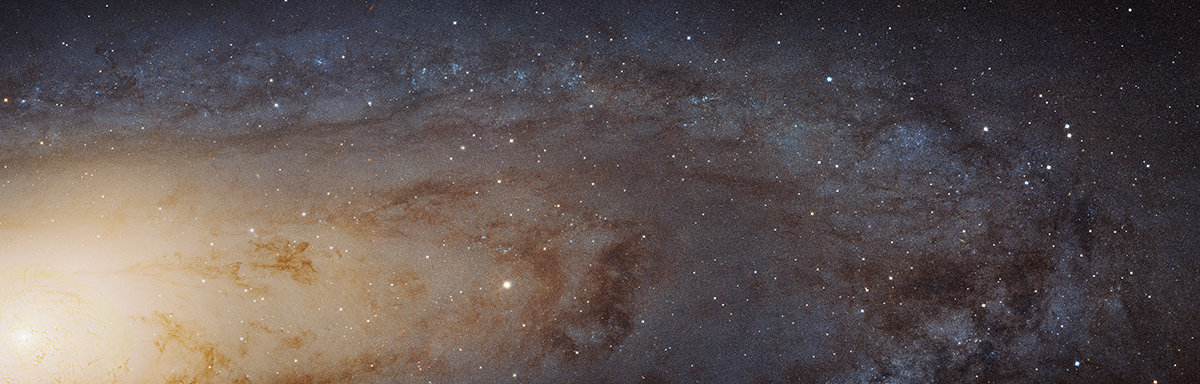
This breathtaking portrait showcases over 100 million stars within a portion of the Andromeda galaxy, our nearest large galactic neighbor located over 2 million light-years away. This magnificent mosaic represents the largest image ever assembled by Hubble, stitched together from thousands of individual exposures to create an unprecedented view of our sister galaxy. The incredible detail reveals individual stars, star clusters, nebulae, and dust lanes with stunning clarity, allowing astronomers to study stellar populations and galactic structure in ways never before possible. Andromeda, also known as M31, is similar in size and structure to our own Milky Way and is on a collision course with our galaxy, destined to merge in approximately 4.5 billion years. This remarkable image serves as both a scientific treasure trove and a humbling reminder of the vast scale and beauty of the cosmos beyond our own galactic home.
Scientific Significance
The Andromeda Galaxy (M31) is arguably the single most important galaxy for extragalactic astronomy. As the nearest large spiral galaxy, it serves as the primary benchmark for calibrating the cosmic distance ladder — the chain of methods astronomers use to measure distances across the universe. Edwin Hubble's identification of Cepheid variable stars in Andromeda in 1923 proved that it was a separate galaxy far beyond the Milky Way, revolutionizing our understanding of the universe's size and structure. Today, Andromeda remains essential for studying spiral galaxy dynamics, dark matter halos, satellite galaxy interactions, and stellar population gradients. The Panchromatic Hubble Andromeda Treasury (PHAT) survey resolved over 100 million individual stars, creating the most detailed stellar census of any external galaxy. This dataset enables star-by-star comparisons with the Milky Way, constraining models of galaxy formation and evolution. Andromeda's future collision with our galaxy also provides a unique laboratory for predicting and modeling major galaxy mergers.
Observation Details
Hubble's panoramic mosaic of Andromeda was captured as part of the Panchromatic Hubble Andromeda Treasury (PHAT) program, the largest Hubble project ever approved at the time. The observations used the Advanced Camera for Surveys (ACS) and the Wide Field Camera 3 (WFC3) across ultraviolet, visible, and near-infrared filters. Over 7,398 individual exposures were stitched together to form a mosaic covering roughly one-third of the galaxy's disk. The multi-wavelength approach allowed astronomers to classify stars by age, mass, and evolutionary stage, resolving populations from hot young blue stars to old red giants.
Location in the Universe
Constellation
Andromeda
Distance from Earth
2.5 million light-years
Fun Facts
- 1
The Andromeda Galaxy contains approximately one trillion stars, making it the largest galaxy in our Local Group — roughly twice the number of stars in our own Milky Way.
- 2
Andromeda is approaching the Milky Way at about 110 kilometers per second and the two galaxies will collide and merge in roughly 4.5 billion years, forming a new giant elliptical galaxy sometimes nicknamed 'Milkomeda.'
- 3
The Andromeda Galaxy is the most distant object visible to the naked eye, appearing as a faint smudge of light in dark skies — the photons reaching your eyes have been traveling for 2.5 million years.
Image credit: NASA, ESA, Hubble Space Telescope