About This Image
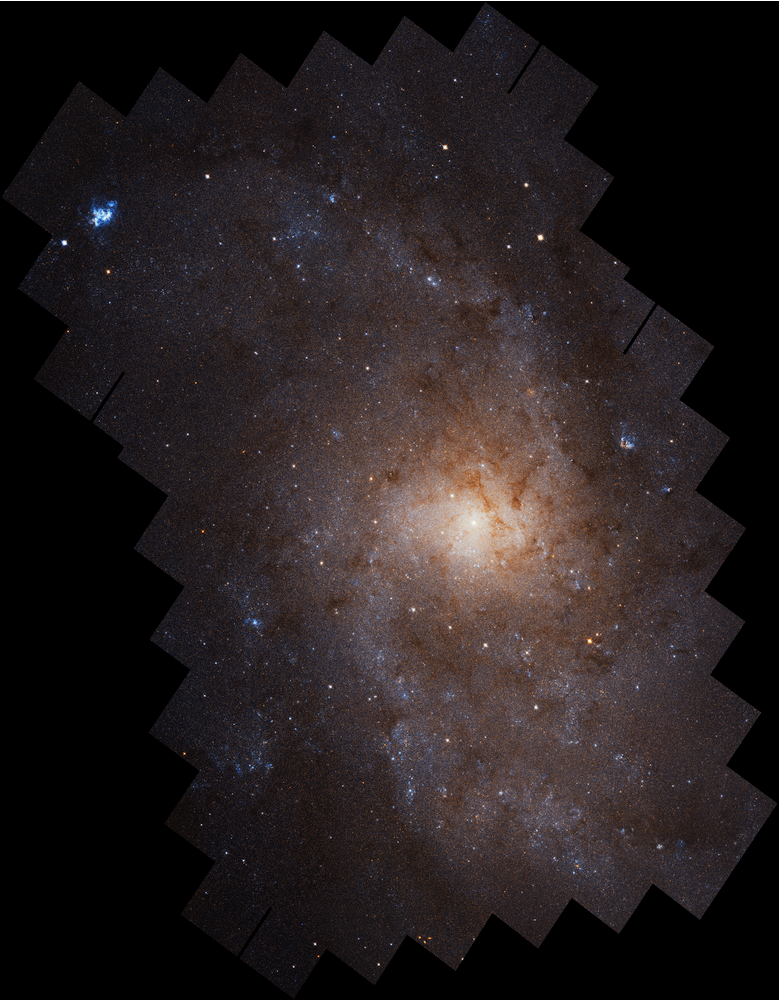
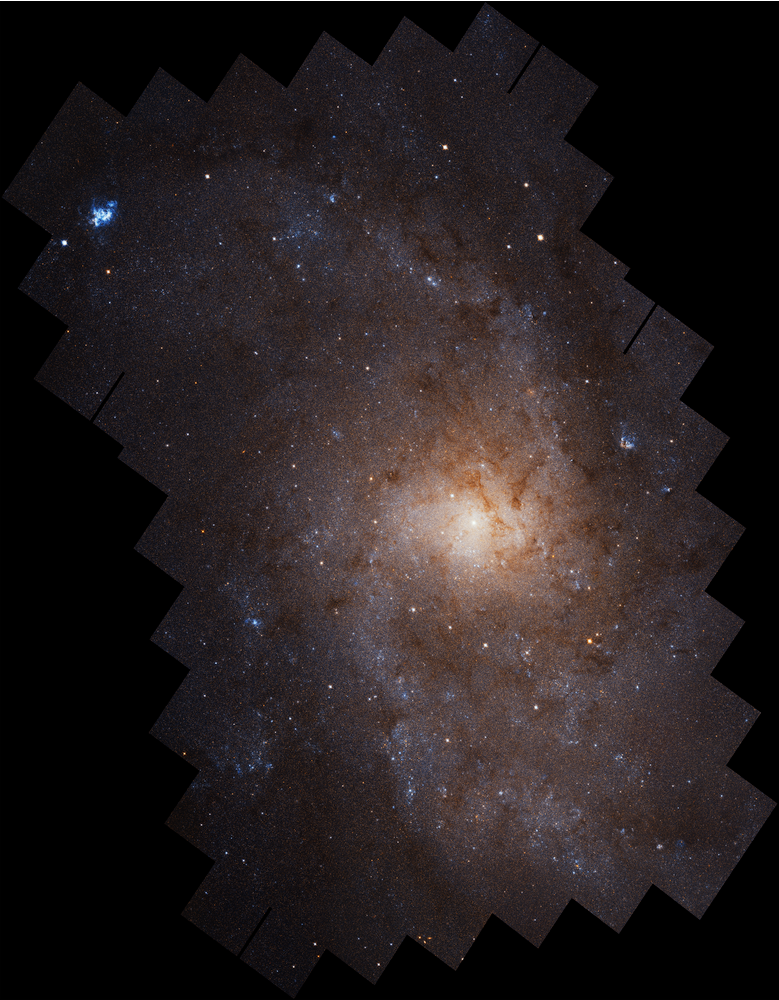
This mosaic captures the nearby Triangulum galaxy. Striking areas of star birth glow bright blue throughout the galaxy, particularly in beautiful nebulas of hot gas like star-forming region NGC 604 in the upper left.
Scientific Significance
Triangulum provides high-value resolved data for testing how star formation proceeds in gas-rich, modest-mass spiral disks. Because individual stars and nebulae are observable in detail, astronomers can link local physics to global scaling relations. This makes M33 an anchor object for nearby-galaxy evolution studies.
Observation Details
Hubble mosaic observations of M33 combine spatial coverage with sufficient resolution to isolate star-forming knots and stellar populations across the disk. Multi-band analysis distinguishes young and old components while mapping dust and ionized gas. These datasets are frequently paired with radio and infrared surveys for multi-wavelength context.
Location in the Universe
Constellation
Triangulum
Distance from Earth
2.73 million light-years
Fun Facts
- 1
M33's disk hosts many luminous H II regions that trace active star formation.
- 2
Its relatively face-on orientation makes spiral structure easy to study.
- 3
Triangulum is often used as a bridge case between dwarf spirals and larger systems.
Image credit: NASA, ESA, Hubble Space Telescope