About This Image
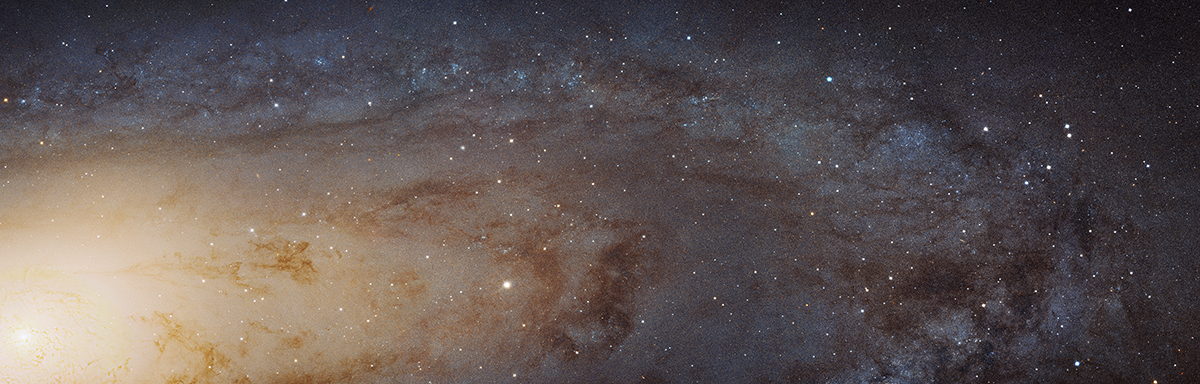
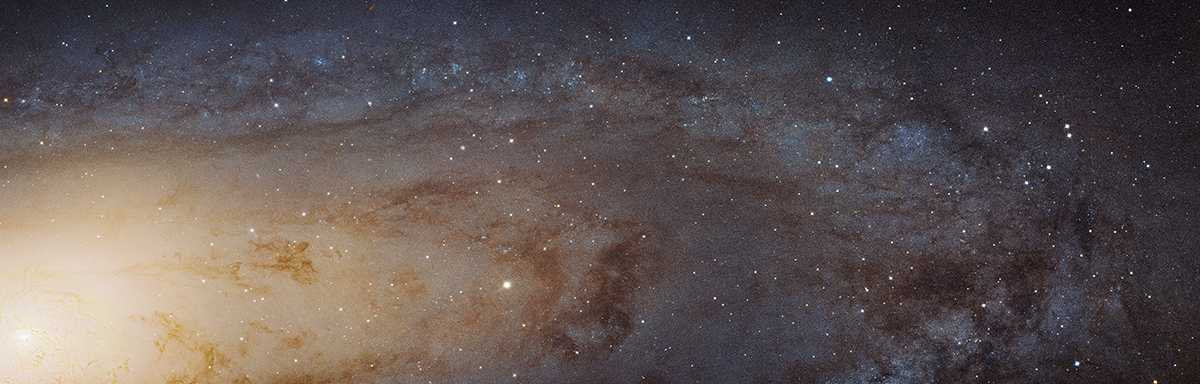
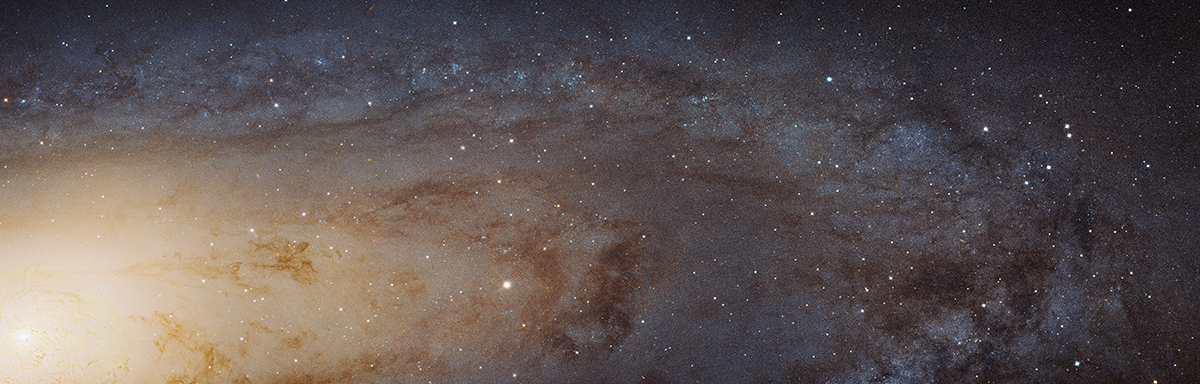
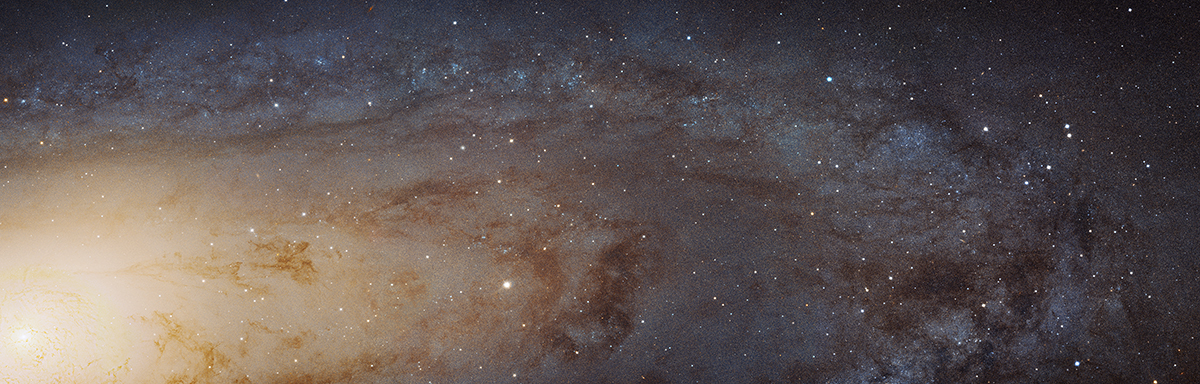
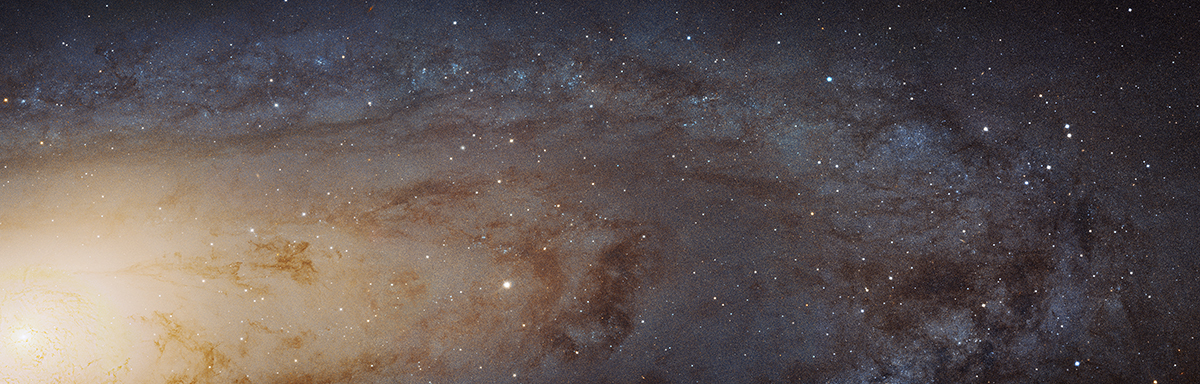
This stunning view captures another section of the Andromeda galaxy's vast stellar disk, revealing the intricate interplay between stars, gas, and dust that defines spiral galaxy structure. Over 100 million individual stars are visible in this portion of Hubble's comprehensive survey, each one a sun potentially hosting its own planetary system. The image showcases the dramatic contrast between the densely packed stellar populations in Andromeda's inner disk and the more sparse outer regions. Brilliant blue star clusters mark sites of recent star formation, while dark dust lanes snake through the disk, obscuring background stars and providing the raw material for future stellar generations. This region demonstrates how spiral galaxies continuously recycle material between stars and the interstellar medium.
Scientific Significance
This region of the PHAT survey provides crucial data for understanding radial trends in stellar populations across Andromeda's disk. By analyzing how the mix of stellar ages and metallicities changes with distance from the galactic center, astronomers can reconstruct the 'inside-out' growth history of the galaxy. The observations reveal that star formation has proceeded more actively in the outer disk in recent epochs, while the inner regions formed their stars earlier in cosmic history. The dust lanes visible in the image trace the galaxy's spiral density wave pattern, which triggers star formation as gas clouds pass through. Comparing these patterns with similar features in the Milky Way helps constrain models of spiral arm dynamics and the physical processes that regulate star formation in galactic disks.
Observation Details
This observation utilized the same multi-filter strategy as the broader PHAT survey, combining ultraviolet, optical, and near-infrared imaging from WFC3 and ACS. The ultraviolet observations were particularly important for identifying hot, young stars that dominate the light from recent star formation episodes. Careful image processing removed artifacts from cosmic rays and detector defects while preserving the photometric accuracy needed for stellar classification. The depth of the observations allows detection of stars down to approximately one solar luminosity, enabling a complete census of the giant star population throughout the surveyed region.
Location in the Universe
Constellation
Andromeda
Distance from Earth
2.5 million light-years
Fun Facts
- 1
The stars visible in this image represent just a tiny fraction of Andromeda's total stellar population — the galaxy contains an estimated one trillion stars in total.
- 2
Light from the stars in this image left Andromeda during the Pliocene epoch on Earth, when early human ancestors were just beginning to walk upright.
- 3
Andromeda's supermassive black hole, containing about 100 million solar masses, lies at the galaxy's center but is not visible in these outer disk observations.
Image credit: NASA, ESA, Hubble Space Telescope