About This Image
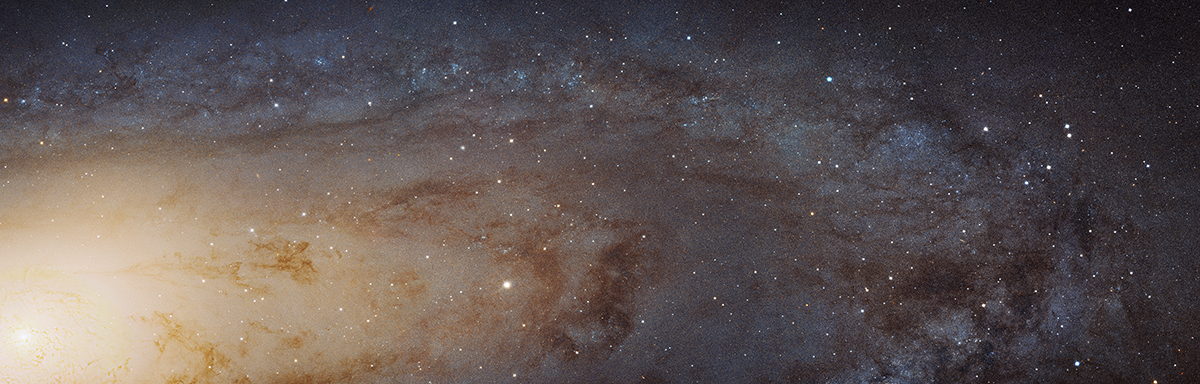
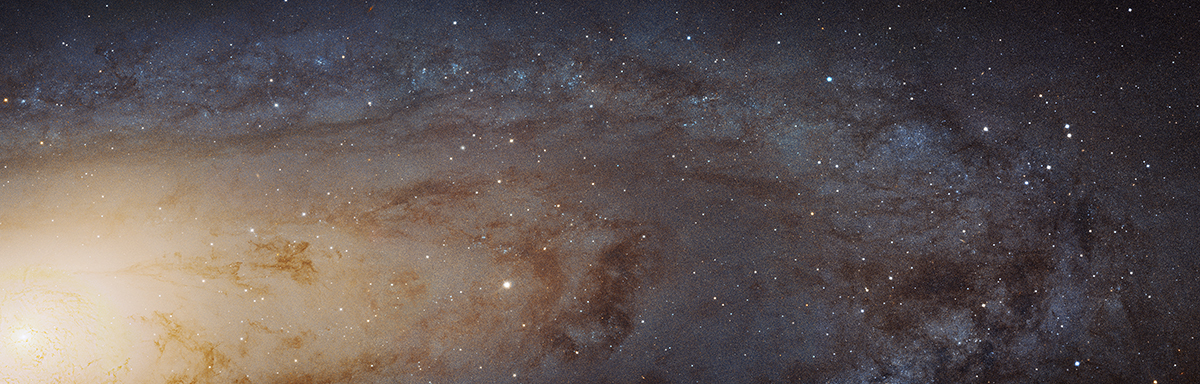
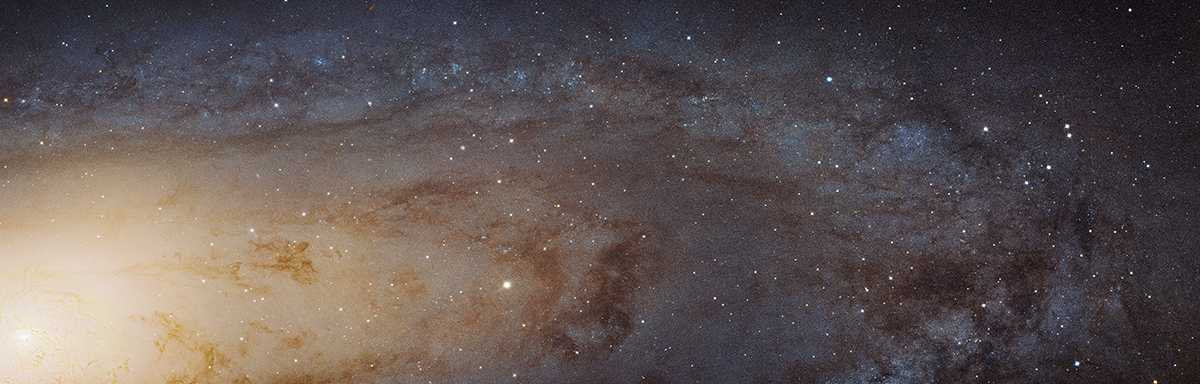
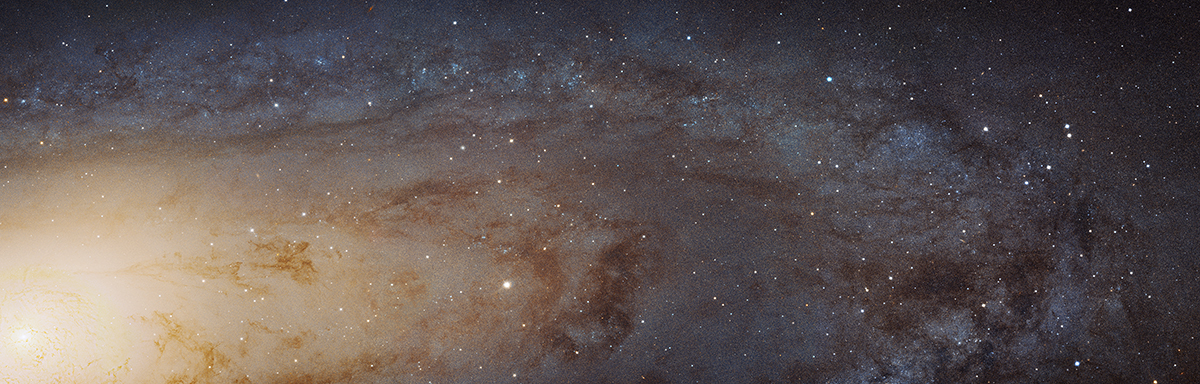
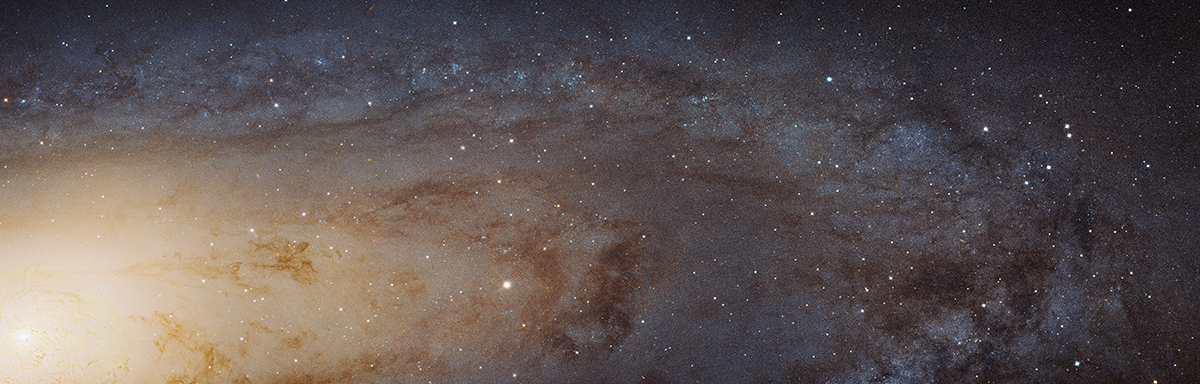
This spectacular view presents yet another region of the Andromeda galaxy's expansive disk, continuing Hubble's unprecedented survey of our nearest spiral neighbor. Over 100 million stars fill this field of view, each one representing a sun with its own unique evolutionary history. The image captures the full spectrum of stellar life, from the blue blaze of stars just emerging from their birth clouds to the red glow of aging giants swollen to hundreds of times their original size. Intricate networks of dust lanes wind through the stellar backdrop, silhouetted against the accumulated light of billions of more distant stars. This cosmic tapestry demonstrates the richness and complexity that characterizes all major spiral galaxies, including our own Milky Way.
Scientific Significance
The comprehensive stellar census enabled by the PHAT survey has revealed surprising details about Andromeda's assembly history. The survey detected an excess of intermediate-age stars (2-4 billion years old) compared to models of steady star formation, suggesting a burst of activity possibly triggered by a close passage with the neighboring Triangulum galaxy or a merger with a now-disrupted satellite. The stellar metallicity distribution across the disk shows evidence for radial migration, where stars born in the inner galaxy gradually moved outward over billions of years. These findings inform models of how all spiral galaxies grow and evolve, with Andromeda serving as a detailed template that can be compared with statistical studies of more distant systems.
Observation Details
This observation represents one of many pointings in the systematic PHAT survey, which covered Andromeda's northeastern quadrant in a brick-like pattern of overlapping fields. The survey design ensured uniform coverage and photometric calibration across the entire mosaic. Data reduction involved careful treatment of charge transfer efficiency degradation in the aging ACS detector, cosmic ray rejection through comparison of multiple exposures, and precise astrometric registration between different camera fields. The final photometric catalogs include measurements for over 117 million individual stars, making this the largest resolved stellar population study ever conducted beyond the Milky Way.
Location in the Universe
Constellation
Andromeda
Distance from Earth
2.5 million light-years
Fun Facts
- 1
The Andromeda galaxy has at least 450 globular clusters orbiting it — nearly three times the number around the Milky Way — each containing hundreds of thousands of ancient stars.
- 2
Andromeda is so large that it spans about 3 degrees on the sky — six times the apparent diameter of the full Moon — though only its bright core is visible to the naked eye.
- 3
Both Andromeda and the Milky Way are currently cannibalizing smaller satellite galaxies, growing larger through these cosmic mergers.
Image credit: NASA, ESA, Hubble Space Telescope