About This Image
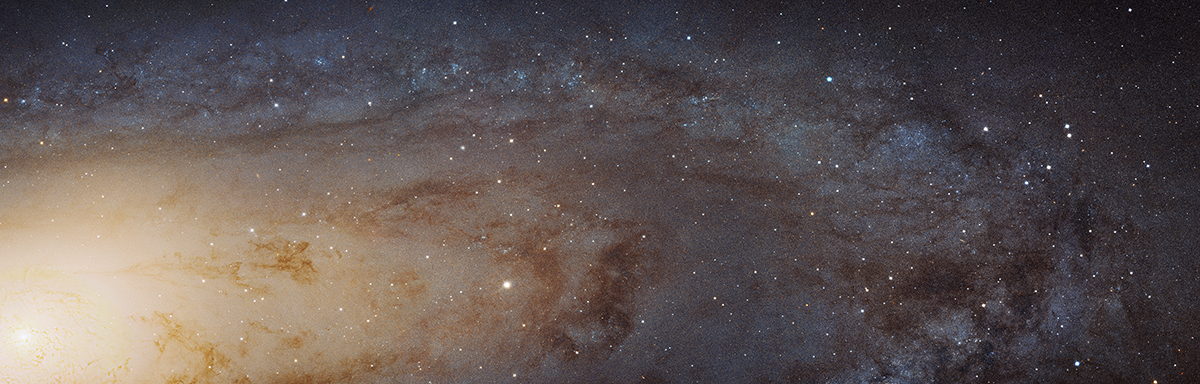
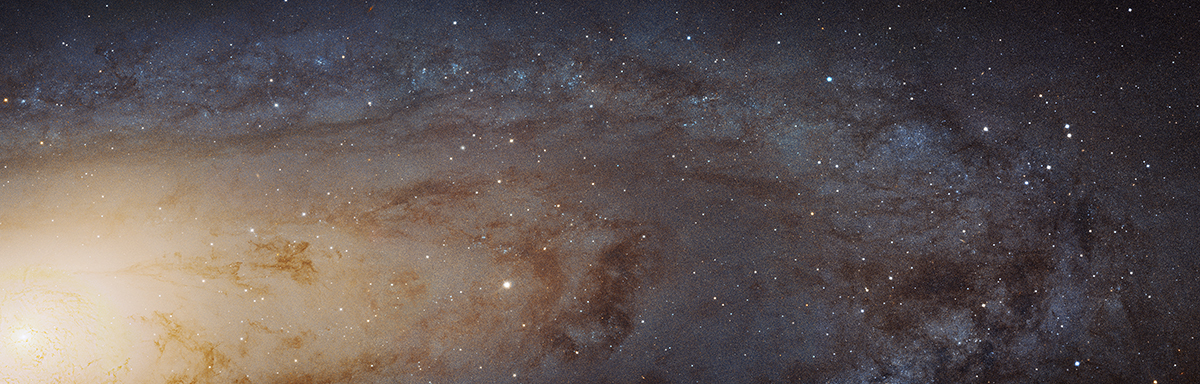
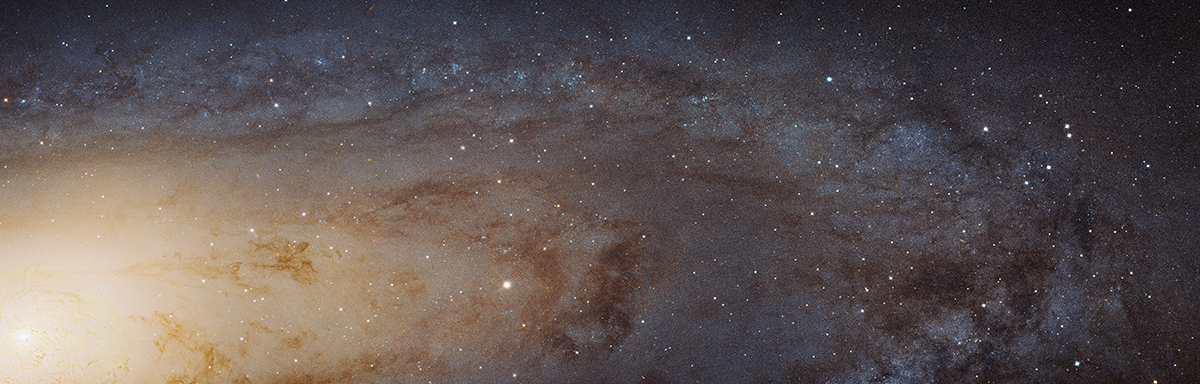
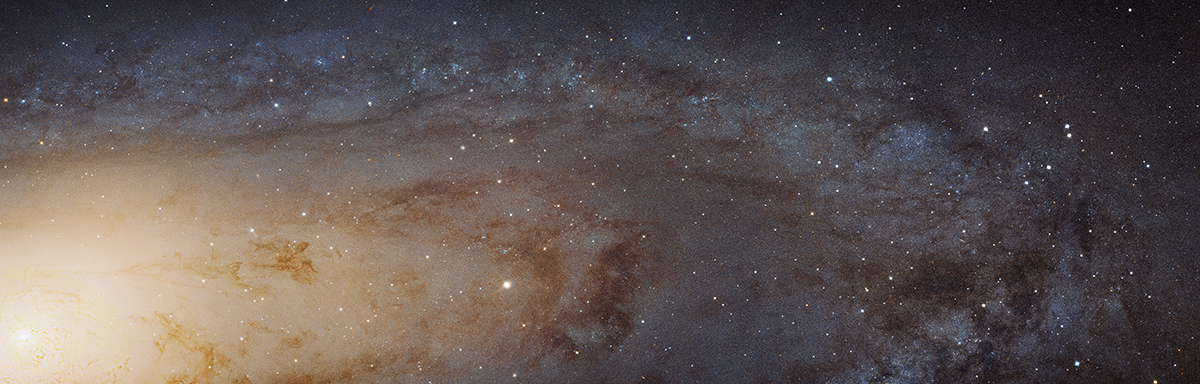
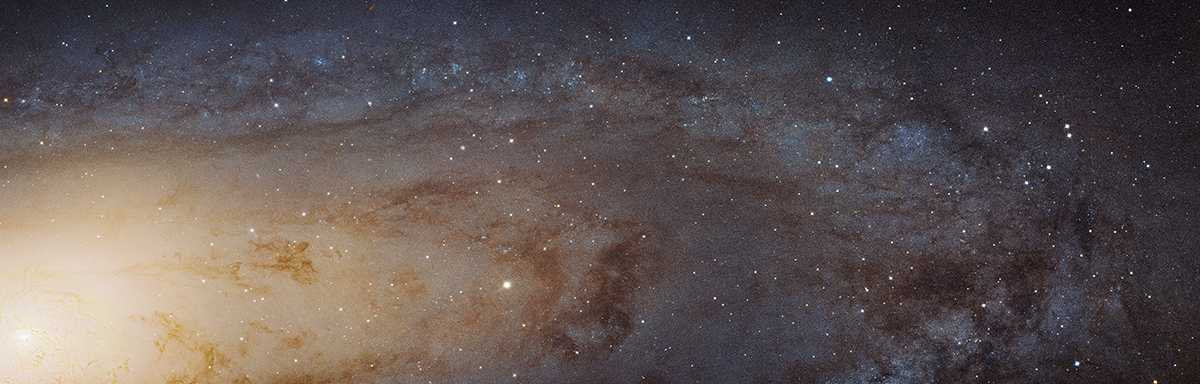
Another breathtaking section of the Andromeda galaxy emerges in this Hubble observation, showcasing the remarkable diversity of stellar environments within our nearest spiral neighbor. Over 100 million stars populate this view, ranging from ancient red giants that formed billions of years ago to young blue supergiants born within the last few million years. The image reveals how Andromeda's spiral arms concentrate young stellar populations along their leading edges, while older stars distribute more uniformly throughout the disk. Dark filaments of interstellar dust weave complex patterns through the starfield, absorbing and reddening the light of background stars while marking the locations of dense molecular clouds where new stars continue to form today.
Scientific Significance
This section of the Andromeda survey captures a region where multiple stellar populations of different ages overlap, providing a natural laboratory for studying how stellar evolution proceeds in a well-characterized environment. The high photometric precision of Hubble observations enables construction of detailed color-magnitude diagrams that reveal the star formation history at each location in the galaxy. By identifying rare stellar types such as luminous blue variables, Wolf-Rayet stars, and asymptotic giant branch stars, astronomers can probe stellar evolution at masses and metallicities not easily accessible in the Milky Way. The survey has also identified thousands of star clusters, from young associations to ancient globular clusters, enabling studies of how clusters form, evolve, and dissolve over cosmic time.
Observation Details
The observations employed Hubble's exceptional angular resolution to separate individual stars in the crowded fields of Andromeda's disk. At Andromeda's distance, Hubble can resolve stars separated by approximately 0.5 parsecs (about 1.5 light-years), sufficient to distinguish individual giants and supergiants even in dense stellar environments. The survey's observing strategy included multiple exposures at each pointing with small positional offsets (dithering) to improve sampling of the point spread function and enable removal of detector artifacts. Sophisticated photometry algorithms extracted accurate brightnesses for millions of stars simultaneously, accounting for overlapping stellar profiles in crowded regions.
Location in the Universe
Constellation
Andromeda
Distance from Earth
2.5 million light-years
Fun Facts
- 1
If you could travel at the speed of light, it would still take you 2.5 million years to reach even the nearest star in this image.
- 2
The color of each star in this image reveals its temperature — blue stars are extremely hot (up to 50,000 K), while red stars are cooler (around 3,000 K).
- 3
Andromeda was first described by the Persian astronomer Abd al-Rahman al-Sufi in 964 CE, who called it a 'nebulous smear' — over a thousand years later, Hubble reveals it as trillions of individual stars.
Image credit: NASA, ESA, Hubble Space Telescope