About This Image
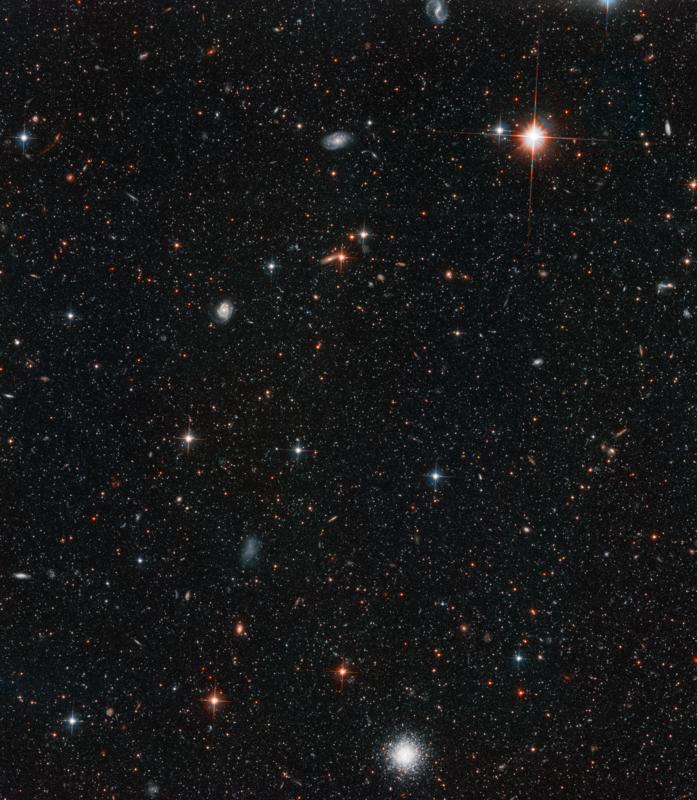
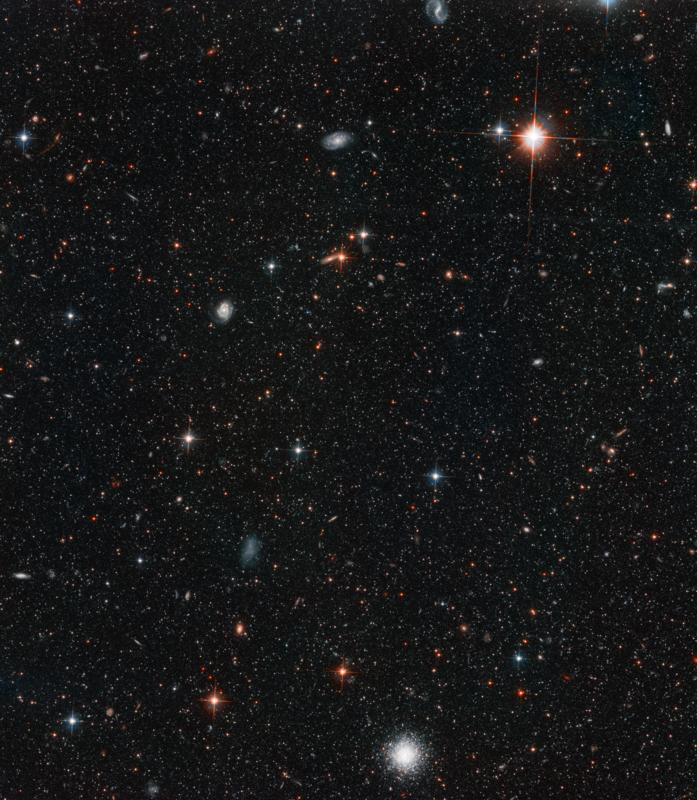
This image captures the light from 300,000 stars (and a star cluster) in the Andromeda galaxy's halo, a vast spherical cloud of stars surrounding the galaxy's bright disk. Also embedded in the image are many background galaxies that are much farther away.
Scientific Significance
Andromeda halo stars record the assembly history of a large spiral galaxy. Their age and metallicity distributions provide direct constraints on hierarchical galaxy growth models.
Observation Details
Deep multi-filter Hubble exposures were used to build color-magnitude diagrams of sparse halo populations while separating compact galaxies from individual stars.
Location in the Universe
Constellation
Andromeda
Distance from Earth
2.5 million light-years
Fun Facts
- 1
Halo fields mix faint Andromeda stars with much more distant background galaxies.
- 2
Halo substructure preserves signatures of past mergers and tidal streams.
- 3
Resolved red giant stars in M31 halo fields are measurable with deep Hubble imaging.
Image credit: NASA, ESA, Hubble Space Telescope