About This Image
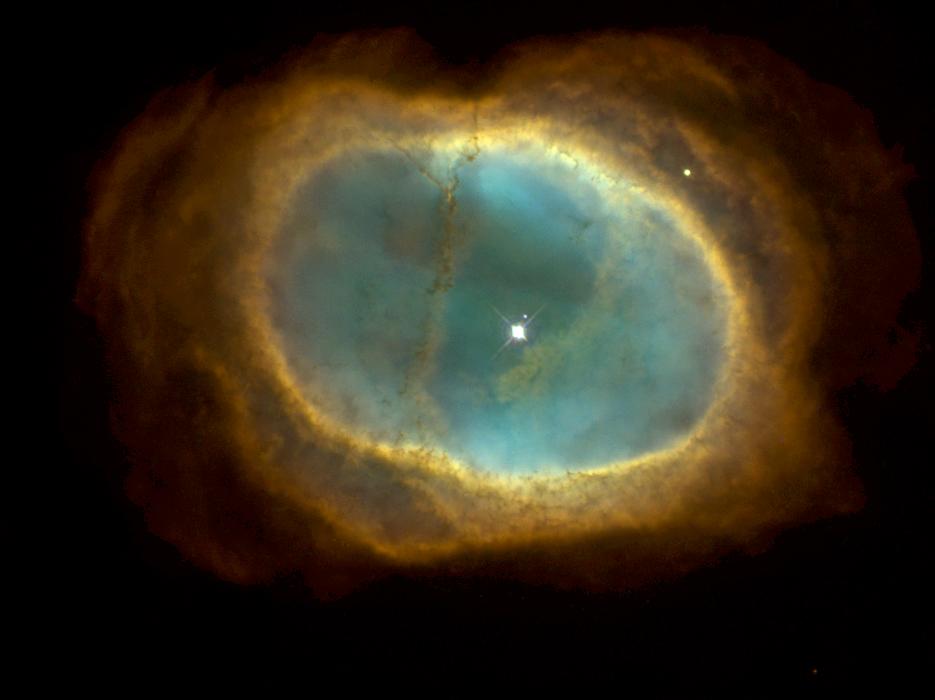
This image of the Southern Ring Nebula clearly shows two stars near the center of the nebula: a bright, white one, and a fainter companion to its upper right. The faint star is actually the star that has ejected the material that forms the nebula.
Scientific Significance
The Southern Ring Nebula illustrates how Sun-like stars eject enriched gas in late evolution. Its shell structure helps constrain mass-loss history and binary-shaping effects.
Observation Details
Hubble used broad and narrow optical bands to resolve shell texture and ionization layers, separating central stars from surrounding emission.
Location in the Universe
Constellation
Vela
Distance from Earth
2,000 light-years
Fun Facts
- 1
The central system is a binary where one star expelled the nebular shell.
- 2
Different colors trace gas at different ionization states and temperatures.
- 3
Planetary nebulae are short-lived and fade on astronomical short timescales.
Image credit: NASA, ESA, Hubble Space Telescope