About This Image
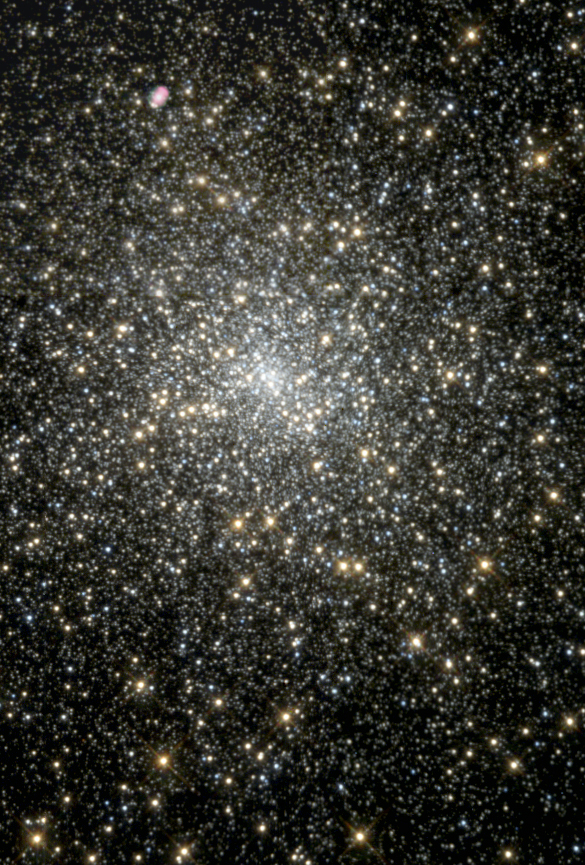
These stars belong to the globular cluster M15. Nestled among them is an astronomical oddity. The pinkish object to the upper left of the cluster's core is a gas cloud surrounding a dying star. Known as Kuestner 648, this was the first planetary nebula found in a globular cluster.
Scientific Significance
M15 is a benchmark for studying old stellar populations, mass segregation, and dense-cluster evolution. Its stellar content constrains Galactic halo age and dynamical models.
Observation Details
Hubble high-resolution imaging resolves crowded core stars and unusual members through point-spread-function photometry across multiple optical filters.
Location in the Universe
Constellation
Pegasus
Distance from Earth
33,600 light-years
Fun Facts
- 1
M15 is one of the most densely packed globular clusters in our galaxy.
- 2
It hosts the rare planetary nebula Pease 1 inside a globular cluster.
- 3
Its collapsed core makes it a key testbed for dense-cluster dynamics.
Image credit: NASA, ESA, Hubble Space Telescope