About This Image
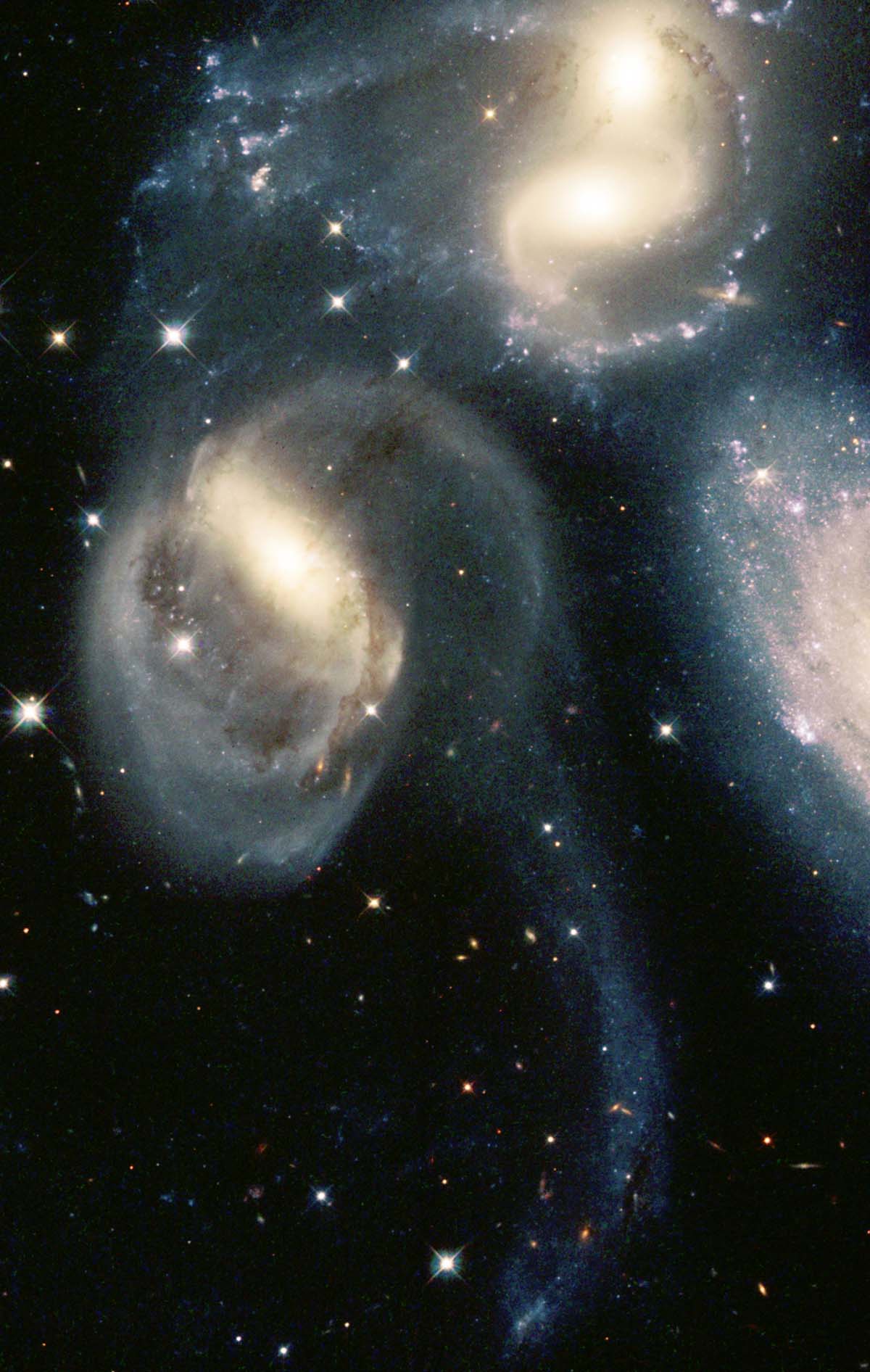
This close-up shows four of the five galaxies that make up Stephan's Quintet. The image reveals bright, blue clusters of stars, born from the violent interactions between some of the member galaxies.
Scientific Significance
Stephan's Quintet is a classic laboratory for multi-galaxy interaction physics. It reveals how repeated encounters drive shocks, tidal debris, and morphological transformation in dense environments.
Observation Details
Hubble mosaics in optical bands resolve dust lanes, star-forming knots, and tidal features across the compact group, supporting kinematic and interaction-sequence studies.
Location in the Universe
Constellation
Pegasus
Distance from Earth
290 million light-years
Fun Facts
- 1
Stephan's Quintet is one of the best-known compact interacting galaxy groups.
- 2
Four main galaxies interact strongly while one bright member is foreground.
- 3
High-speed collisions in the group create large-scale shock structures.
Image credit: NASA, ESA, Hubble Space Telescope