About This Image
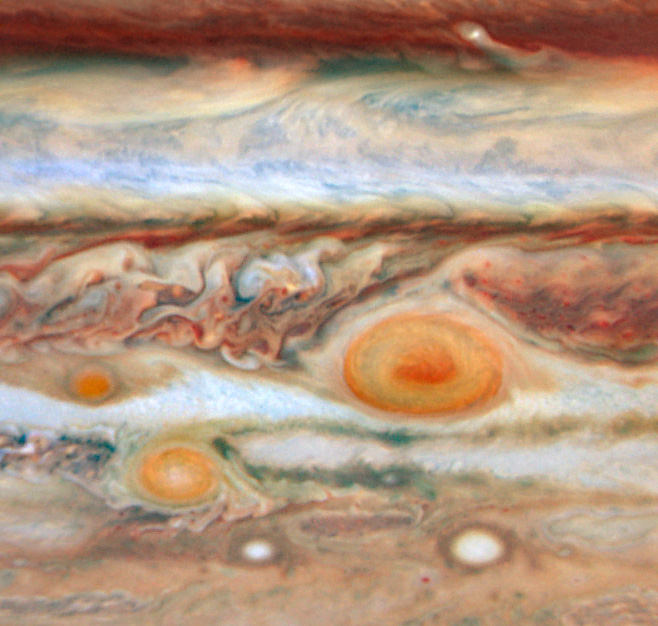
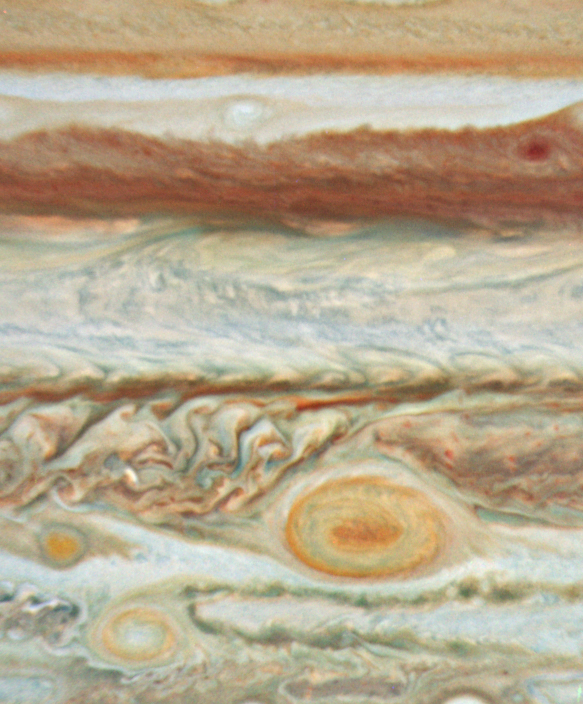
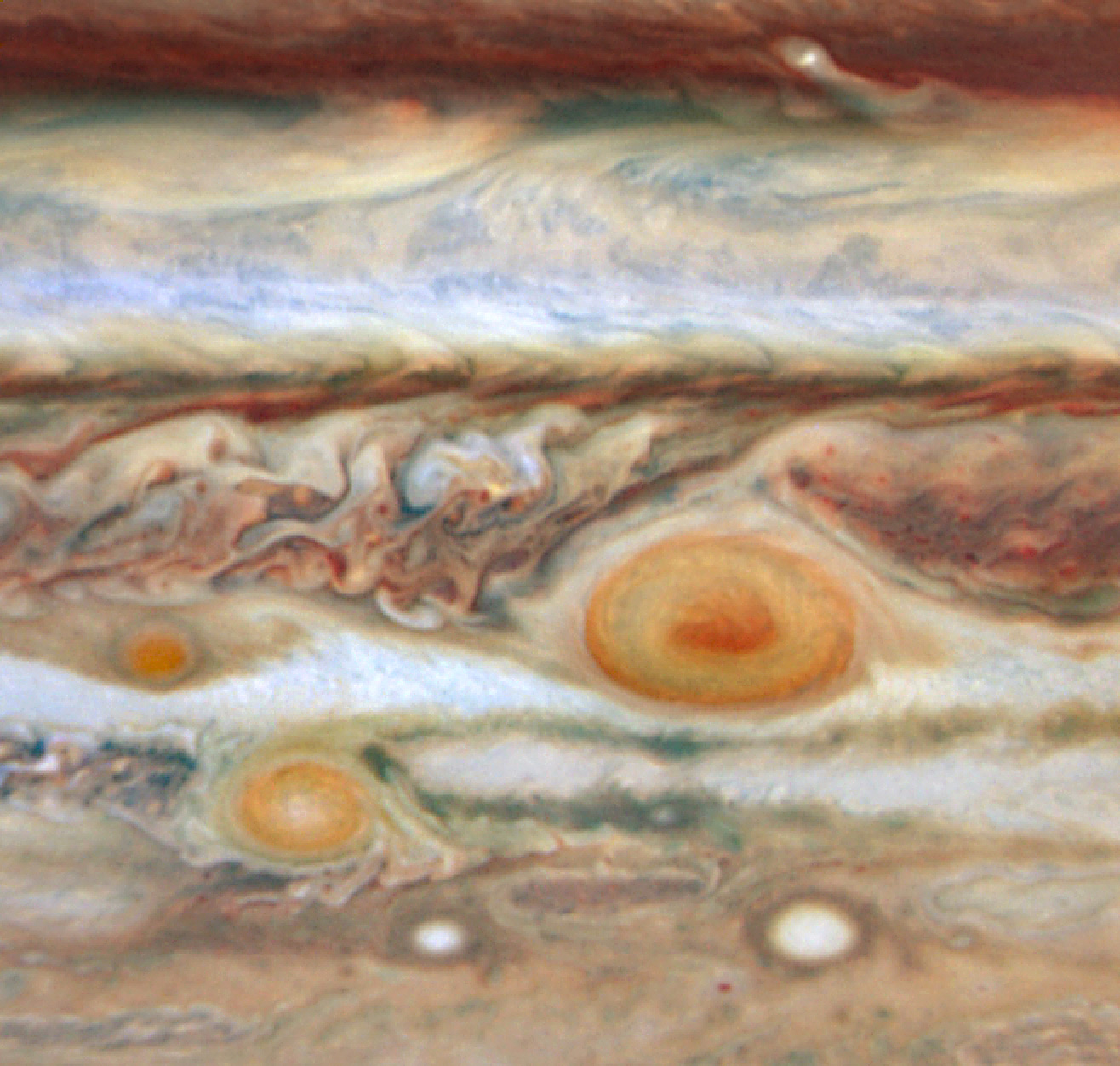
This stunning Hubble image captures an unprecedented triple display of red storm systems in Jupiter's turbulent atmosphere. The legendary Great Red Spot, a colossal anticyclonic storm that has raged for at least 350 years, dominates the right side of the image. To its lower left appears Red Spot Jr. (Oval BA), a younger storm that formed in 2000 and turned red in 2005. Most remarkably, an even smaller third red vortex, informally dubbed the baby red spot, appears at left, having recently developed its red coloration in 2008. This was the first time three simultaneously red storms had ever been observed on Jupiter, providing scientists with a unique natural experiment for understanding the atmospheric chemistry and dynamics that produce the distinctive red coloration in Jovian storm systems.
Scientific Significance
The simultaneous observation of three red storm systems on Jupiter in 2008 provided an extraordinary opportunity to study the mechanisms that generate and maintain large anticyclonic vortices in gas giant atmospheres. The Great Red Spot has been the subject of study for centuries, yet the fundamental question of what chemical compound produces its red color remains unanswered. By comparing the spectral properties of three storms of different sizes, ages, and intensities, astronomers could test whether the reddening mechanism is primarily driven by storm intensity, altitude, chemical composition, or exposure time to solar ultraviolet radiation. The subsequent destruction of the baby red spot through interaction with the Great Red Spot provided data on vortex-vortex interactions and the stability of Jupiter's banded wind structure. These observations have direct implications for understanding atmospheric dynamics on other giant planets and exoplanets.
Observation Details
This image was captured using Hubble's Wide Field and Planetary Camera 2 (WFPC2) in multiple visible-light filters on May 15, 2008. The observations were strategically timed to capture all three red storms on the same hemisphere of Jupiter. Multiple short exposures were combined to freeze Jupiter's rapid 10-hour rotation and maximize signal-to-noise while avoiding motion blur. Different color filters probed different atmospheric depths: blue filters are sensitive to higher-altitude hazes, while red and near-infrared filters penetrate to deeper cloud layers, enabling a three-dimensional view of the storm structures.
Location in the Universe
Constellation
N/A (Solar System)
Distance from Earth
365 million to 601 million miles (varies)
Fun Facts
- 1
The Great Red Spot is so large that two to three Earths could fit inside it, yet it has been slowly shrinking over the past century — measurements from the 1800s suggest it was once over 25,000 miles wide, compared to roughly 10,000 miles today.
- 2
The baby red spot visible on the left of this image was short-lived: just weeks after Hubble captured this portrait, the tiny vortex drifted too close to the Great Red Spot and was torn apart and absorbed by the larger storm.
- 3
Nobody knows exactly what chemical compound gives Jupiter's red spots their distinctive color, but leading candidates include phosphorus compounds or complex organic molecules called tholins formed when ammonia and acetylene are exposed to ultraviolet sunlight.
Image credit: NASA, ESA, Hubble Space Telescope