About This Image
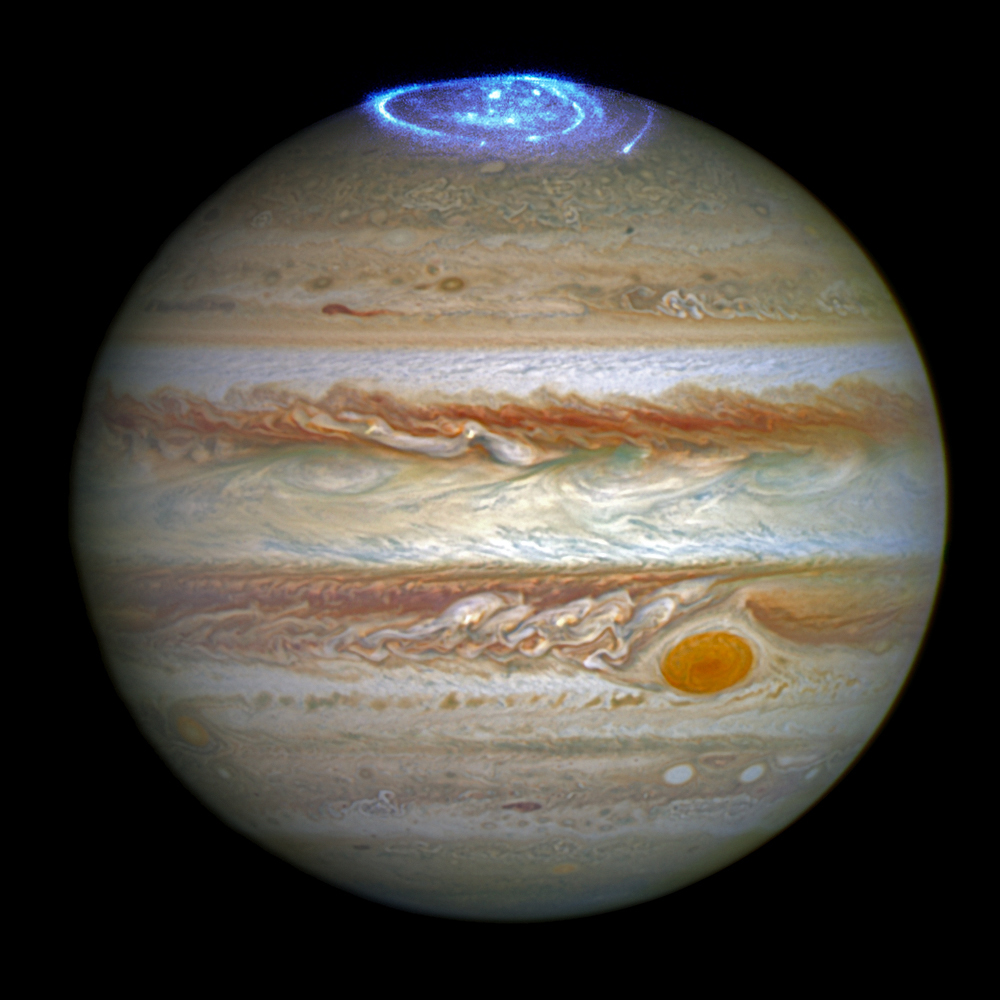
In 2014, Hubble observed Jupiter in ultraviolet light, revealing the planet's spectacular polar auroras — shimmering curtains of light far more powerful than anything seen on Earth. Jupiter's auroras are generated by charged particles from the solar wind and from its volcanic moon Io, which ejects roughly a ton of sulfur dioxide per second into space. These particles are captured by Jupiter's immense magnetic field — the strongest of any planet — and funneled toward the poles, where they collide with atmospheric molecules and produce brilliant ultraviolet emissions. The auroral ovals encircle both poles and include distinct bright spots corresponding to the magnetic footprints of Io, Europa, and Ganymede, revealing the direct electromagnetic connection between Jupiter and its moons.
Scientific Significance
Hubble's ultraviolet observations of Jupiter's auroras have been foundational in understanding magnetospheric physics beyond Earth. Jupiter possesses the largest and most powerful magnetosphere in the solar system, extending millions of kilometers into space and creating a complex environment of trapped radiation, plasma flows, and electromagnetic interactions. The auroral footprints of Io, Europa, and Ganymede — bright spots within the auroral oval corresponding to where magnetic flux tubes connecting to each moon intersect Jupiter's atmosphere — provide direct evidence of moon-magnetosphere coupling, a phenomenon unique to the Jovian system. Time-series ultraviolet monitoring has revealed how the auroras respond to changes in solar wind pressure and to volcanic activity on Io, distinguishing between externally and internally driven auroral processes.
Observation Details
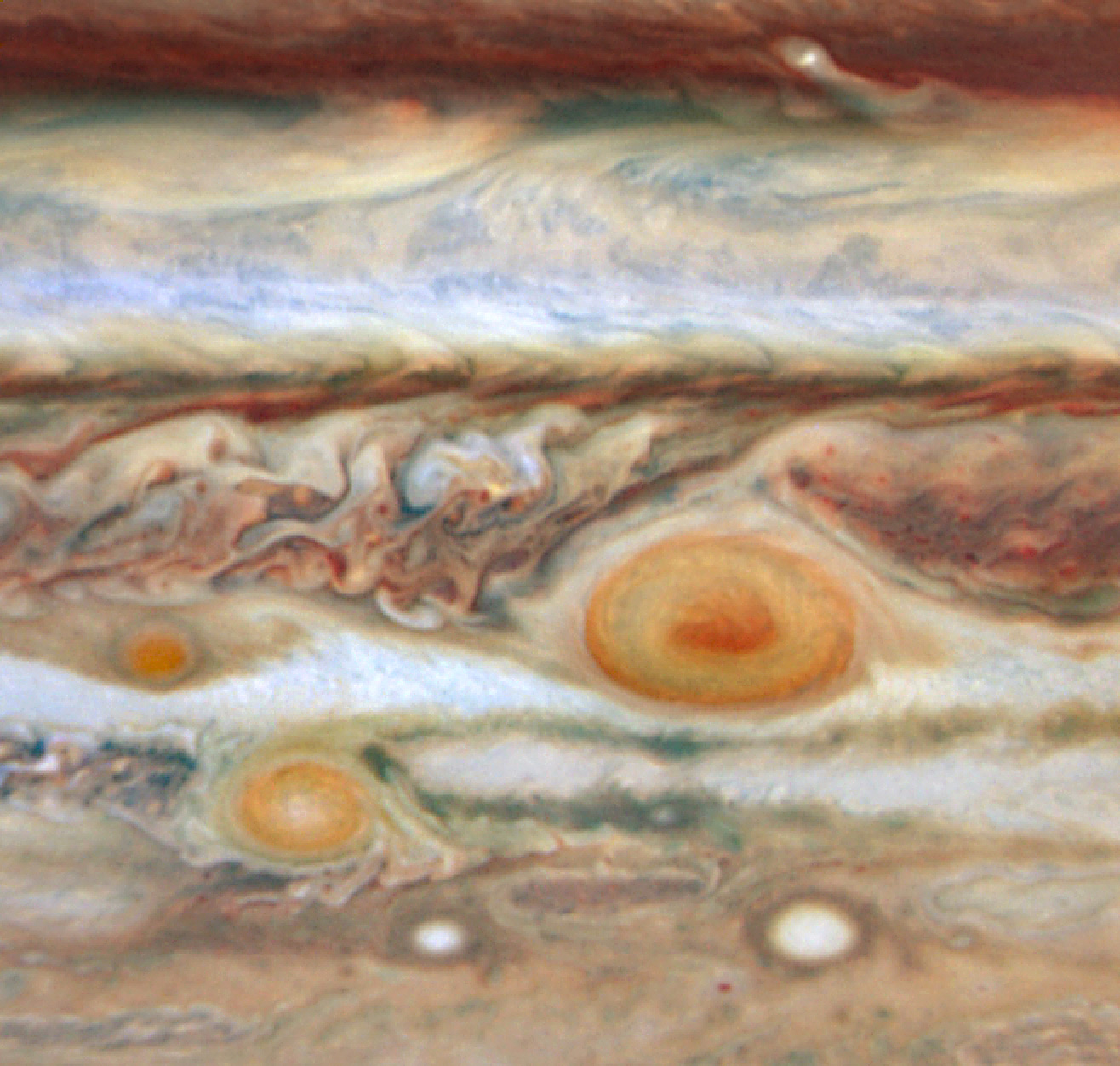
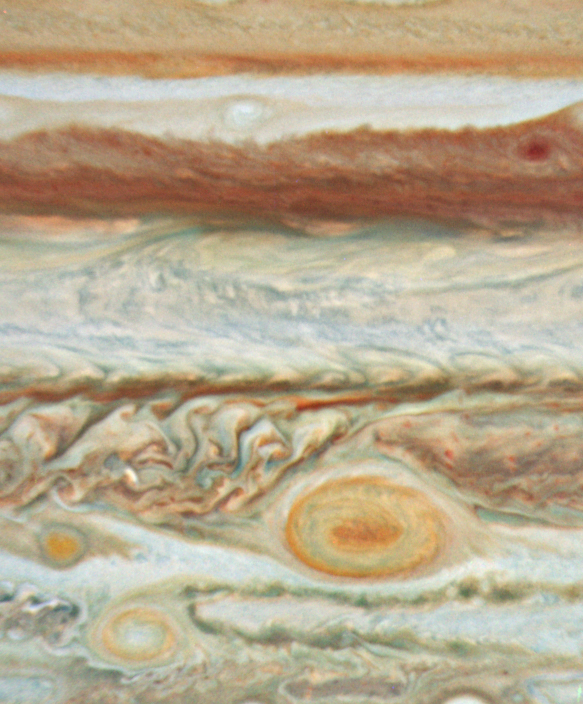
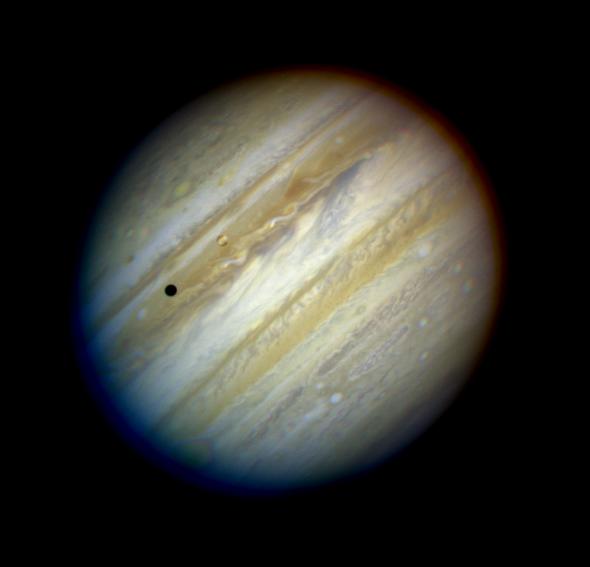
Hubble observed Jupiter's auroras using the Space Telescope Imaging Spectrograph (STIS) in the far-ultraviolet band, which is sensitive to emissions from molecular hydrogen excited by energetic particle impacts in Jupiter's upper atmosphere. Earth's atmosphere is opaque to far-ultraviolet light, making Hubble uniquely positioned for these observations. Multiple exposures were taken over several Jupiter rotation periods to map the full auroral morphology and track temporal variations. The ultraviolet images were later superimposed on visible-light images of Jupiter taken with the Wide Field Camera 3 to create composite views showing the auroras in their geographic context.
Location in the Universe
Constellation
N/A (Solar System)
Distance from Earth
500 million miles (at time of observation)
Fun Facts
- 1
Jupiter's auroras are hundreds of times more energetic than Earth's, covering an area larger than the entire surface of our planet, and they never fully turn off because Jupiter's magnetic field is so powerful.
- 2
Io contributes a continuous stream of charged particles to Jupiter's magnetosphere through its volcanic eruptions, creating a donut-shaped plasma torus around Jupiter that fuels the persistent auroral emissions.
- 3
Unlike Earth's auroras, which are primarily driven by the solar wind, Jupiter's auroras are largely powered internally by the planet's rapid rotation, which flings magnetospheric plasma outward and drives massive electrical currents along magnetic field lines.
Image credit: NASA, ESA, Hubble Space Telescope