About This Image
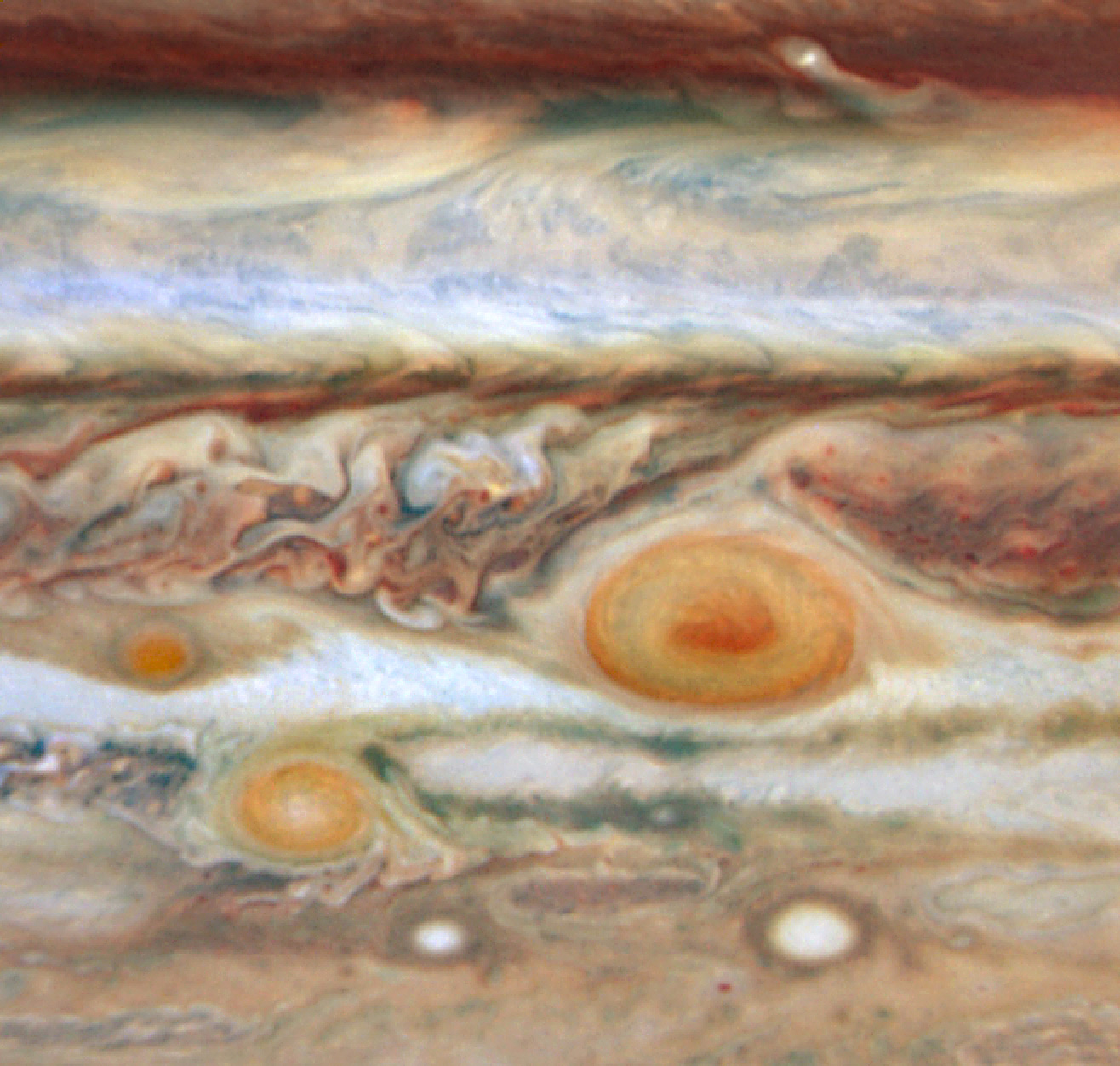
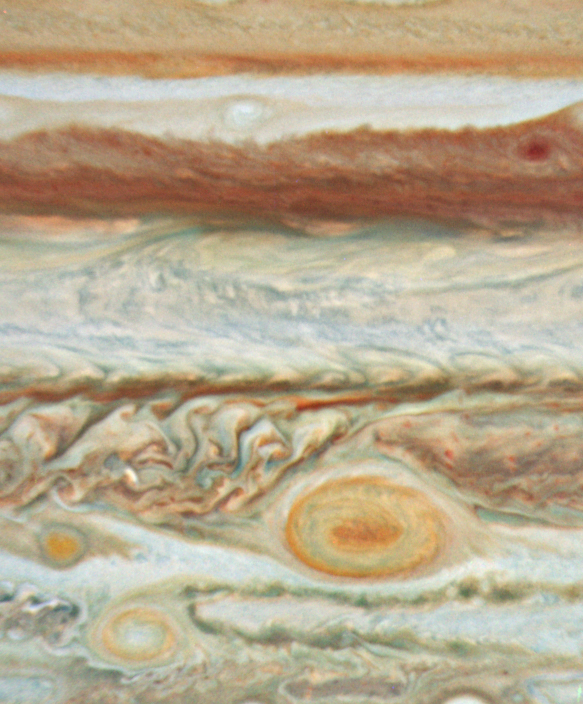
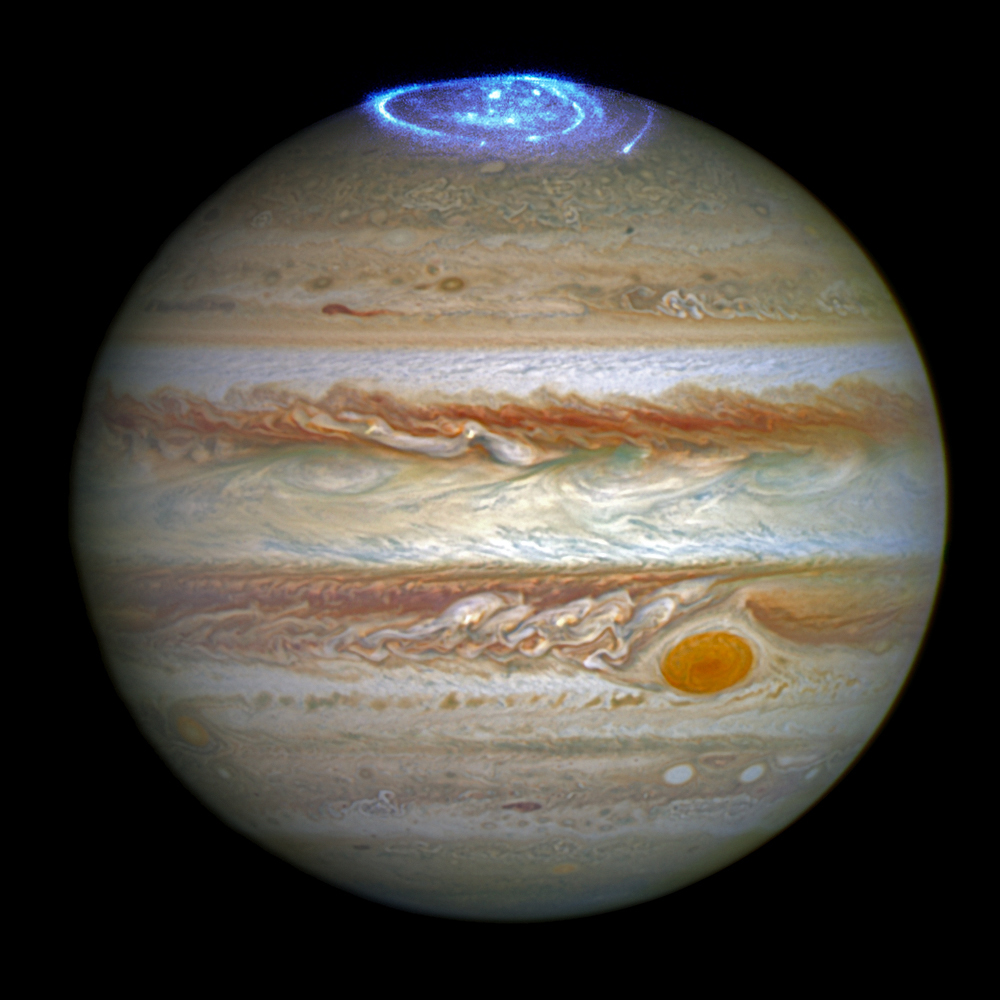
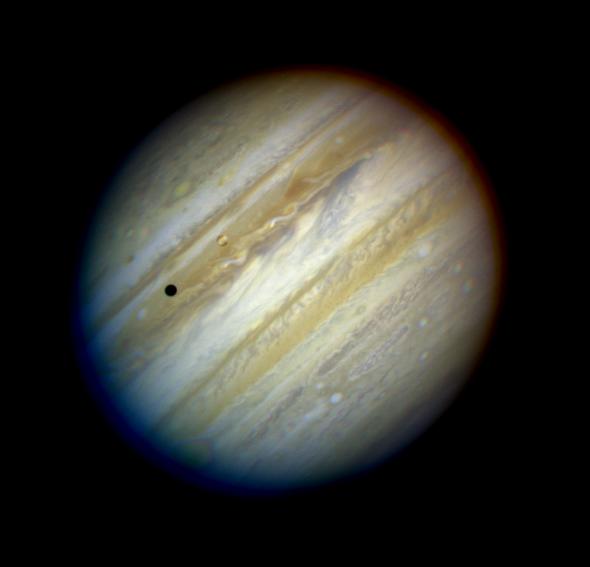
In 1994, Hubble captured a striking image of Jupiter that revealed the shadow of its volcanic moon Io transiting across the planet's banded cloud tops. The small, perfectly circular shadow cast by Io moved steadily across Jupiter's face, creating a natural eclipse visible from the giant planet's upper atmosphere. This observation showcased the dynamic nature of the Jovian system, where the four Galilean moons — Io, Europa, Ganymede, and Callisto — regularly pass in front of and behind the planet as seen from Earth. The image also highlighted Jupiter's intricate atmospheric structure, with delicate details visible in the alternating light zones and dark belts that girdle the planet, each driven by powerful jet streams and complex convective processes.
Scientific Significance
Hubble's 1994 observation of Io's shadow transit across Jupiter served multiple scientific purposes. Precise timing and positioning of satellite shadow events allows refinement of the orbital ephemerides of Jupiter's moons, which are essential for planning spacecraft flybys and studying the tidal dynamics of the Jovian system. The shadow itself acts as a natural probe of Jupiter's upper atmosphere: by analyzing how the shadow's edge appears at different wavelengths, scientists can infer the scattering properties and vertical structure of the cloud layers. This particular observation occurred in the same year that Comet Shoemaker-Levy 9 collided with Jupiter, making 1994 a landmark year for Jupiter science that provided an unprecedentedly detailed picture of the planet's atmosphere.
Observation Details
Hubble used the Wide Field Planetary Camera 2 (WFPC2) to capture Jupiter in multiple optical filters, resolving atmospheric features as small as a few hundred kilometers across from Earth's orbital distance. The observations required precise timing to catch Io's shadow at the desired position on Jupiter's disk. Short exposure times were used to freeze the planet's rotation, which shifts surface features noticeably in just minutes due to Jupiter's rapid 10-hour rotation period. The resulting color composite combined blue, green, and red filter images to produce a near-true-color representation of the planet's appearance.
Location in the Universe
Constellation
N/A (Solar System)
Distance from Earth
477 million miles (at time of observation)
Fun Facts
- 1
Io is the most volcanically active body in the solar system, with over 400 active volcanoes fueled by intense tidal heating as Jupiter's immense gravity flexes and deforms the moon's interior.
- 2
Shadow transits of Jupiter's moons were historically used to calculate the speed of light — Ole Romer first estimated it in 1676 by timing delays in Io's eclipses at different Earth-Jupiter distances.
- 3
Jupiter's atmospheric bands rotate at different speeds, with equatorial winds reaching over 400 miles per hour, creating the shearing forces that generate the planet's many vortices and storms.
Image credit: NASA, ESA, Hubble Space Telescope