About This Image
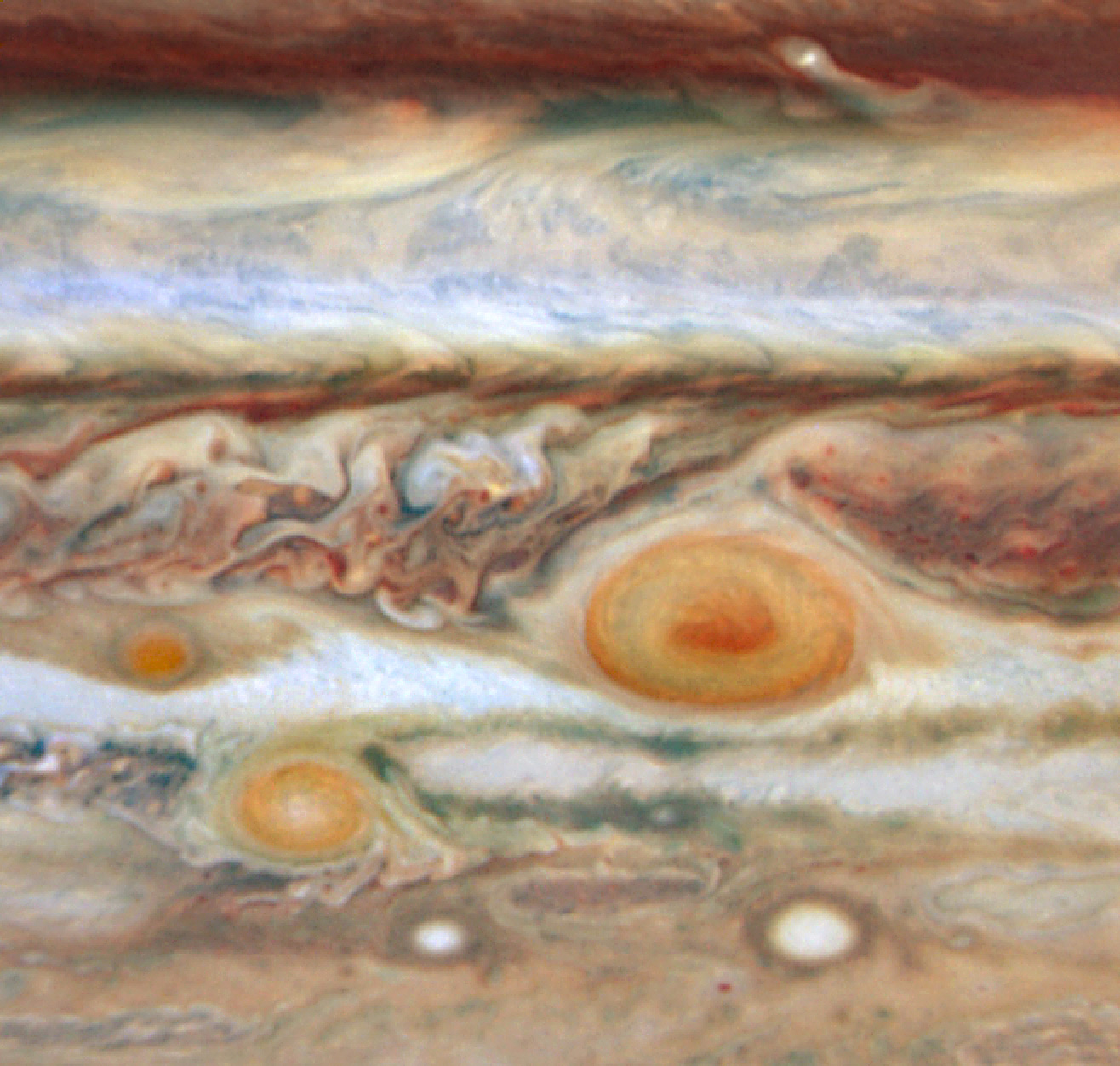
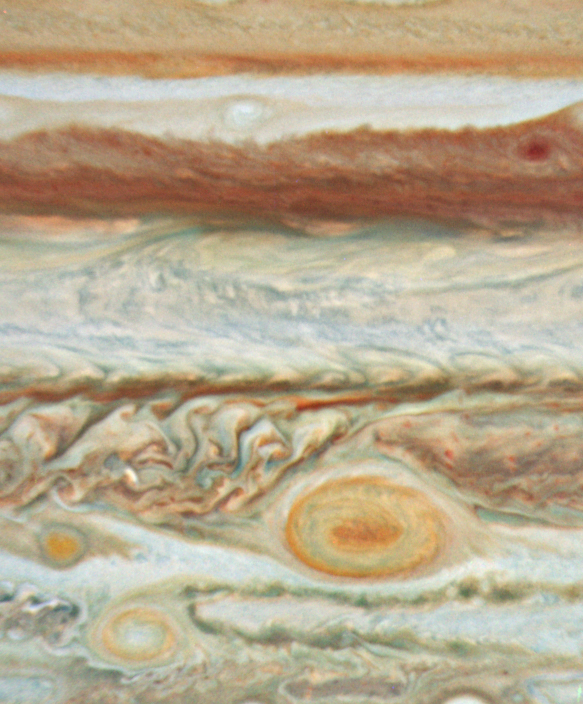
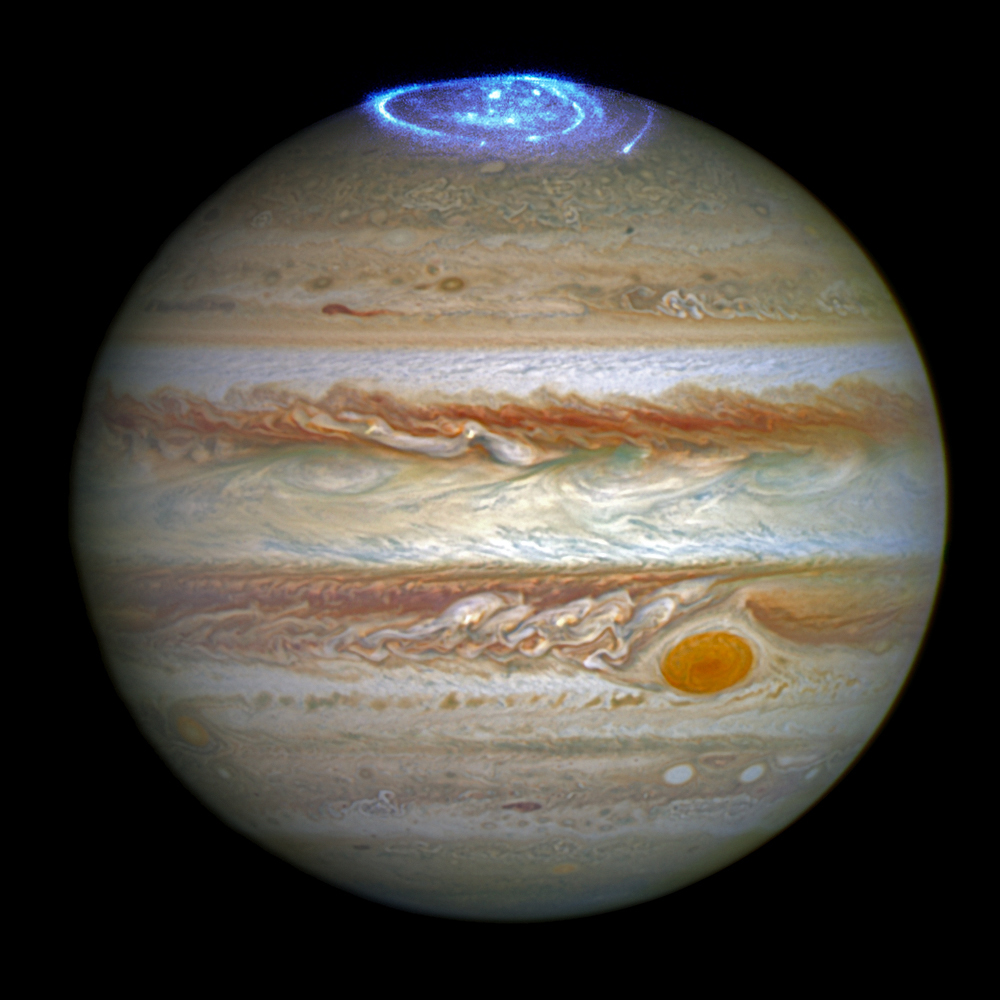
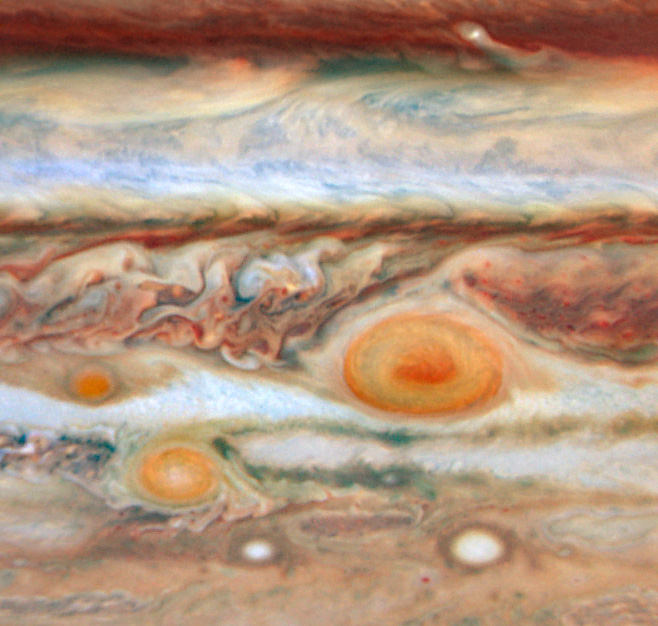
This Hubble image offers another perspective on the remarkable triple-red-spot event of 2008, when three anticyclonic storm systems simultaneously displayed Jupiter's characteristic ruddy coloration. The Great Red Spot, Jupiter's most iconic atmospheric feature and the largest known storm in the solar system with wind speeds exceeding 400 miles per hour, anchors the right side of the frame. Red Spot Jr. (Oval BA), born from the merger of three century-old white storms and unexpectedly reddened in 2005, sits to the lower left. The small baby red spot at left represents the newest member of this exclusive group, a compact vortex that had only recently acquired its red hue before being captured in this historic observation.
Scientific Significance
This additional observation of Jupiter's triple red spot configuration contributed critical time-series data to the understanding of how massive storm systems evolve and interact. By obtaining images at different rotational phases and over multiple days, astronomers could track the relative motions of the three vortices and measure changes in their size, shape, and color intensity. The data revealed that the baby red spot was being deflected from its original latitude as it approached the Great Red Spot's zone of influence, providing a real-time demonstration of vortex interaction dynamics. When the baby red spot was eventually shredded and absorbed by the Great Red Spot weeks later, the preceding Hubble observations established precise initial conditions for dynamical simulations. These results have been applied to models of storm dynamics on Saturn, Neptune, and giant exoplanets.
Observation Details
This image was obtained using Hubble's Wide Field and Planetary Camera 2 (WFPC2) in broadband visible-light filters, capturing Jupiter at a slightly different rotational phase than the companion May 9 observation. The multi-epoch observations allowed astronomers to measure the drift rates of each vortex independently and to detect subtle changes in their morphology. Methane-band filter observations were also obtained to probe the altitude structure of the storms, as methane absorption at 889 nanometers is sensitive to cloud-top altitude. These data confirmed that all three red spots extend to higher altitudes than the surrounding white clouds.
Location in the Universe
Constellation
N/A (Solar System)
Distance from Earth
365 million to 601 million miles (varies)
Fun Facts
- 1
Jupiter's atmosphere has no solid surface, so the Great Red Spot is essentially an endlessly swirling hurricane floating in an ocean of hydrogen and helium gas that extends thousands of miles deep until the pressure transforms the gas into liquid and eventually metallic hydrogen.
- 2
Wind speeds at the edges of the Great Red Spot reach approximately 430 miles per hour, nearly twice the speed of the strongest Category 5 hurricanes on Earth, yet the interior of the storm is remarkably calm.
- 3
Oval BA, the middle-sized red spot, formed through the sequential merger of three smaller white oval storms that had been tracked by astronomers since the 1930s — their gradual coalescence took about 10 years from start to finish.
Image credit: NASA, ESA, Hubble Space Telescope