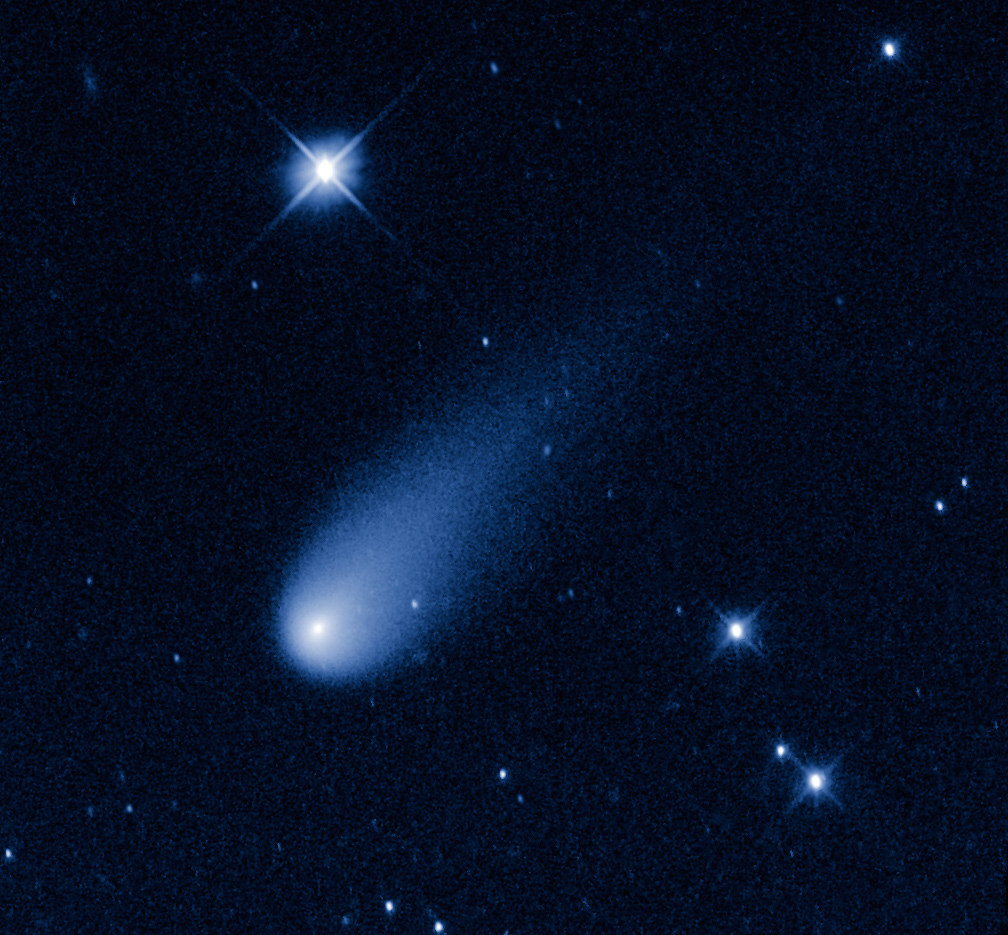
About This Image
At the time Hubble captured this remarkable image, Comet ISON (officially designated C/2012 S1) was hurtling toward the Sun at a breathtaking 48,000 miles per hour. The comet was 403 million miles from Earth, positioned between the orbits of Mars and Jupiter, yet already displaying a well-developed dusty coma and a nascent tail. Discovered in September 2012 by Russian astronomers Vitali Nevski and Artyom Novichonok using the International Scientific Optical Network, Comet ISON was widely heralded as a potential comet of the century due to its trajectory bringing it extraordinarily close to the Sun. Hubble's image revealed the comet's icy nucleus to be no larger than three to four miles across, surrounded by a cloud of gas and dust extending approximately 3,100 miles from the nucleus.
Scientific Significance
Comet ISON represented a rare opportunity to study a dynamically new comet — one making its very first passage through the inner solar system from the Oort Cloud. Such pristine comets preserve primordial material from the solar nebula that formed 4.6 billion years ago, essentially offering a frozen sample of the chemical conditions that gave rise to our solar system. Because ISON had never been heated by the Sun before, its surface ices and dust grains were expected to be unaltered by previous perihelion passages, making its outgassing behavior a direct probe of primordial composition. The comet's eventual destruction during its close solar approach provided valuable scientific data about the structural integrity of cometary nuclei under extreme thermal and tidal stress. Multi-wavelength observations tracked ISON's activity from discovery through disintegration, creating one of the most comprehensive datasets ever assembled for a sungrazing comet.
Observation Details
This image was captured using Hubble's Wide Field Camera 3 (WFC3) in visible-light filters on April 10, 2013, when the comet was approximately 386 million miles from the Sun. Hubble's resolution allowed astronomers to measure the extent of the coma and constrain the nuclear size to less than four miles in diameter. The blue-green color of the coma arises from the fluorescence of diatomic carbon (C2) and cyanogen (CN) molecules released by sublimating ices. Hubble also measured the dust production rate by analyzing the coma's surface brightness profile, revealing that ISON was already actively shedding material well before reaching the asteroid belt.
Location in the Universe
Constellation
N/A (Solar System)
Distance from Earth
403 million miles from Earth (at time of image)
Fun Facts
- 1
Comet ISON was a sungrazing comet that passed within 730,000 miles of the Sun's surface on November 28, 2013, but the intense solar heat and tidal forces completely disintegrated it, leaving only a fading trail of dust behind.
- 2
ISON originated in the Oort Cloud, a vast spherical shell of icy bodies extending roughly two light-years from the Sun, and had been traveling toward the inner solar system for millions of years before its discovery in 2012.
- 3
Hubble's observations revealed that Comet ISON was shedding approximately 112,000 pounds of dust per minute even while still hundreds of millions of miles from the Sun, indicating a highly volatile surface rich in carbon dioxide ice.
Image credit: NASA, ESA, Hubble Space Telescope