About This Image
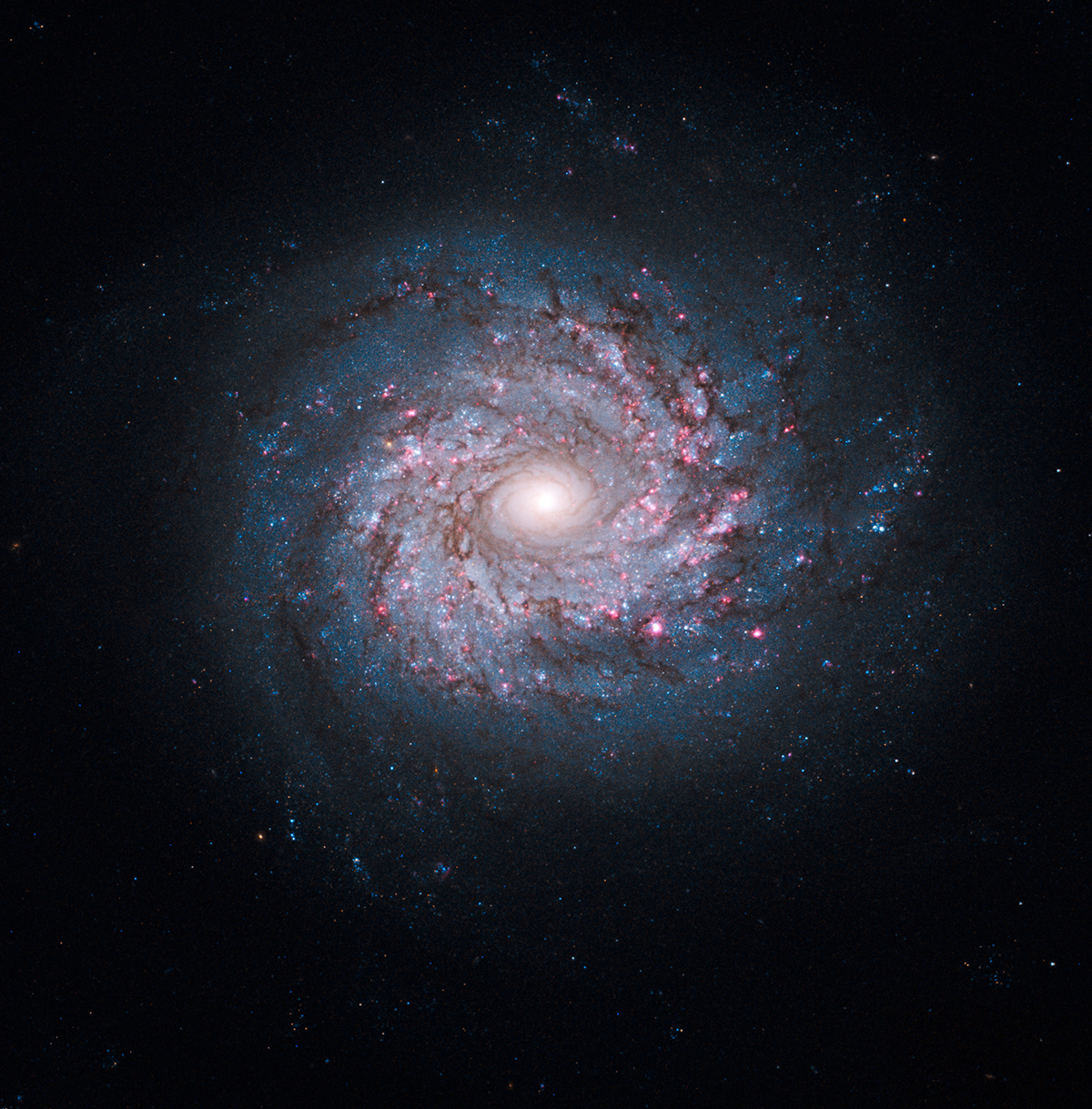
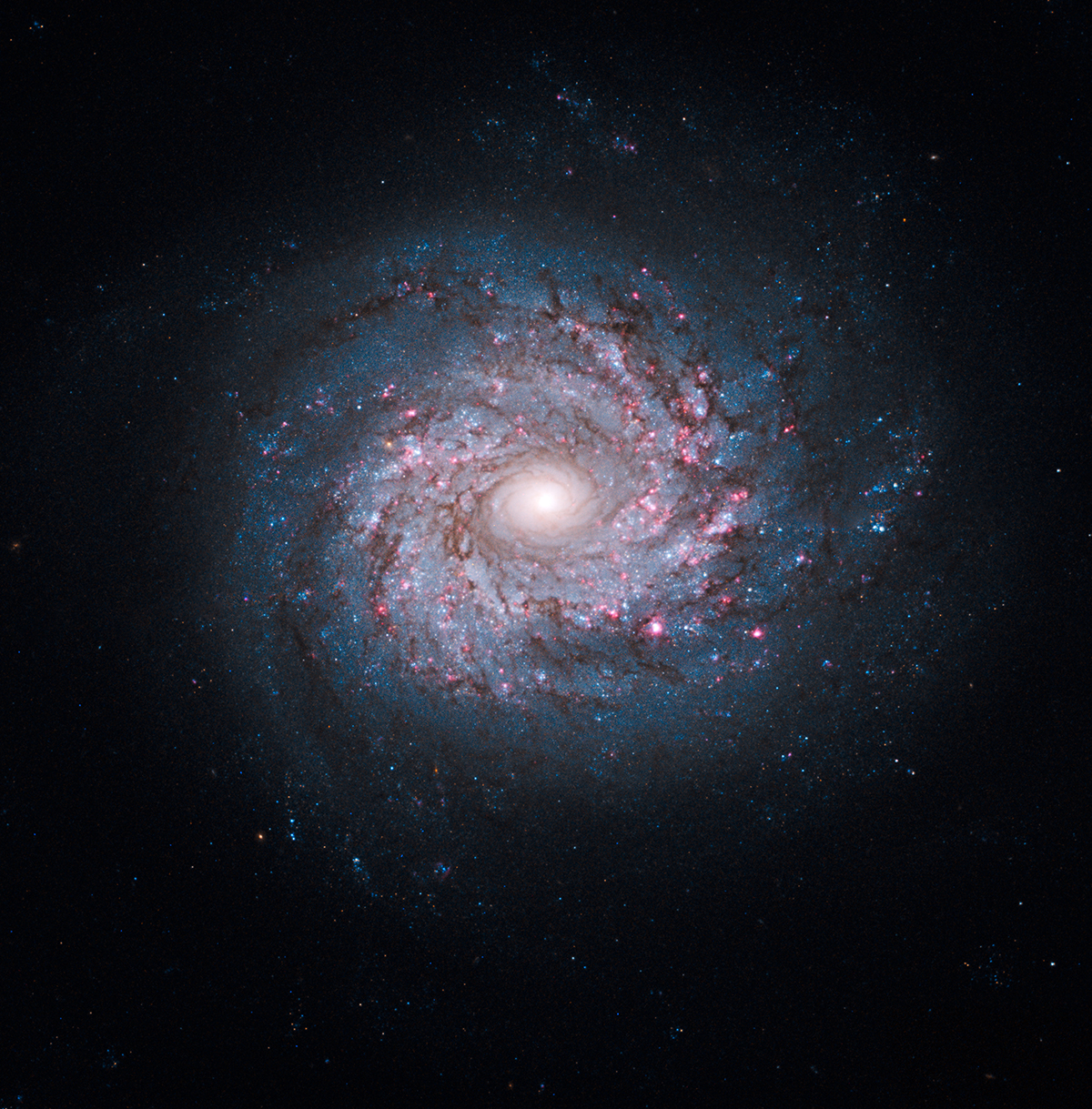
NGC 3982 is a striking face-on spiral galaxy whose compact disk showcases the full palette of galactic star formation activity. Hubble's sharp vision resolves the galaxy's tightly wound spiral arms into a tapestry of pink hydrogen-emission regions where massive stars are being born, brilliant blue clusters of recently formed hot stars, and sinuous dark lanes of dust and molecular gas winding toward the bright central bulge. As a Seyfert 2 galaxy, NGC 3982 harbors an active nucleus powered by accretion onto a supermassive black hole, though this activity is largely hidden behind an obscuring ring of dust when viewed from our perspective. Located in the M109 galaxy group, this relatively nearby spiral offers astronomers a detailed look at the interplay between nuclear activity, spiral structure, and the ongoing cycle of stellar birth and death.
Scientific Significance
NGC 3982 serves as an important nearby example of a Seyfert galaxy, allowing astronomers to study the connection between central black hole activity and the broader galactic environment in exquisite detail. The galaxy's face-on orientation is particularly advantageous because it eliminates the projection effects that complicate the study of inclined galaxies, allowing a clear mapping of spiral arm structure, star formation rate distribution, and dust geometry across the entire disk. The Type Ia supernova SN 1998aq provided a critical rung on the cosmic distance ladder: by comparing the supernova's known intrinsic luminosity with its observed brightness, astronomers obtained a precise distance to NGC 3982. Its membership in the M109 group also makes it valuable for studying environmental influences on galaxy evolution in group environments.
Observation Details
This image was captured using Hubble's Wide Field and Planetary Camera 2 (WFPC2) in a combination of ultraviolet, visible, and infrared filters. Ultraviolet filters trace the hottest, youngest stars concentrated in the spiral arms, while visible-light filters reveal the intermediate-age stellar population and the warm ionized gas in HII regions. Near-infrared observations penetrate the dust lanes to map the underlying distribution of older stars that dominate the galaxy's mass. The composite reveals the full complexity of NGC 3982's ecosystem, from ancient bulge stars to newly ignited stellar nurseries.
Location in the Universe
Constellation
Ursa Major
Distance from Earth
68 million light-years
Fun Facts
- 1
NGC 3982 belongs to the M109 group of galaxies in Ursa Major, which contains over 50 member galaxies gravitationally associated with each other, making it one of the larger galaxy groups in the nearby universe.
- 2
The supernova SN 1998aq discovered in NGC 3982 was a Type Ia event whose light curve was so well-measured that it became a calibration standard for cosmological distance measurements used to determine the expansion rate of the universe.
- 3
Despite its modest size of only 30,000 light-years across, NGC 3982 contains spiral arms as clearly defined and richly detailed as those found in galaxies several times its size, making it a photogenic favorite among astronomers.
Image credit: NASA, ESA, Hubble Space Telescope