About This Image
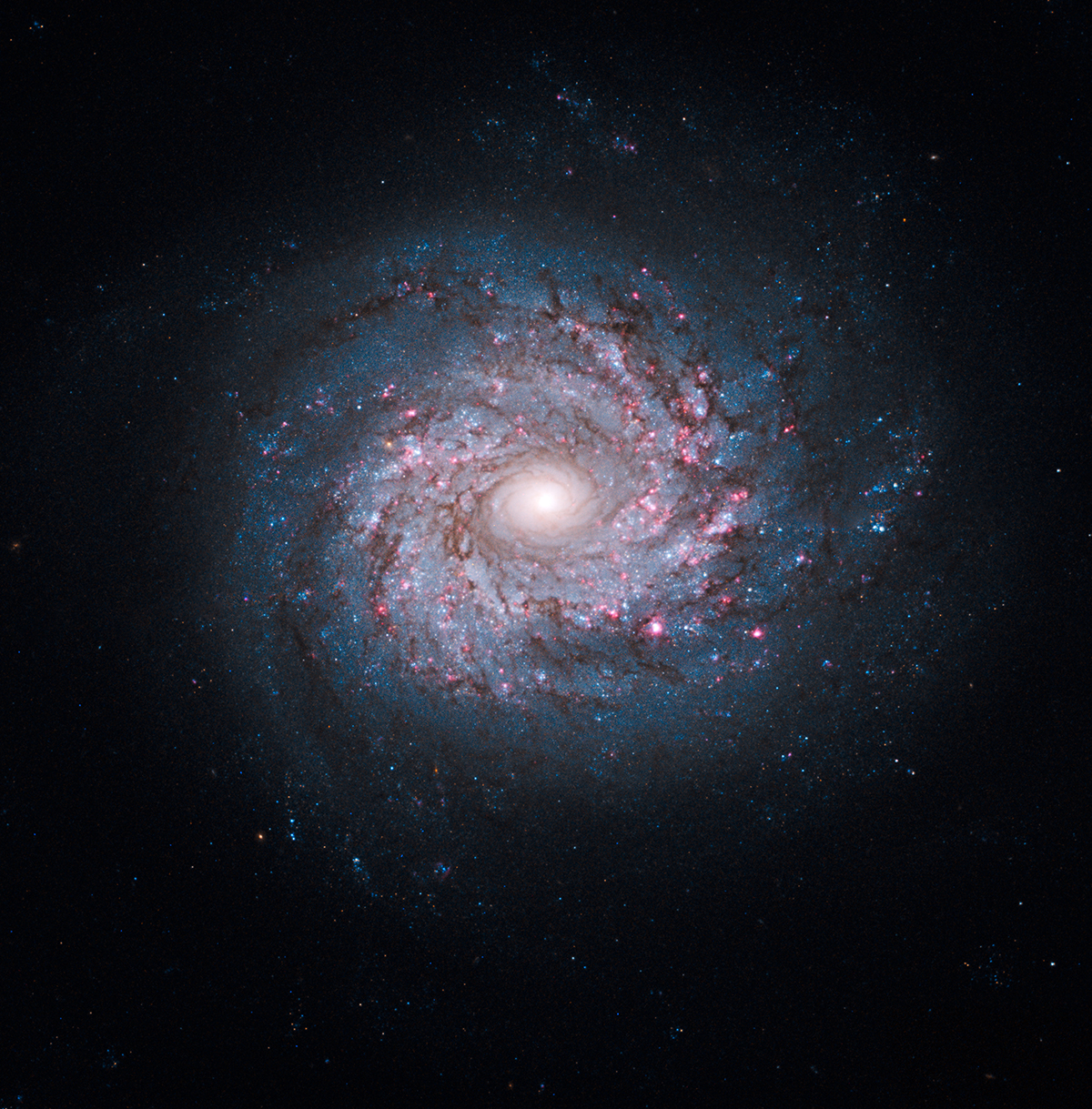
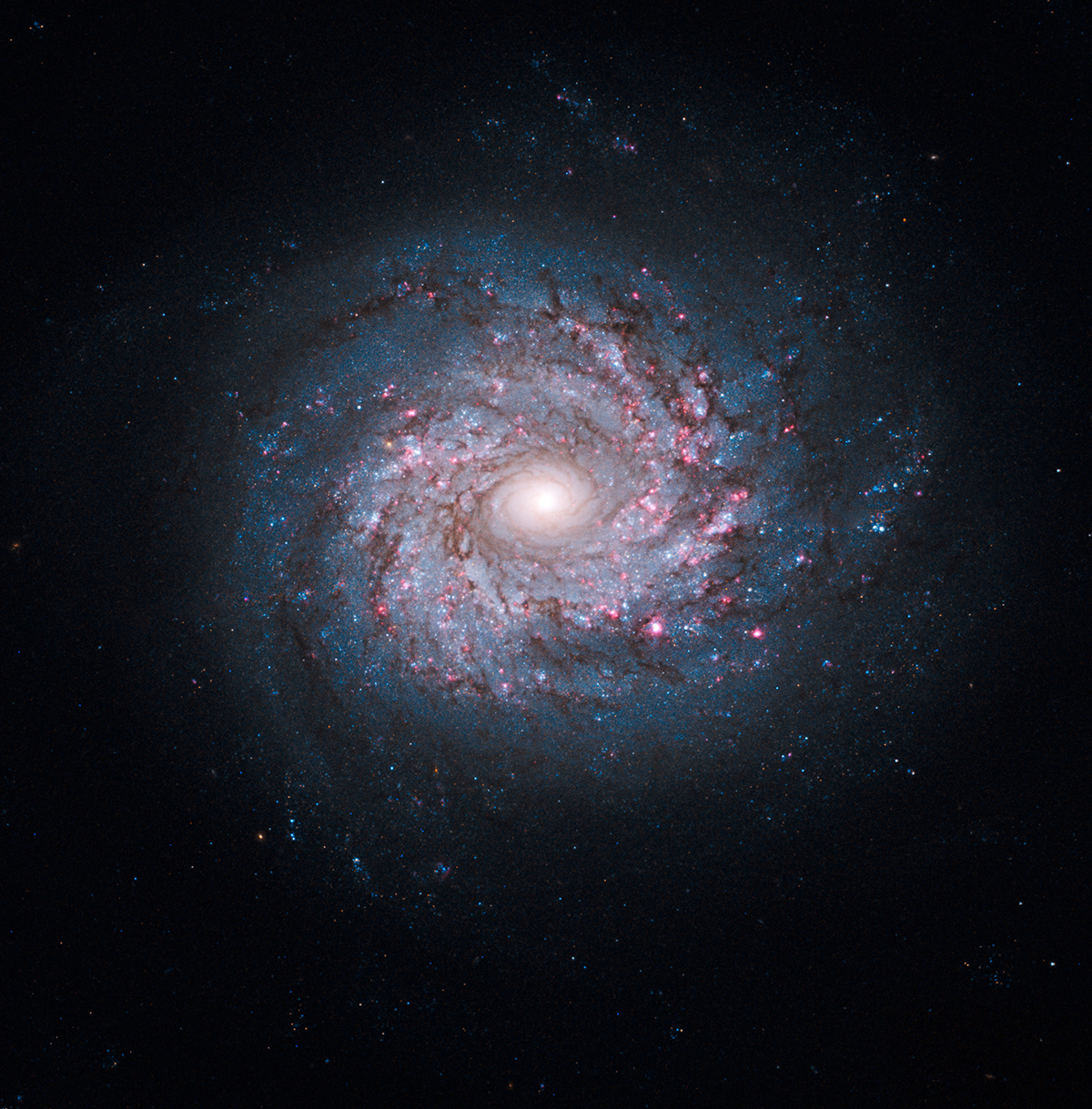
This image captures the face-on spiral galaxy NGC 3982, a compact but stunning example of a grand-design spiral located in the constellation Ursa Major. Its tightly wound arms are lined with pink star-forming regions of glowing hydrogen, brilliant blue clusters of newborn stars, and sinuous dark dust lanes that provide the raw material for future generations of stars. NGC 3982 is classified as a Seyfert 2 galaxy, meaning its nucleus harbors an actively accreting supermassive black hole hidden behind a torus of obscuring dust. The galaxy spans roughly 30,000 light-years in diameter and belongs to the M109 group, a collection of over 50 galaxies bound together by gravity in this region of the northern sky.
Scientific Significance
NGC 3982 is a scientifically valuable nearby spiral galaxy that offers insights into multiple areas of astrophysics. Its face-on orientation provides an unobstructed view of the spiral arm structure, enabling detailed mapping of star formation across the entire disk without the projection effects that complicate studies of inclined galaxies. The Type Ia supernova SN 1998aq that erupted in NGC 3982 was particularly important for cosmology, as it provided a critical calibration point on the cosmic distance ladder — the chain of distance measurements that ultimately reveals the expansion rate of the universe. NGC 3982's Seyfert 2 classification connects it to the study of active galactic nuclei, where the geometry of the obscuring torus determines whether the central engine appears as a bright Type 1 or hidden Type 2 nucleus. Its membership in the M109 group also makes it relevant for studying environmental influences on galaxy evolution.
Observation Details
This image was captured using Hubble's Wide Field and Planetary Camera 2 (WFPC2) in a combination of ultraviolet, visible, and infrared filters designed to highlight different components of the galaxy's stellar population and interstellar medium. Ultraviolet filters trace the hottest, youngest stars concentrated in the spiral arms, while visible-light filters reveal the warm ionized gas in HII regions. Near-infrared observations penetrate the dust lanes to map the underlying distribution of older stars that dominate the galaxy's mass. The composite reveals the full complexity of NGC 3982's ecosystem of stellar birth and death.
Location in the Universe
Constellation
Ursa Major
Distance from Earth
68 million light-years
Fun Facts
- 1
NGC 3982 hosted the Type Ia supernova SN 1998aq, whose exceptionally well-measured light curve became a calibration standard for cosmological distance measurements used to study the expansion rate of the universe.
- 2
Despite being only about one-third the diameter of the Milky Way, NGC 3982 displays spiral arms as clearly defined and richly detailed as those in galaxies several times its size, making it a favorite target for both amateur and professional astronomers.
- 3
As a Seyfert 2 galaxy, NGC 3982's central black hole is actively consuming surrounding material, but the emission is hidden from direct view by a thick ring of dust — we see evidence of this activity only through spectral signatures in infrared and X-ray wavelengths.
Image credit: NASA, ESA, Hubble Space Telescope