About This Image
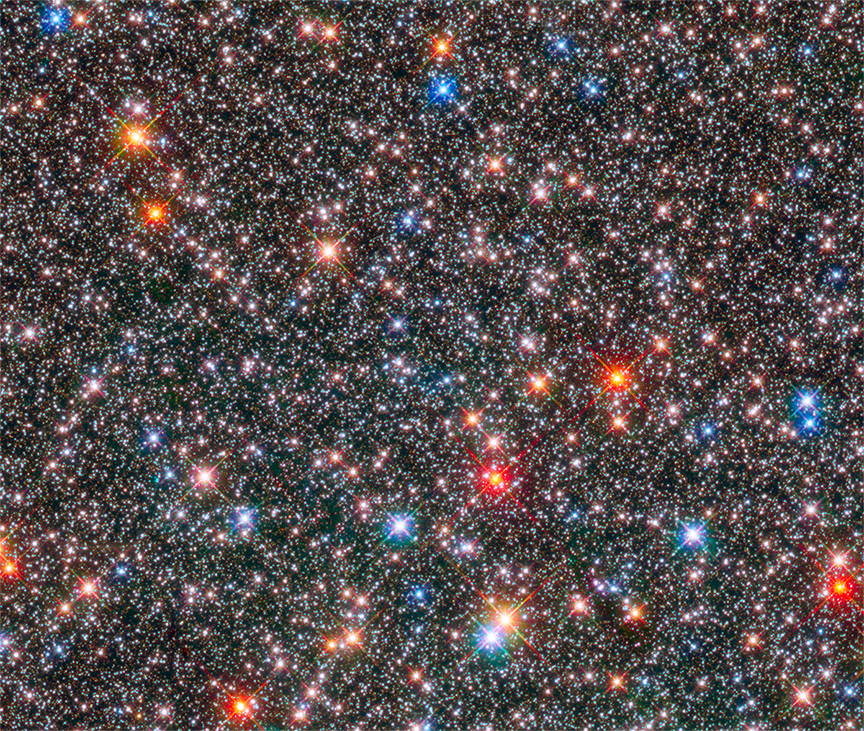
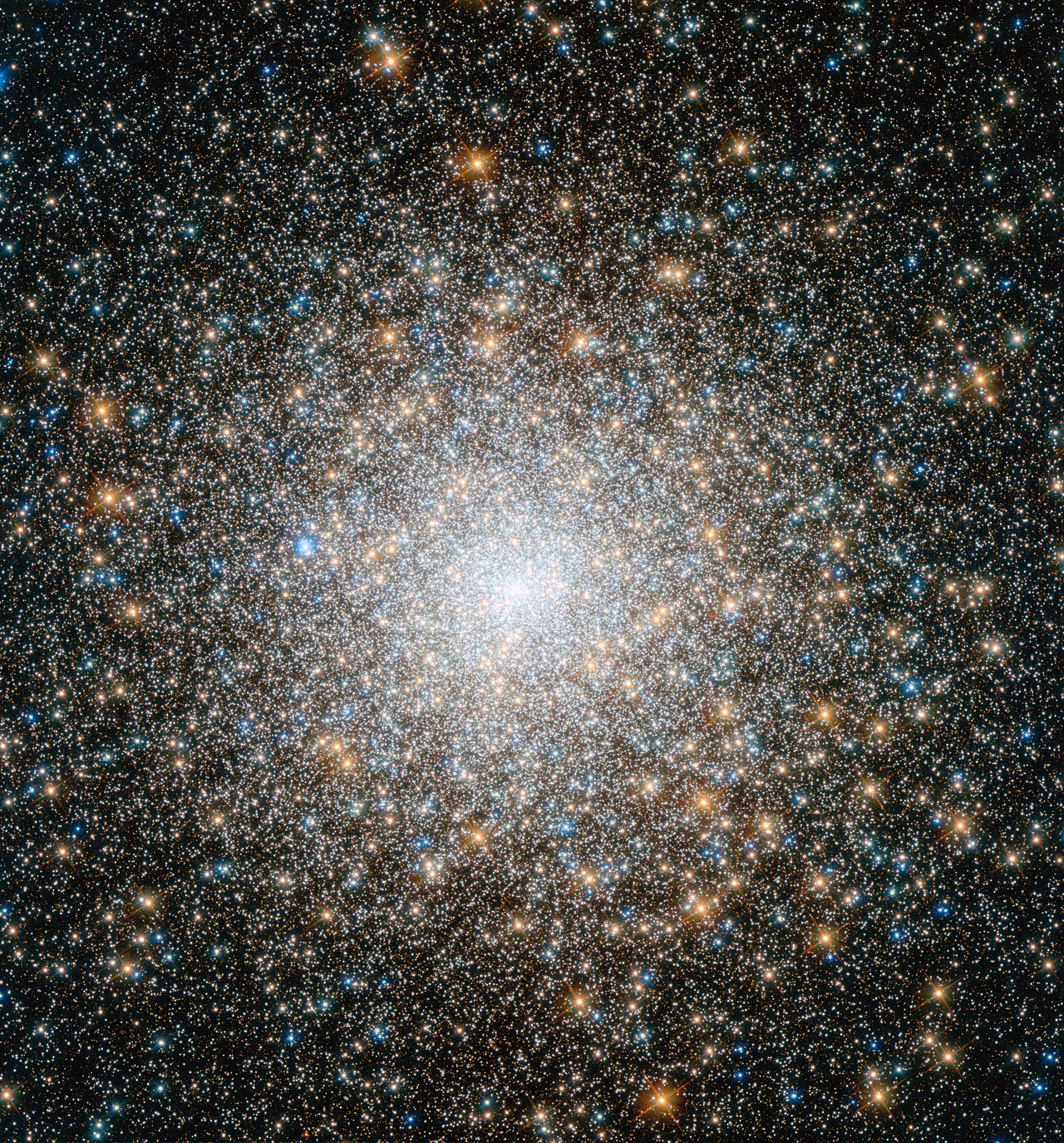
This dense cluster of stars is known as Messier 15 (M15), one of the oldest and most densely packed globular clusters in our galaxy, located about 35,000 light-years away in the constellation Pegasus. Containing roughly 100,000 stars gravitationally bound together in a sphere only about 175 light-years across, M15 has undergone a process called core collapse, in which gravitational interactions have caused its central stars to concentrate into an extraordinarily dense core. The fuzzy blue area to the left of the cluster's core is a planetary nebula called Pease 1, a cloud of gas cast off by a dying medium-sized star — one of only four planetary nebulae known to exist within globular clusters. M15 is estimated to be approximately 12 billion years old, making it nearly as old as the universe itself.
Scientific Significance
M15 holds special importance in astrophysics as one of the most extreme examples of a core-collapsed globular cluster. Core collapse occurs when a cluster's densest central region contracts under its own gravity over billions of years, eventually reaching stellar densities millions of times higher than the solar neighborhood. This process is driven by gravitational encounters that gradually transfer energy from inner to outer stars, causing the core to shrink while the outer regions expand. The possibility that M15 harbors an intermediate-mass black hole has been extensively debated; such objects would fill a crucial gap in the mass spectrum of black holes and could explain the extreme stellar velocities measured near the cluster's center. M15's ancient age of approximately 12 billion years makes its stars among the oldest in the Milky Way, providing constraints on the age of the universe and the chemical conditions of the early galaxy.
Observation Details
This image was captured using Hubble's Advanced Camera for Surveys (ACS) in visible-light wavelengths. Hubble's exceptional angular resolution was essential for resolving individual stars in M15's extremely dense core, where ground-based telescopes see only a uniform blur of overlapping stellar images. The observations combined short exposures to capture the bright giant stars without saturation with longer exposures to detect fainter main-sequence stars deep into the cluster. Multiple filters provided color information used to construct color-magnitude diagrams that reveal the cluster's stellar populations and evolutionary state.
Location in the Universe
Constellation
Pegasus
Distance from Earth
35,000 light-years
Fun Facts
- 1
M15 is one of the densest globular clusters known, with stars in its core packed so tightly that they are separated by only a fraction of a light-year — roughly 100 times closer together than stars in the Sun's neighborhood.
- 2
The planetary nebula Pease 1, visible as a blue smudge near M15's core, is one of only four planetary nebulae ever found inside a globular cluster, making it an exceptionally rare object in an already remarkable environment.
- 3
M15 may harbor an intermediate-mass black hole at its center, with a mass of roughly 4,000 solar masses — a mysterious class of black holes that bridges the gap between stellar-mass and supermassive black holes.
Image credit: NASA, ESA, Hubble Space Telescope