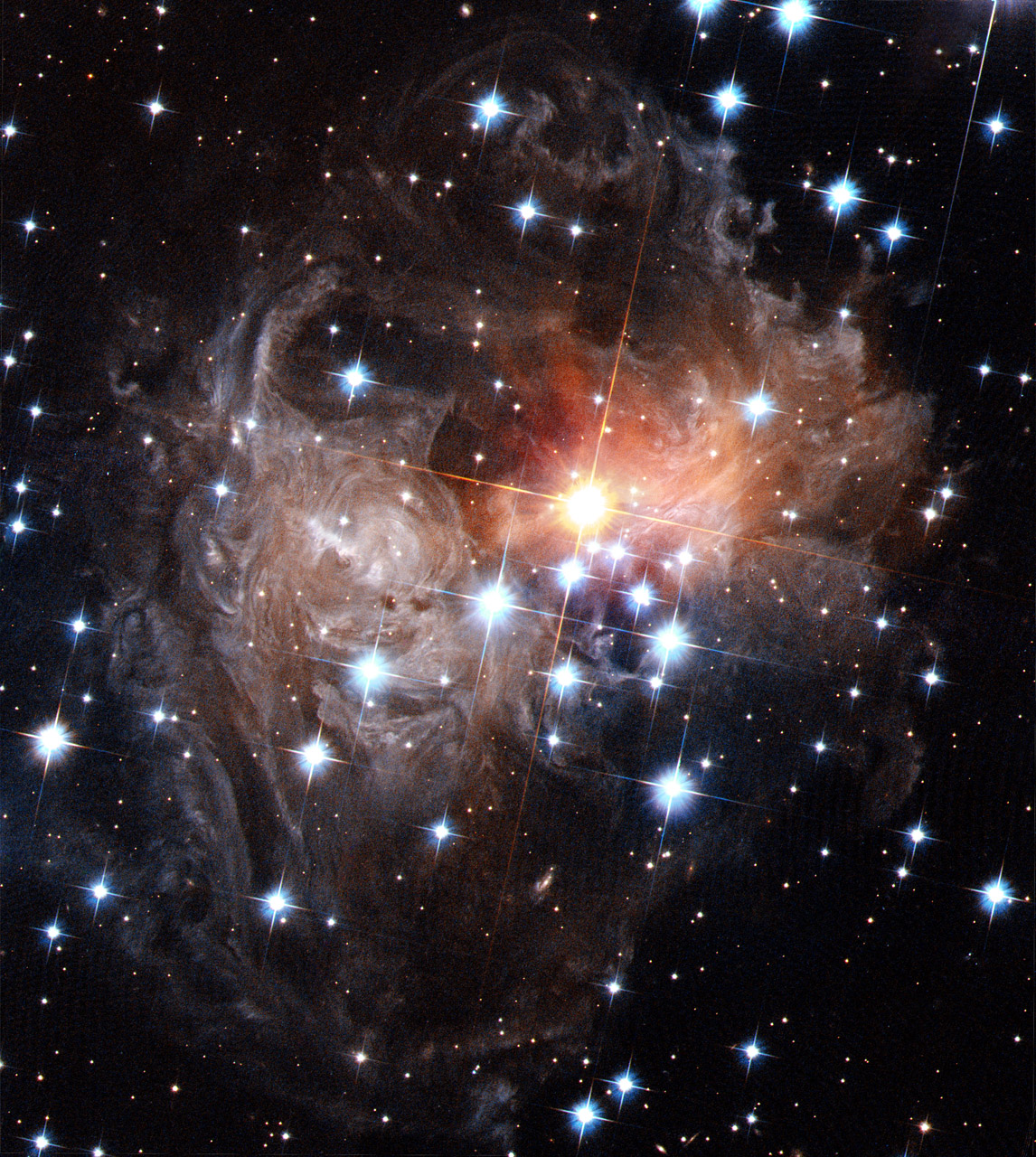
V838 Monocerotis Light Echo
Observed in 2006
About This Image
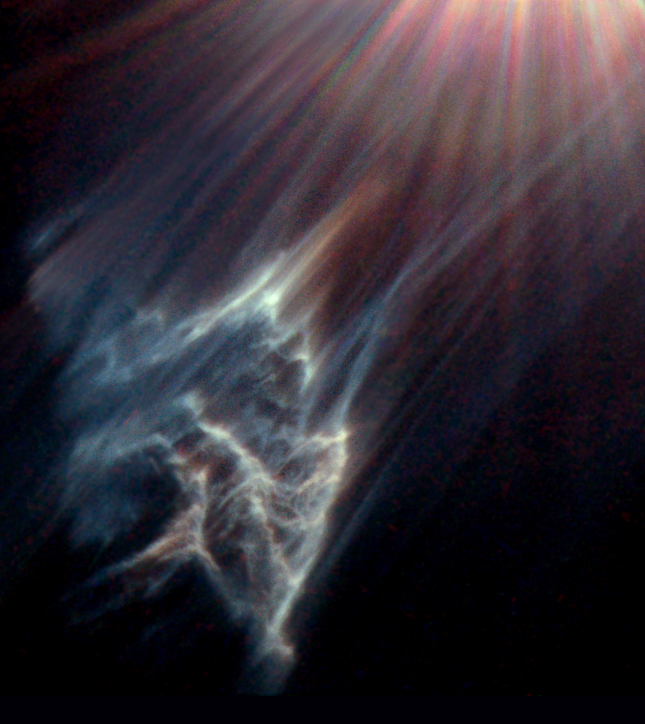
This image captures a light echo from the star V838 Monocerotis. After the star brightened temporarily, light from that eruption began propagating outward through a dusty cloud around the star. The light reflects or "echoes" off the dust and then travels to Earth.
Scientific Significance
The V838 Monocerotis light echo is a classic demonstration of time-domain astrophysics combined with high-resolution imaging. By monitoring the evolving illuminated dust structures, astronomers reconstruct the three-dimensional distribution of circumstellar and interstellar material around the star. The event also constrained models of unusual stellar eruptions that do not fit standard nova behavior. Light-echo geometry provides an independent way to estimate distances and dust properties, making this target valuable for both stellar-evolution studies and dust-scattering physics in the Milky Way.
Observation Details
Hubble repeatedly imaged V838 Monocerotis over multiple epochs after the eruption, producing a time series of changing dust illumination. Broad optical filters captured scattered light with fine spatial detail, revealing arcs, knots, and layered shells. Careful alignment and subtraction between epochs quantified expansion of the echo pattern and brightness evolution. The data required stable photometric calibration because the source morphology changed significantly with time. Hubble's angular resolution was essential for separating fine dust structures that would blend together in lower-resolution observations.
Location in the Universe
Constellation
Monoceros
Distance from Earth
About 20,000 light-years
Fun Facts
- 1
The expanding rings are not material moving at superluminal speed; they are illumination fronts moving through pre-existing dust.
- 2
V838 Monocerotis briefly became one of the brightest stars in the Milky Way during its 2002 outburst.
- 3
Light echoes let astronomers map three-dimensional dust geometry around stars by tracking the changing patterns over time.
Image credit: NASA, ESA, Hubble Space Telescope