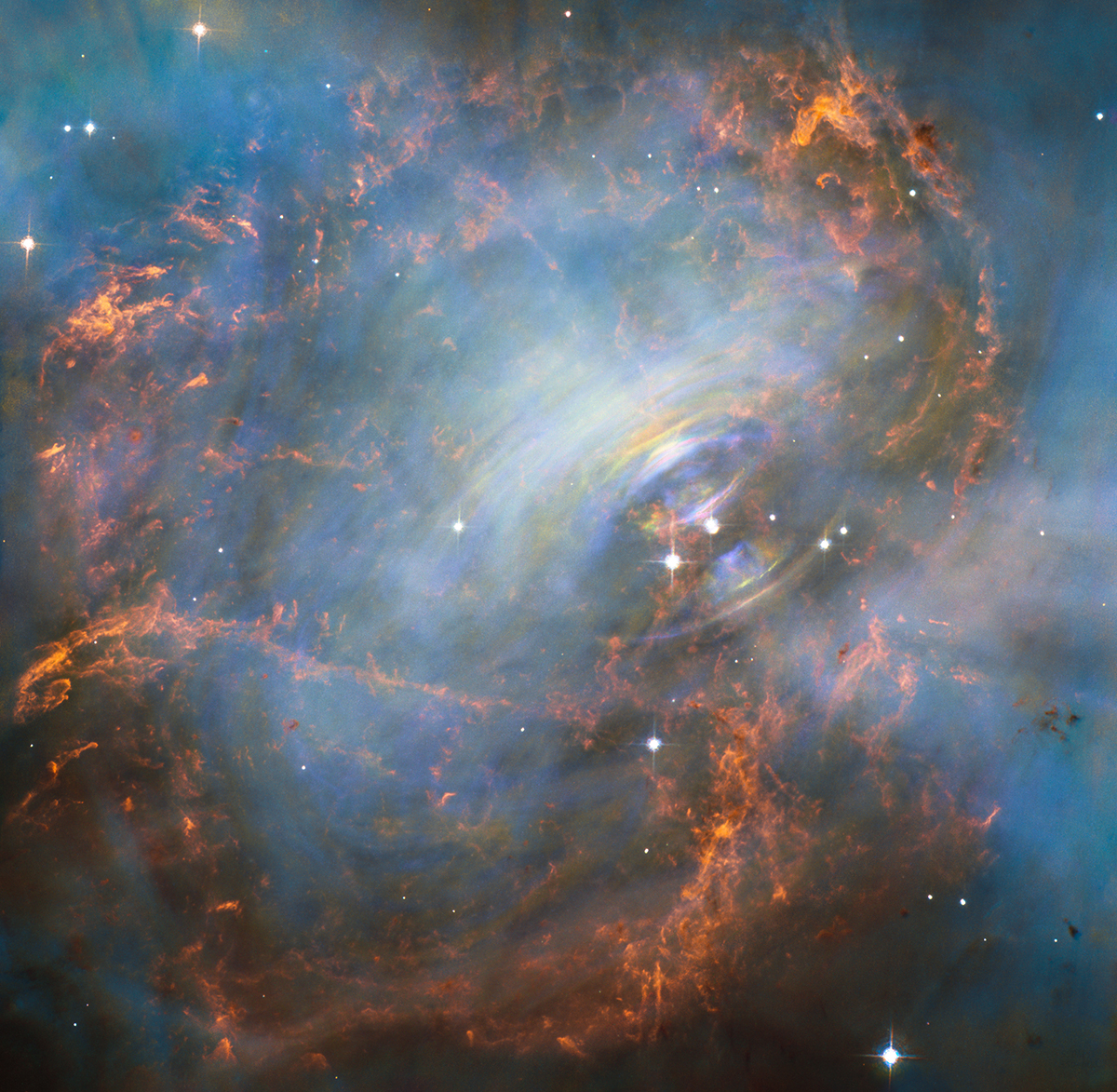
About This Image
At the center of the Crab Nebula sits a stellar remnant called a neutron star that has about the same mass as the Sun compressed into a sphere only a few miles across. Spinning 30 times a second, the neutron star shoots out beams of energy that make it look like it's pulsating.
Scientific Significance
The Crab Nebula is the single most important object for understanding pulsar physics and the interaction between pulsars and their environments. The central pulsar provides a natural clock of extraordinary precision, allowing astronomers to study relativistic phenomena and the properties of matter at nuclear densities. Time-resolved Hubble observations have captured the pulsar's optical pulsations and revealed the intricate structure of the pulsar wind nebula — the region where the pulsar's relativistic wind shocks against the expanding supernova debris. The Crab serves as a calibration source across the electromagnetic spectrum, from radio waves to gamma rays, enabling astronomers to cross-check observations from different telescopes. The nebula's expansion has been tracked over decades, allowing direct measurement of its age and the energy output of the central pulsar.
Observation Details
Hubble observed the Crab Nebula's core using the Advanced Camera for Surveys (ACS) and Wide Field Planetary Camera 2 (WFPC2) in multiple filters spanning optical wavelengths. The observations required precise timing to phase with the pulsar's rotation period, enabling creation of images at specific rotational phases. The blue synchrotron emission dominating the core was captured in continuum filters, while narrowband filters isolated line emission from the expanding filaments of supernova debris at larger radii. Time-series observations spanning years revealed the rapid changes in the inner nebula structure, where wisps and jets appear and disappear over timescales of weeks to months as the pulsar wind interacts with the magnetic field.
Location in the Universe
Constellation
Taurus
Distance from Earth
6,500 light-years
Fun Facts
- 1
The neutron star at the Crab's center is so dense that a teaspoon of its material would weigh about 6 billion tons — more than all the cars on Earth combined.
- 2
The Crab Pulsar was the first pulsar to be identified with a supernova remnant, confirming the theoretical prediction that neutron stars are born in supernova explosions.
- 3
Ancient Chinese astronomers recorded the supernova that created the Crab as a 'guest star' visible in daylight for 23 days — it was bright enough to cast shadows at night.
Image credit: NASA, ESA, Hubble Space Telescope