About This Image
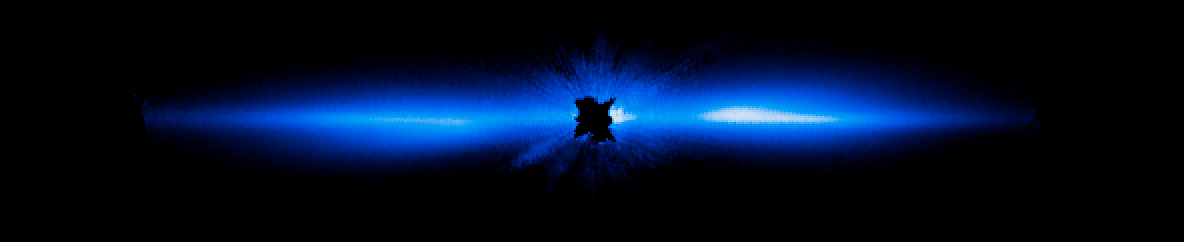
In 1984, Beta Pictoris was the very first star discovered to be surrounded by a bright disk of light-scattering dust and debris. Planets are thought to form in such disks, and astronomers have discovered two planets orbiting Beta Pictoris.
Scientific Significance
Beta Pictoris occupies a singular position in the history of exoplanet science as the prototypical debris disk system. Its discovery in 1984 provided the first direct evidence that circumstellar material — the raw ingredient for planet formation — exists around other stars, fundamentally changing our understanding of how common planetary systems might be in the galaxy. Hubble's observations over nearly three decades have tracked the morphological evolution of the disk, revealing a warp in the disk plane that was correctly predicted to be caused by the gravitational influence of an inclined planet before Beta Pictoris b was directly imaged. The disk also shows asymmetries and brightness variations attributed to recent collisions between large planetesimals, providing observational evidence for the violent accretion processes that built the rocky planets in our own solar system. The detection of transient spectroscopic features from infalling cometary bodies has established Beta Pictoris as an analog to the Late Heavy Bombardment period in our solar system's history, connecting exoplanetary science to our own cosmic origins.
Observation Details
Hubble observed the Beta Pictoris disk using the Space Telescope Imaging Spectrograph (STIS) with its coronagraphic mode, which uses an opaque mask to block the overwhelming light of the central star and reveal the much fainter surrounding disk. This technique is essential because the star is millions of times brighter than the scattered light from the dust disk. The observations were conducted in visible light at multiple epochs spanning over a decade, enabling astronomers to track the orbital motion of the disk warp and detect changes in disk morphology over time. Complementary near-infrared observations using the Near Infrared Camera and Multi-Object Spectrometer (NICMOS) probed the thermal emission from larger dust grains closer to the star.
Location in the Universe
Constellation
Pictor
Distance from Earth
63 light-years
Fun Facts
- 1
Beta Pictoris b, the first planet confirmed around this star, is about 7 times the mass of Jupiter and orbits at roughly the same distance as Saturn does from our Sun — it was one of the first exoplanets ever directly imaged.
- 2
Astronomers have detected 'falling evaporating bodies' — essentially giant comets — plunging into Beta Pictoris at rates of several per day, suggesting the system contains a massive comet population similar to our own solar system's early bombardment era.
- 3
At only about 20 million years old, Beta Pictoris is a stellar infant, and its disk is actively forming planets right now — giving astronomers a front-row seat to the process that created our own solar system 4.6 billion years ago.
Image credit: NASA, ESA, Hubble Space Telescope