About This Image
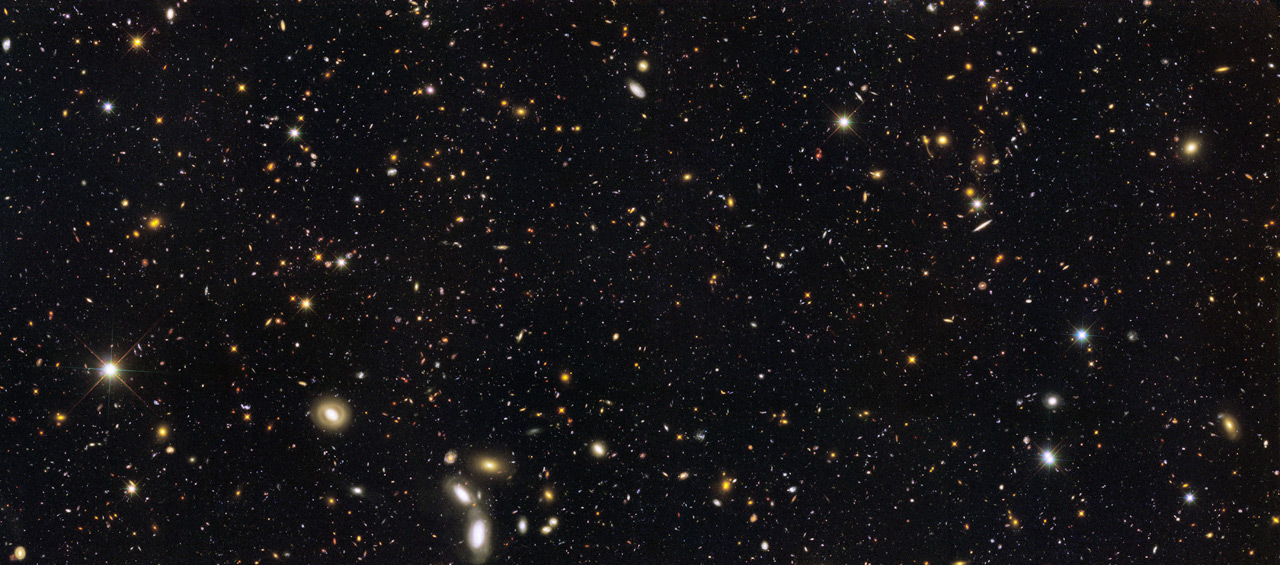
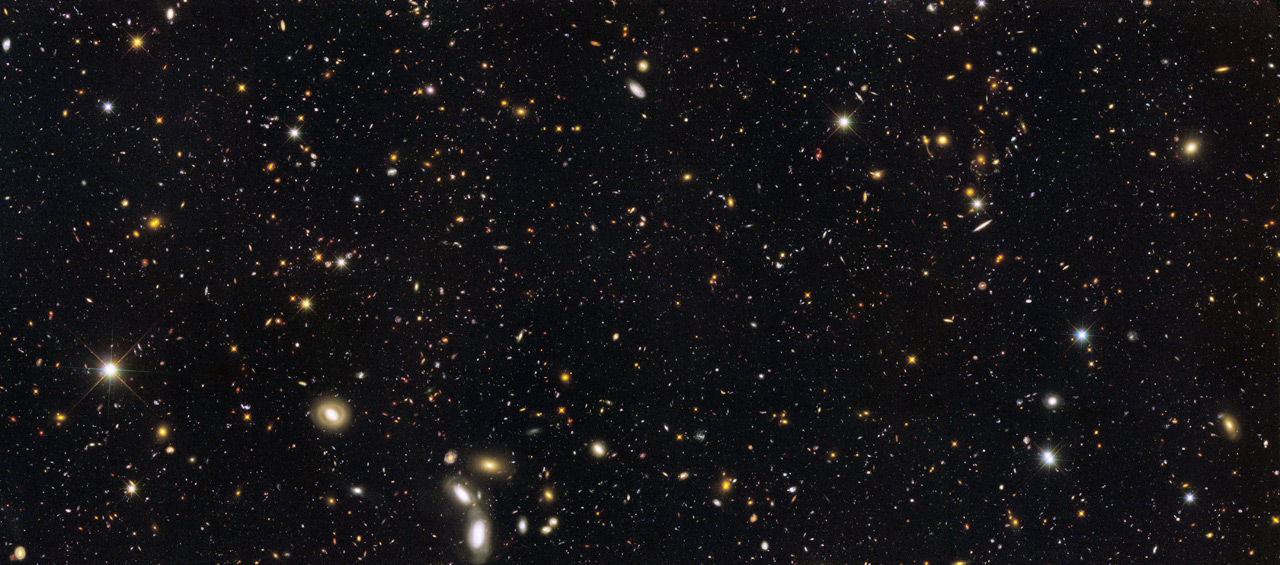
More than 12 billion years of cosmic history are shown in this panoramic view of thousands of galaxies in various stages of assembly. The view covers a portion of the southern field of a galaxy census called the Great Observatories Origins Deep Survey (GOODS). This remarkable image captures galaxies at every stage of evolution, from irregular protogalaxies still in the process of formation to grand spiral galaxies and massive ellipticals that represent the endpoints of galactic evolution.
Scientific Significance
The GOODS South Field has enabled groundbreaking studies of active galactic nuclei (AGN) and supermassive black holes across cosmic time. By combining Hubble's optical data with X-ray observations from Chandra, astronomers have identified hundreds of galaxies harboring actively accreting black holes, many of which are heavily obscured by dust and would be invisible in optical light alone. These studies have revealed that supermassive black hole growth and galaxy star formation are intimately linked, with both processes peaking at similar cosmic epochs. The field has also been crucial for understanding the demographics of black holes in the early universe and testing theories of how these massive objects form and grow. The multi-wavelength nature of GOODS makes it uniquely suited for separating AGN emission from starlight in host galaxies.
Observation Details
The initial GOODS observations in 2002 used Hubble's Advanced Camera for Surveys (ACS) in four optical filters (B, V, i, and z bands) to provide color information for photometric redshift measurements. The survey strategy involved multiple visits to each pointing to build up depth gradually while enabling the detection of variable objects like supernovae and AGN. The observations were carefully scheduled to maximize overlap with the Chandra Deep Field South X-ray survey and the Spitzer GOODS Legacy program, creating a uniquely comprehensive multi-wavelength dataset.
Location in the Universe
Constellation
Fornax
Distance from Earth
Up to 13 billion light-years
Fun Facts
- 1
The total area covered by GOODS (north and south fields combined) is about 320 square arcminutes—roughly one-tenth the apparent area of the full Moon.
- 2
Every speck of light in this image, except for a few foreground stars from our own Milky Way, is an entire galaxy containing billions of stars.
- 3
Astronomers have measured the distances to thousands of galaxies in this field using spectroscopy, turning this 2D image into a 3D map of the universe.
Image credit: NASA, ESA, Hubble Space Telescope