About This Image
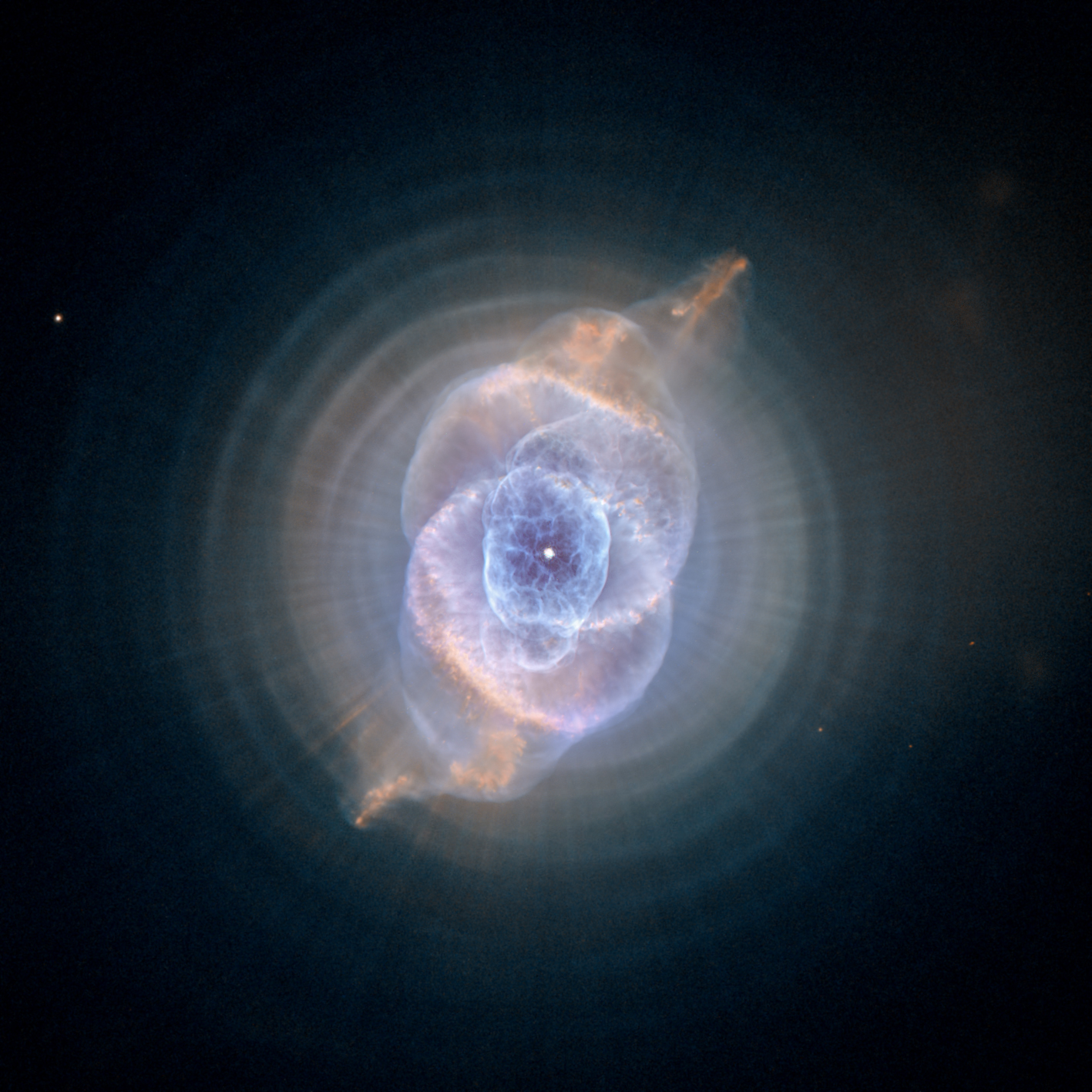
Produced by a dying Sun-like star, the Cat's Eye Nebula (NGC 6543) is one of the most structurally complex planetary nebulae known to astronomers. This Hubble image reveals an astonishing pattern of concentric gas shells, high-speed jets, and intricate knotted structures surrounding the hot central star. Each concentric ring visible in the outer halo is actually the edge of a spherical bubble of material ejected by the star during periodic thermal pulses separated by roughly 1,500 years. The inner nebula displays a far more chaotic geometry, with intersecting elliptical shells and polar jets that suggest the presence of a companion star whose gravitational influence shapes the outflowing gas into these extraordinary patterns. The central star, now exposed and blazing at a surface temperature of approximately 80,000 degrees Kelvin, illuminates the surrounding gas with intense ultraviolet radiation.
Scientific Significance
The Cat's Eye Nebula has challenged and refined models of planetary nebula formation since Hubble first resolved its intricate structure. The simple expectation that a single star should produce a spherically symmetric nebula is dramatically contradicted by the Cat's Eye's complex geometry of nested shells, polar jets, and bipolar lobes. This complexity has been central to the development of the binary hypothesis for planetary nebulae, which proposes that interaction with a companion star is responsible for shaping many of the most visually striking planetary nebulae. High-resolution spectroscopy has revealed gas moving at speeds exceeding 1,000 kilometers per second in the polar jets, among the fastest outflows measured in any planetary nebula. The regularly spaced concentric shells provide direct evidence for episodic mass loss during the asymptotic giant branch phase, constraining theoretical models of thermal pulse cycles in evolved intermediate-mass stars.
Observation Details
This image was captured using Hubble's Advanced Camera for Surveys (ACS) and the Wide Field and Planetary Camera 2 (WFPC2) through narrowband filters that isolate emission from ionized hydrogen, nitrogen, and oxygen. These different emission lines probe distinct physical conditions: oxygen emission traces the highest-temperature gas closest to the central star, while nitrogen emission highlights cooler, denser knots and filaments in the outer nebula. The multi-filter approach enables astronomers to construct temperature and density maps of the nebula's three-dimensional structure. Hubble's angular resolution was essential for resolving the fine-scale features in the inner nebula.
Location in the Universe
Constellation
Draco
Distance from Earth
3,300 light-years
Fun Facts
- 1
The Cat's Eye Nebula was one of the first planetary nebulae ever discovered, found by astronomer William Herschel in 1786, and it was also the first planetary nebula to be examined with a spectroscope, revealing in 1864 that it was made of gas rather than stars.
- 2
The concentric rings surrounding the Cat's Eye represent 11 or more distinct episodes of mass ejection by the dying star over approximately 15,000 years, each releasing roughly the mass of Jupiter into surrounding space.
- 3
The central star of the Cat's Eye is losing mass at a rate 20 billion times greater than our Sun's solar wind and will eventually shrink into a white dwarf no larger than Earth, while the nebula disperses into the interstellar medium over the next 10,000 years.
Image credit: NASA, ESA, Hubble Space Telescope