About This Image
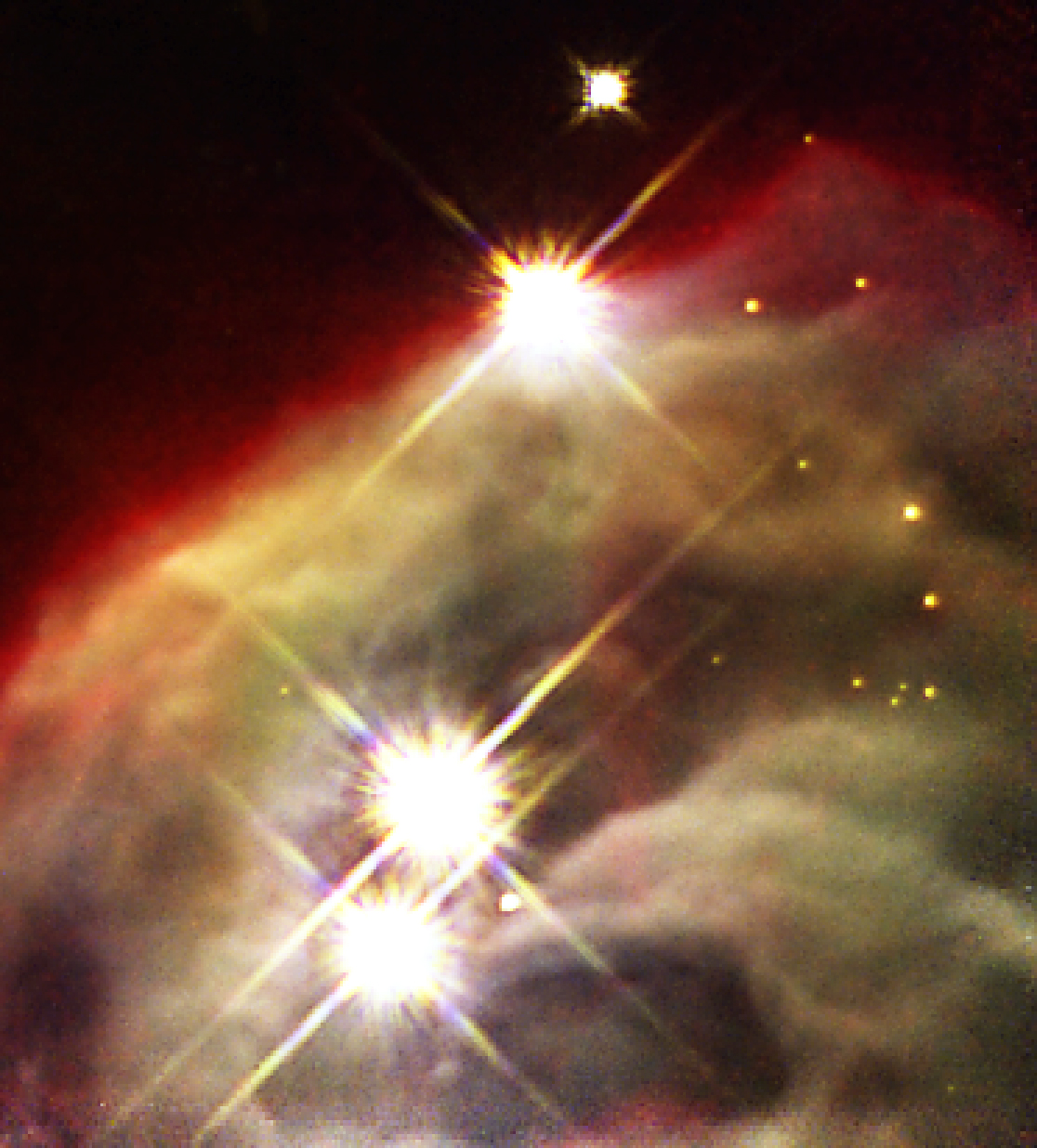
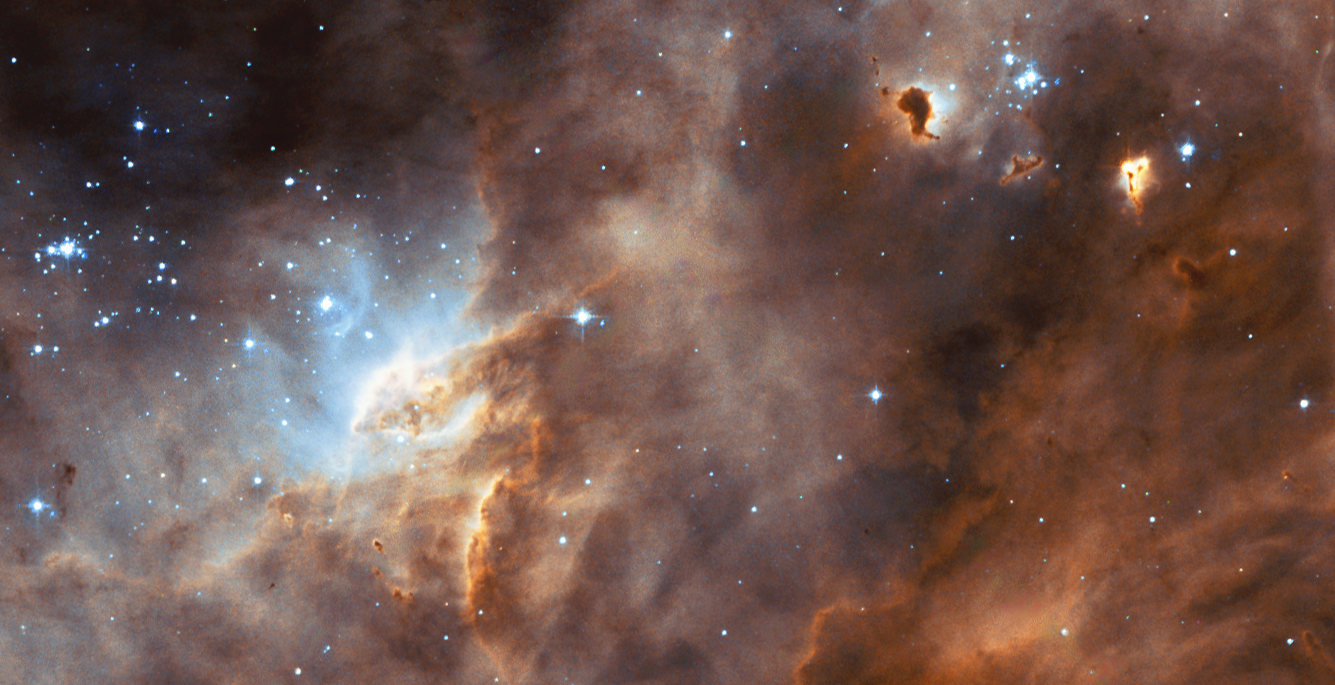
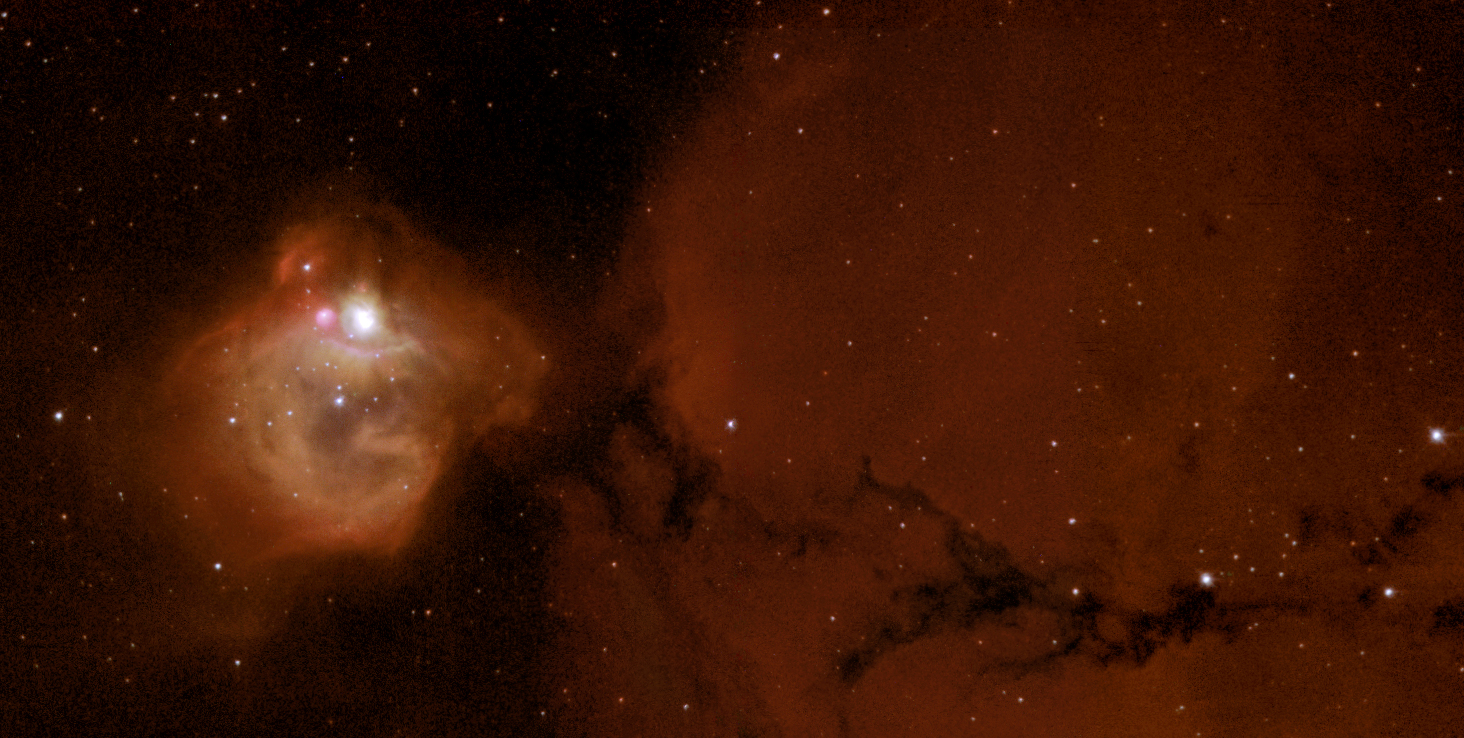
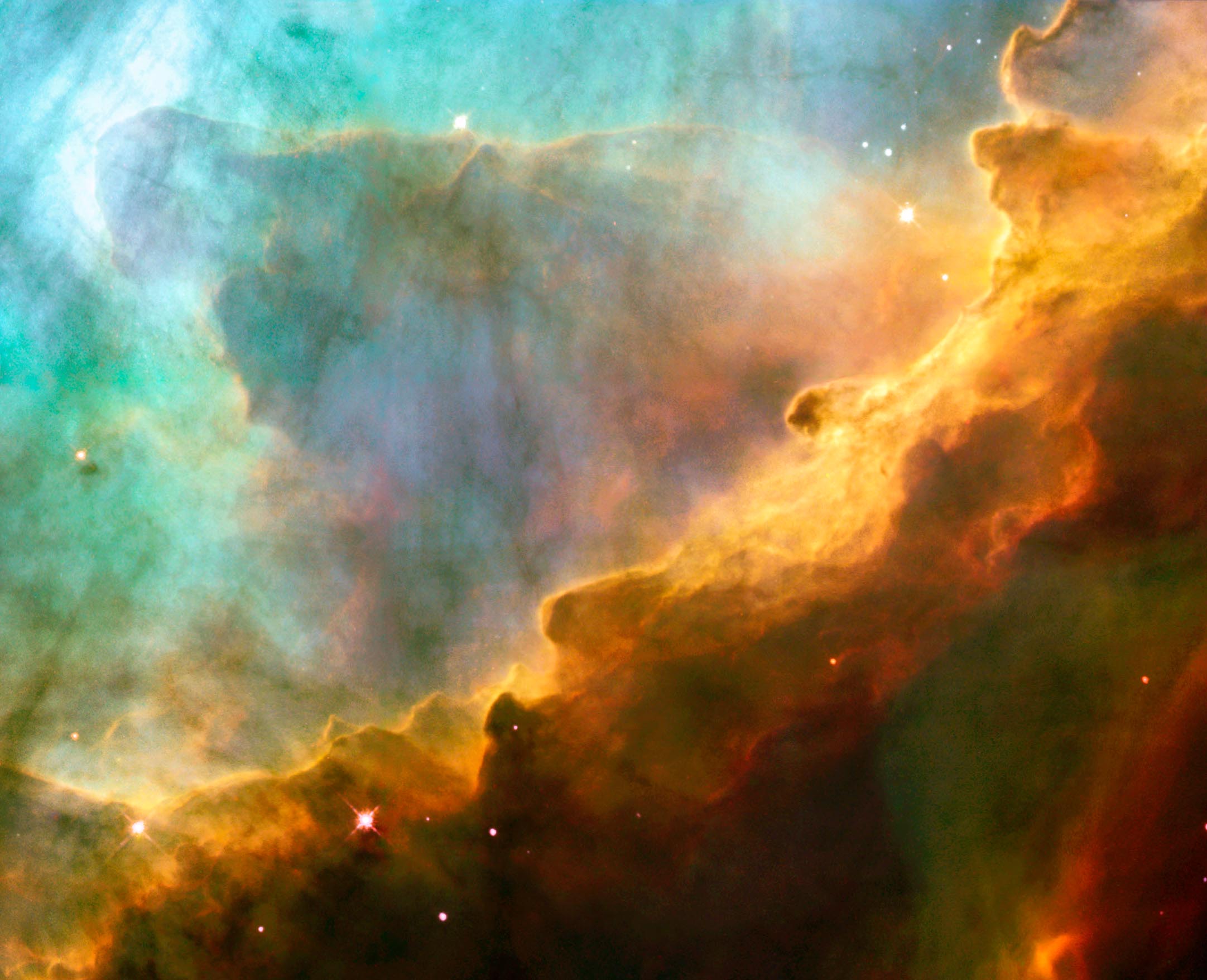
The Swan Nebula, also known as Messier 17 or the Omega Nebula, is one of the most luminous and massive star-forming regions in our galaxy, located approximately 5,500 light-years away in the constellation Sagittarius. This Hubble image reveals the nebula's tumultuous interior in stunning detail, where powerful radiation and stellar winds from dozens of newly born massive stars are sculpting the surrounding molecular cloud into dramatic ridges, pillars, and wave-like formations. The wave-like patterns of gas have been sculpted and illuminated by a torrent of ultraviolet radiation from young, massive stars located outside the picture to the upper left. The Swan Nebula contains an estimated 800 solar masses of ionized gas and harbors a young open star cluster of about 35 hot O and B type stars.
Scientific Significance
The Swan Nebula is one of the premier laboratories for studying massive star formation and the interaction between young stellar clusters and their natal molecular clouds. Its proximity and brightness allow astronomers to resolve individual structures at scales of just a few hundred astronomical units, revealing the processes that shape the interstellar medium in real time. The sharp boundary between the ionized hydrogen region and the adjacent molecular cloud — known as the photodissociation region — is among the most clearly defined examples in the Milky Way, making M17 a benchmark object for theoretical models of ionization front propagation. The nebula's young cluster provides a nearly complete sample of the stellar initial mass function from the highest masses down to brown dwarfs. M17 also exhibits a complex magnetic field structure that influences the morphology of the ionization front.
Observation Details
Hubble captured this image of the Swan Nebula using the Wide Field Planetary Camera 2 with a combination of broadband and narrowband filters. The narrowband filters isolated emission from hydrogen-alpha, ionized sulfur, and doubly ionized oxygen, which were mapped to different color channels to create a composite that reveals the nebula's ionization structure and chemical stratification. The resulting image highlights the sharp ionization front where the advancing radiation meets the dense molecular cloud. Hubble's angular resolution revealed fine-scale features including evaporating gaseous globules — small dense knots of gas that are being photoevaporated by the intense radiation field.
Location in the Universe
Constellation
Sagittarius
Distance from Earth
5,500 light-years
Fun Facts
- 1
The Swan Nebula produces more ionizing radiation than the famous Orion Nebula, making it one of the brightest infrared sources in the sky and a powerhouse of high-energy stellar activity in our galactic neighborhood.
- 2
Messier 17 contains a hidden population of over 10,000 young stars, most of which are still embedded within the surrounding molecular cloud and invisible at optical wavelengths but detectable in infrared observations.
- 3
The nebula gets its Swan nickname from its graceful arching shape visible in small telescopes, while the alternative name Omega Nebula comes from its resemblance to the Greek letter capital omega when viewed in certain orientations.
Image credit: NASA, ESA, Hubble Space Telescope