About This Image
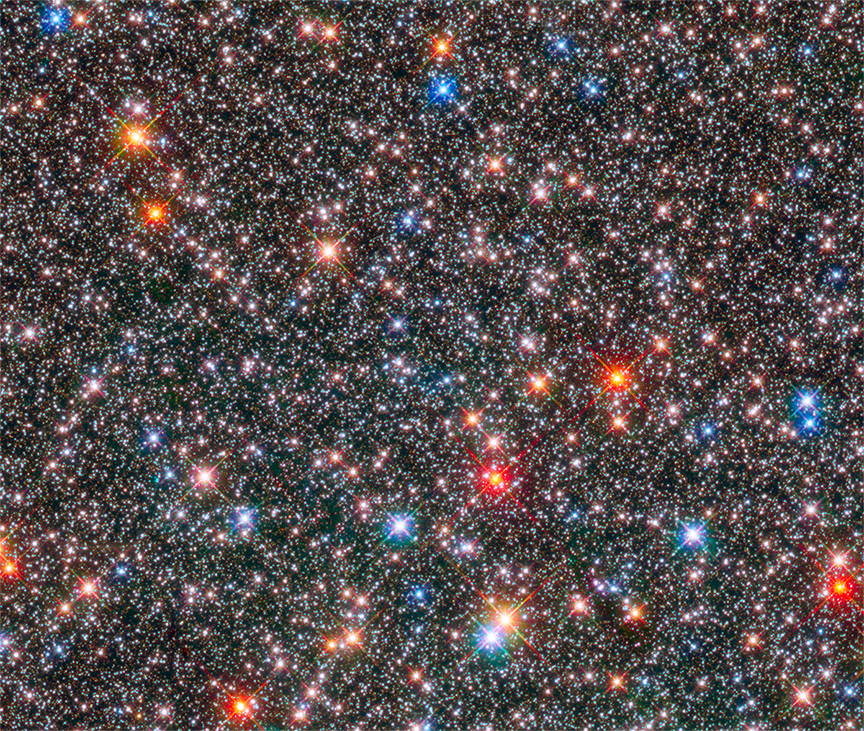
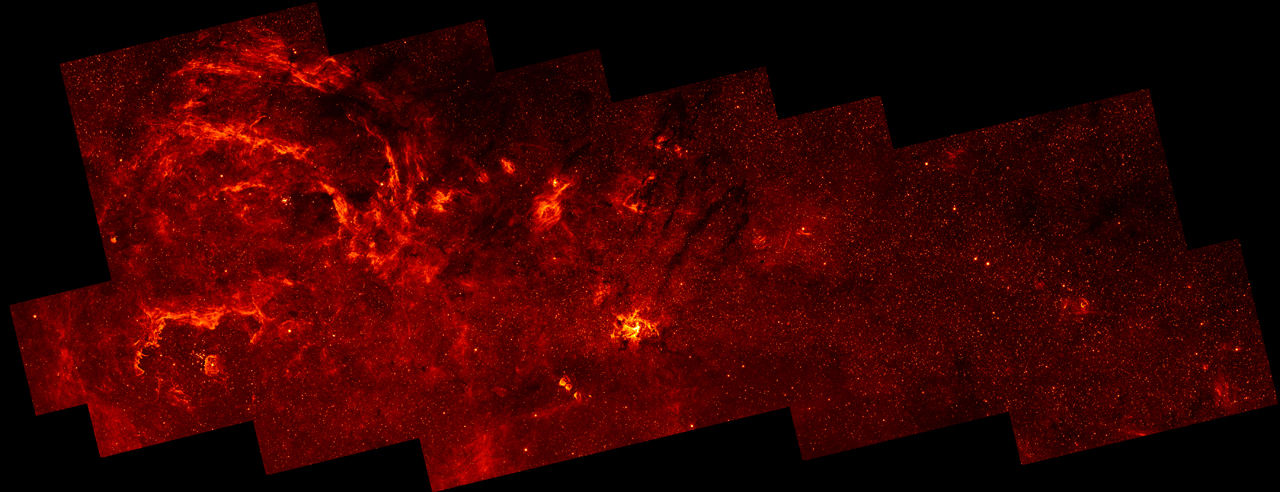
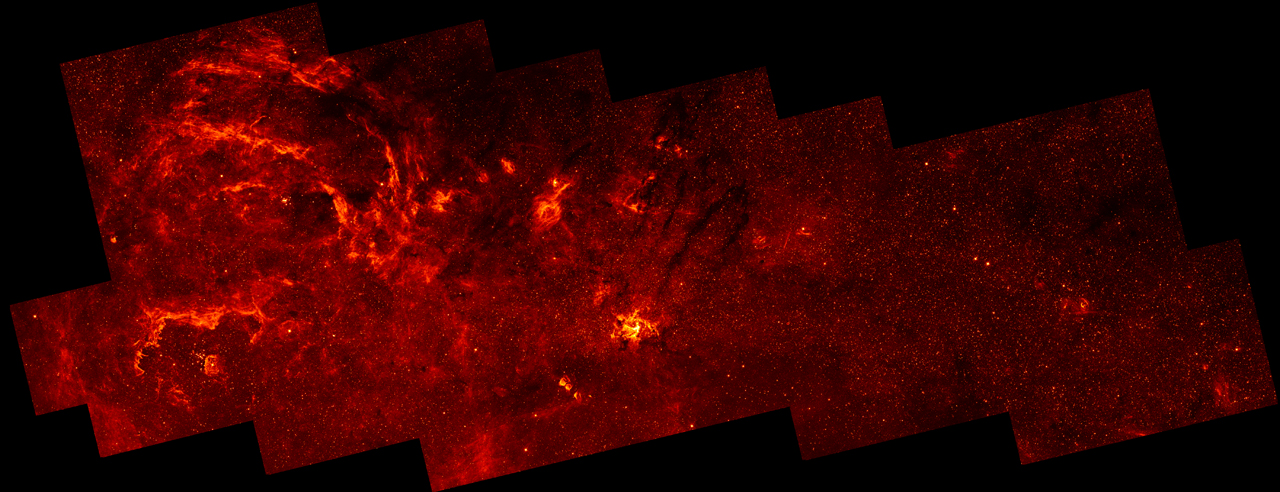
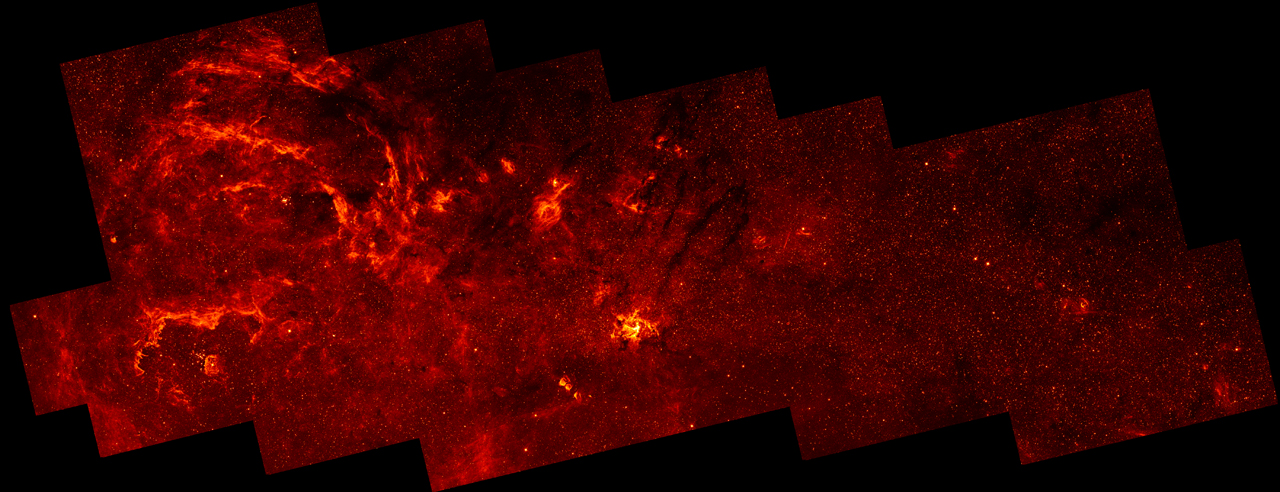
This infrared image of the center of our Milky Way galaxy reveals a population of massive stars and complex structures in the hot ionized gas that swirls around the galactic core. Penetrating the thick veil of interstellar dust that renders this region invisible at optical wavelengths, Hubble's infrared camera unveils a crowded stellar landscape within the central few light-years of the galaxy. This region is dominated by the gravitational influence of Sagittarius A*, the supermassive black hole at the Milky Way's heart, weighing approximately four million solar masses. Surrounding the black hole is a dense cluster of young, massive stars whose presence so close to such an extreme gravitational environment has puzzled astronomers, as conventional star formation theory suggests they should not be able to form there.
Scientific Significance
The Milky Way's galactic center provides the closest and most detailed view of a galactic nucleus available to astronomers, serving as a fundamental reference point for understanding the centers of galaxies throughout the universe. The discovery of young, massive stars in tight orbits around Sagittarius A* — known as the S-stars and the clockwise disk — poses a major theoretical challenge known as the paradox of youth, since the extreme tidal forces near the black hole should prevent conventional molecular cloud collapse. Proposed solutions include in-situ formation in a dense accretion disk or migration from farther out. Hubble's observations have been critical for characterizing the stellar population near the galactic center, measuring proper motions, and constraining the mass distribution of the central star cluster. These observations also provide context for interpreting the behavior of Sagittarius A*'s occasional X-ray flares.
Observation Details
This image was captured using Hubble's Near Infrared Camera and Multi-Object Spectrometer (NICMOS) at wavelengths between 1.1 and 1.9 micrometers. At these infrared wavelengths, Hubble can see through much of the intervening dust that completely obscures the galactic center at visible wavelengths. The false-color rendering assigns visible colors to different infrared bands, allowing astronomers to distinguish stellar types by their infrared colors. The observations resolved hundreds of individual stars in the central parsec, enabling measurements of their luminosities, temperatures, and proper motions relative to Sagittarius A*.
Location in the Universe
Constellation
Sagittarius
Distance from Earth
26,000 light-years
Fun Facts
- 1
The supermassive black hole Sagittarius A* at the center of this image has a mass of approximately four million Suns compressed into a region smaller than the orbit of Mercury, yet it is remarkably quiet compared to the active black holes in other galaxies.
- 2
Stars orbiting within a light-year of Sagittarius A* travel at speeds up to 3 percent the speed of light, completing their orbits in as little as 12 years, and tracking their motions earned astronomers the 2020 Nobel Prize in Physics.
- 3
The dust between Earth and the galactic center is so thick that visible light is attenuated by a factor of one trillion, meaning infrared observations like this one are the only way Hubble can peer into the Milky Way's central engine.
Image credit: NASA, ESA, Hubble Space Telescope