About This Image
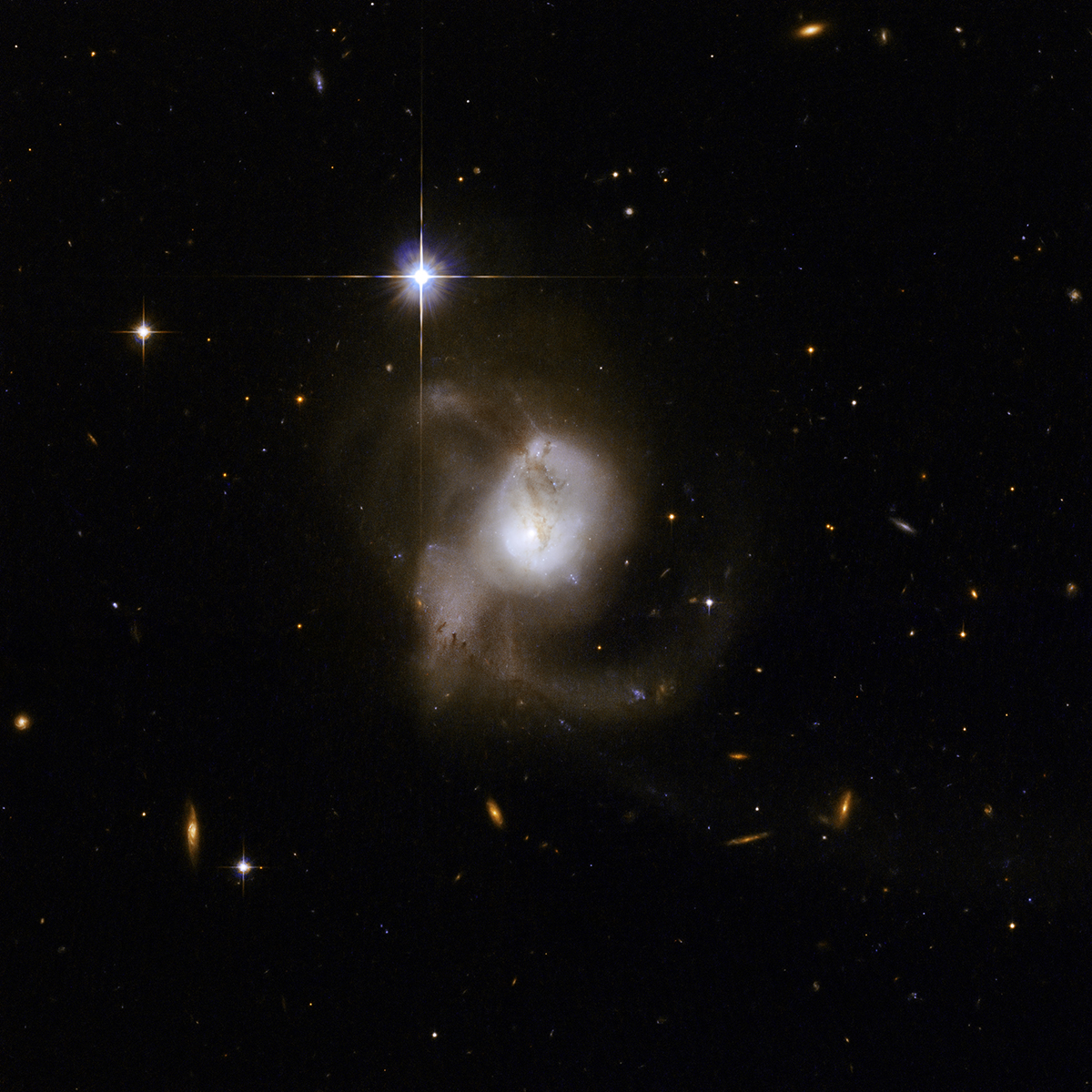
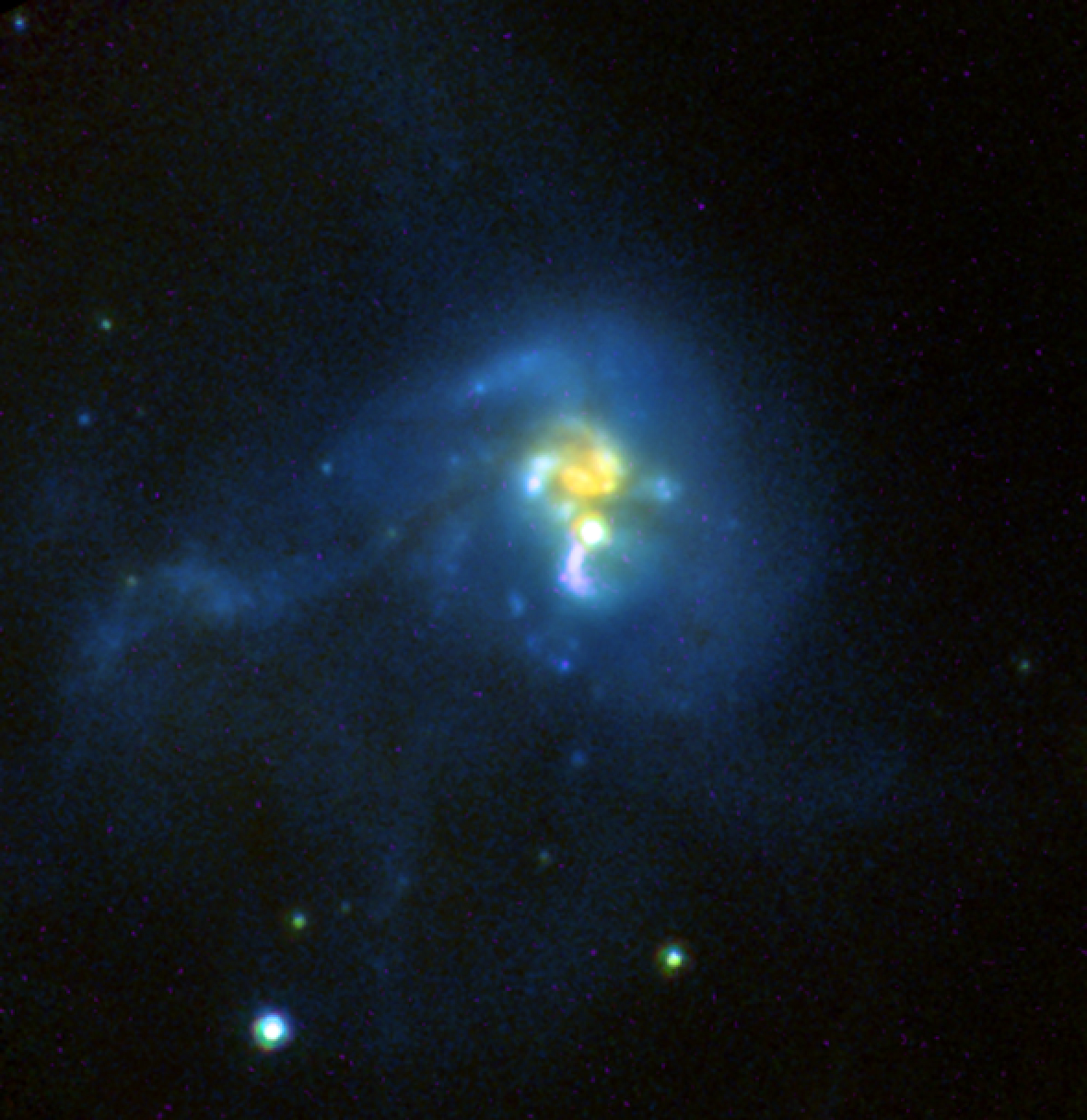
This image shows a tumultuous collision between four galaxies located 1 billion light-years from Earth in the constellation Aquila. The tangled-up galaxies, called IRAS 19297-0406, are crammed together in the center of the picture, their individual structures distorted beyond recognition by immense tidal forces. This ultra-luminous infrared galaxy system radiates enormous amounts of energy, primarily in the infrared, as the gravitational interactions compress vast reservoirs of gas and dust, triggering intense bursts of star formation. Tidal forces have pulled long streamers of stars and gas into chaotic arcs and bridges. The system represents an advanced stage of a multiple-galaxy merger that will eventually produce a single massive elliptical galaxy after hundreds of millions of years of gravitational turmoil.
Scientific Significance
IRAS 19297-0406 is a key object for understanding the most extreme environments of star formation in the universe. Ultra-luminous infrared galaxies are thought to represent a brief but transformative phase in galaxy evolution, during which major mergers funnel enormous quantities of gas into compact central regions, fueling starbursts and potentially feeding supermassive black holes. The four-body nature of this particular merger provides unique constraints on numerical simulations of galaxy interactions, testing whether models can reproduce the observed morphologies, star formation rates, and gas dynamics of such complex systems. The system also serves as a local analog for the dusty, intensely star-forming galaxies observed at high redshifts, offering a nearby laboratory to study processes that were far more common in the early universe.
Observation Details
Hubble captured IRAS 19297-0406 using the Near Infrared Camera and Multi-Object Spectrometer (NICMOS), which was essential for penetrating the thick veil of dust surrounding the merging galaxies. Near-infrared observations revealed the underlying structure of the four interacting components, including tidal tails and bridges of material that are largely obscured at visible wavelengths. Additional imaging with the Advanced Camera for Surveys in optical bands captured the outer tidal features and faint stellar streams extending far beyond the central merger. The combination of optical and infrared data provided a comprehensive view of both the dust-enshrouded starburst core and the extended debris field.
Location in the Universe
Constellation
Aquila
Distance from Earth
1 billion light-years
Fun Facts
- 1
IRAS 19297-0406 qualifies as an ultra-luminous infrared galaxy (ULIRG), emitting more than a trillion times the luminosity of our Sun, with most of that energy emerging in far-infrared wavelengths hidden from human eyes.
- 2
Four-way galaxy mergers like IRAS 19297-0406 are exceptionally rare in the nearby universe; most galaxy interactions involve only two participants, making this system a valuable laboratory for extreme merger dynamics.
- 3
The merger will eventually exhaust or expel most of the system's gas, quenching star formation and leaving behind a giant elliptical galaxy — a process that takes roughly 500 million to one billion years to complete.
Image credit: NASA, ESA, Hubble Space Telescope