About This Image
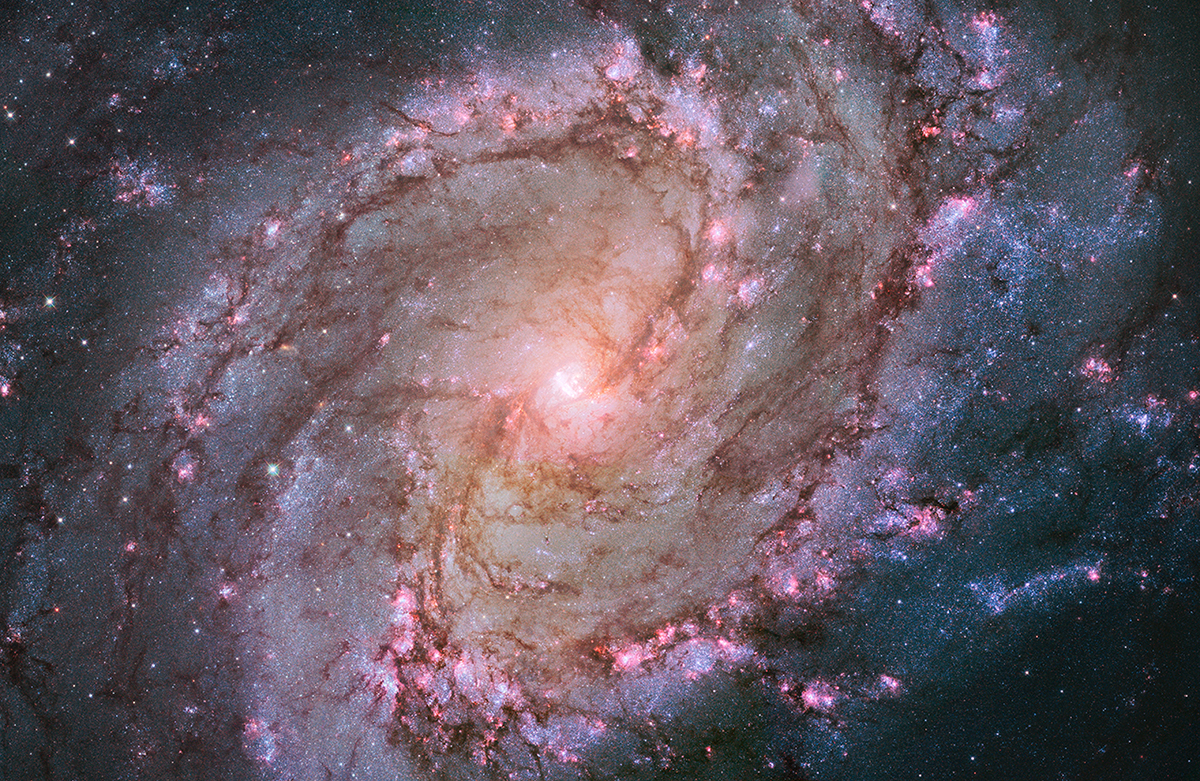
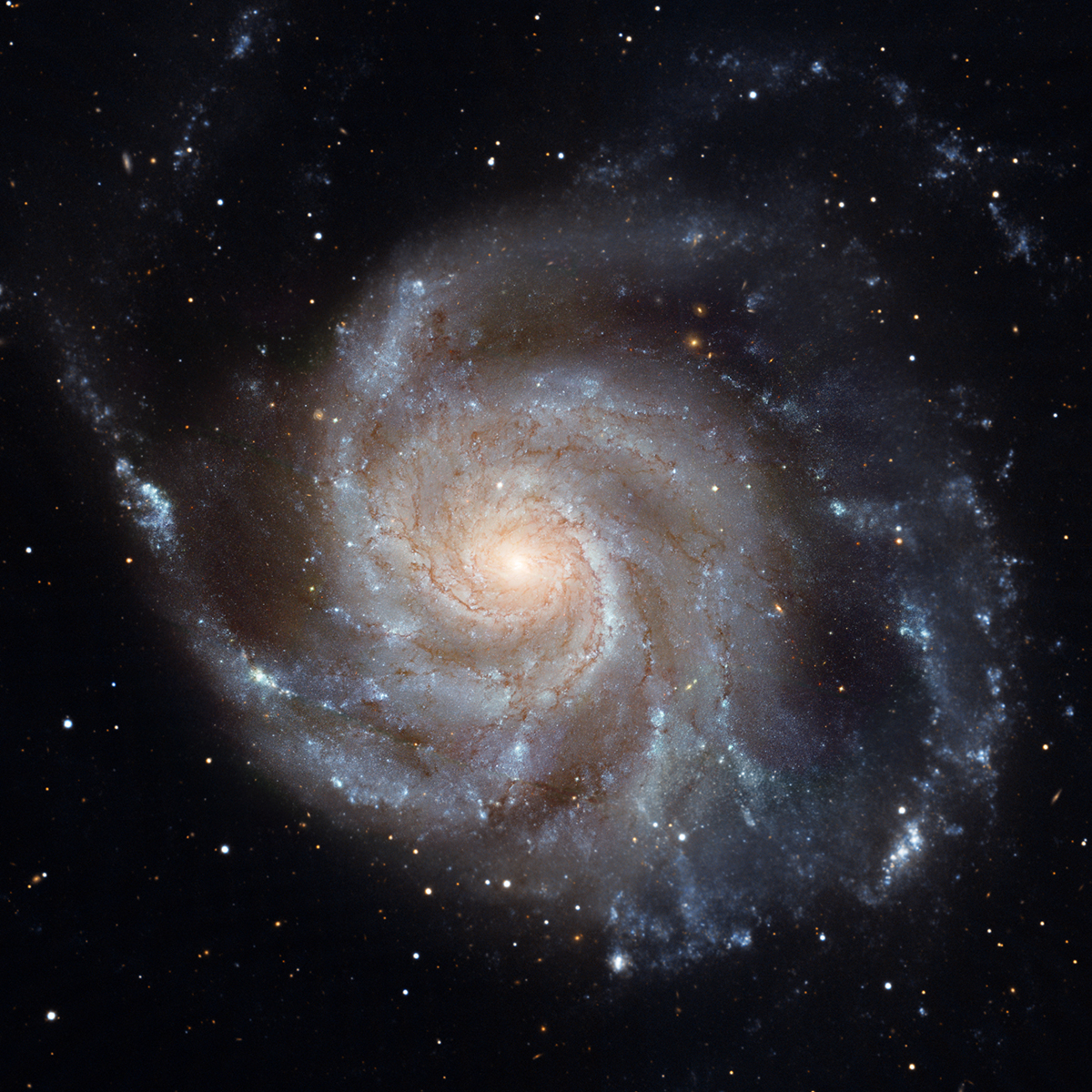
The Pinwheel galaxy has a pancake-like shape that we view face-on. This perspective shows off the spiral structure that gives the galaxy its nickname.
Scientific Significance
M101 has served as a fundamental calibrator for the cosmic distance ladder, hosting Cepheid variable stars that were observed by the Hubble Key Project to refine the Hubble constant — the rate at which the universe expands. The galaxy's face-on orientation makes it ideal for studying the large-scale properties of spiral structure, including how density waves propagate through the disk and trigger sequential star formation along the spiral arms. M101's pronounced asymmetry, with its offset nucleus and lopsided spiral pattern, provides evidence for recent gravitational interactions with companion galaxies in its group, making it a natural laboratory for studying how external perturbations influence spiral arm morphology. The galaxy's enormous HII regions have been extensively studied as laboratories for understanding massive star formation and stellar feedback — the process by which young stars inject energy, radiation, and chemically enriched gas back into the interstellar medium, regulating subsequent generations of star formation. M101's well-resolved stellar populations across its full radial extent have also enabled detailed studies of how chemical abundances decrease from the galaxy's center outward, a gradient that encodes the galaxy's star formation and gas accretion history.
Observation Details
This image was captured using Hubble's Wide Field and Planetary Camera 2 (WFPC2) in visible-light filters. Due to the galaxy's large angular extent on the sky, the complete Hubble portrait of M101 required multiple pointings that were later mosaicked together, creating one of the largest and most detailed images Hubble has produced of any single galaxy. The observations resolved individual bright stars, star clusters, and HII regions across the galaxy's spiral arms. Ground-based images and subsequent Hubble observations with the Advanced Camera for Surveys and Wide Field Camera 3 have supplemented this dataset with additional wavelength coverage from ultraviolet to near-infrared.
Location in the Universe
Constellation
Ursa Major
Distance from Earth
21 million light-years
Fun Facts
- 1
The Pinwheel Galaxy is notably asymmetric — its center is offset from the geometric center of its disk, likely the result of gravitational interactions with its companion galaxies that have tugged the spiral structure off-center over millions of years.
- 2
M101 contains an extraordinary number of giant HII regions — enormous star-forming complexes up to 1,500 light-years across, far larger than any found in the Milky Way — with NGC 5471 being one of the most luminous such regions known in any nearby galaxy.
- 3
In 2023, a Type Ia supernova (SN 2023ixf) exploded in M101 and became one of the closest and brightest supernovae observed in a decade, attracting telescopes worldwide for intensive study of this stellar explosion in real time.
Image credit: NASA, ESA, Hubble Space Telescope